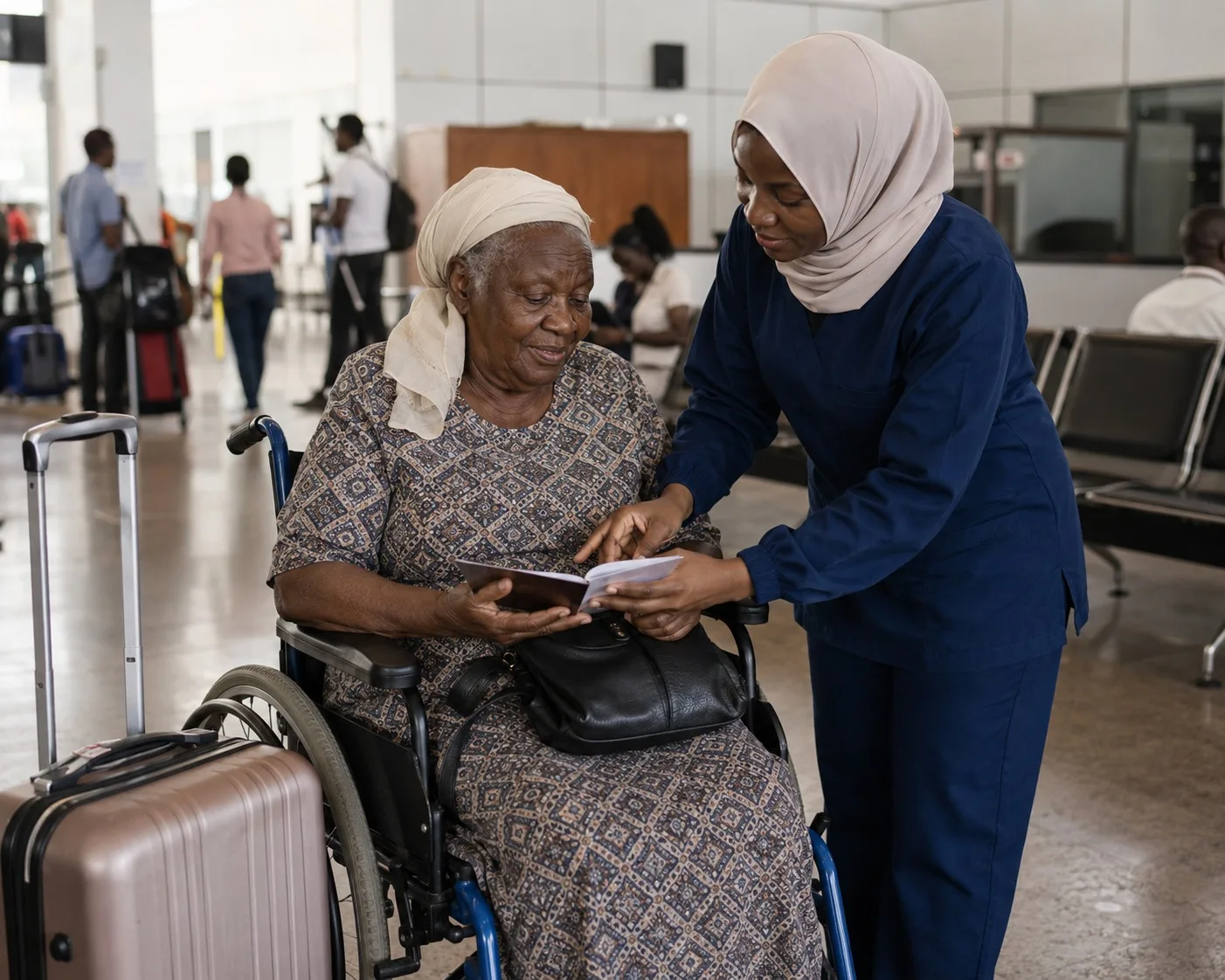
# What Does a Home Caregiver Do in Uganda? A Complete Guide for Families
If you are considering home care for an elderly parent, a person with a disability, afamily member recovering at home or someone who needs additional day-to-day support, one of the first questions you may have is:
**What does a home caregiver actually do?**
The answer depends on the person's needs, the caregiver's role, their training and the arrangement agreed with the family.
A home caregiver may provide practical assistance, companionship, support with everyday routines and other agreed responsibilities. In some situations, appropriately qualified professionals may provide nursing or other healthcare services at home. These should not be confused with general household or family support.
For families in Uganda, understanding the difference is important.
A family looking after an elderly parent in Kampala may need help with meals, errands, companionship and appointments. Another family may need disability support or assistance following a hospital discharge. A diaspora family may need someone locally to coordinate practical support while the children remain in Australia, the United Kingdom, the United States, Canada or another country.
This guide explains **what a home caregiver does in Uganda, what caregivers may help with, what is outside their role, how families should choose support, how home care differs from nursing care, and how Aethla Care can help coordinate the appropriate support route.**
> **Quick answer:** A home caregiver can provide agreed practical, personal or companionship support in a person's home, depending on their role, training and the family's needs. Responsibilities should be clearly defined in advance. Clinical tasks such as diagnosis, prescribing and medical treatment belong to appropriately qualified healthcare professionals.
---
# What is a home caregiver?
A home caregiver is a person who provides agreed support to someone in their home or familiar environment.
The purpose may be to help the person:
* Manage everyday routines * Remain comfortable at home * Maintain independence where possible * Receive companionship * Complete practical household tasks * Attend appointments * Manage errands * Receive assistance with agreed personal needs * Stay connected with family * Receive additional support when family members cannot be present
The exact role varies.
There is no single universal list of tasks that every "caregiver" in Uganda performs.
Families should therefore ask a provider to explain exactly what is included in the arrangement.
---
# Home caregiver vs nurse: what is the difference?
This is one of the most important distinctions families should understand.
A **home caregiver or support worker** may assist with agreed everyday activities and practical support.
A **nurse or other healthcare professional** has a professional clinical role and may provide healthcare services within their qualifications and scope of practice.
For example, a family might need someone to:
* Prepare meals * Help with shopping * Provide companionship * Assist with errands * Coordinate transport * Accompany an elderly person to an appointment * Help organise household routines
Those are different from clinical responsibilities such as:
* Diagnosing a medical condition * Prescribing medicines * Providing medical treatment * Performing clinical procedures * Making specialist medical decisions
If clinical care is required, the appropriate healthcare professional should be involved.
Aethla Care's approach is to clarify which route is appropriate rather than presenting every care need as the same type of service.
---
# Why families may choose home support
Many families prefer to support an older relative or family member in a familiar environment when that arrangement is appropriate.
WHO's current Integrated Care for Older People (ICOPE) approach emphasizes person-centred and coordinated care and includes attention to social support, carers, functional ability and the older person's environment.
WHO also describes a continuum of care that can connect people's homes, primary care, hospitals and other settings, with communities playing an important role in supporting ageing in place.
For families, this means home support should not be viewed simply as "having someone in the house."
The wider objective can be to help a person maintain daily life, independence and connection while ensuring that appropriate professional healthcare is available when needed.
---
# What does a home caregiver do on a typical day?
There is no single standard day.
A caregiver's responsibilities should be based on the person's needs and the agreed role.
Depending on the arrangement, a day could involve:
### Morning
* Checking in with the person * Helping organise the morning routine * Supporting agreed personal routines * Preparing or assisting with breakfast * Helping organise the day's activities
### During the day
* Companionship * Household assistance * Shopping * Errands * Meal preparation * Supporting agreed activities * Appointment coordination * Accompanying the person where appropriate
### Afternoon
* Preparing meals * Household tasks * Companionship * Helping organise appointments or errands * Supporting communication with family
### Evening
* Helping with agreed evening routines * Preparing food * General household support * Ensuring the person has what they need for the evening
Not every caregiver performs every task.
The daily schedule should be agreed before the arrangement begins.
---
# 1. Companionship
Companionship can be an important part of home support.
An older person may spend significant periods alone, particularly if their spouse has died, adult children have moved away or mobility has become more difficult.
Companionship can involve:
* Conversation * Reading * Watching television together * Playing games * Walking where appropriate * Helping maintain social routines * Accompanying the person during ordinary activities * Supporting communication with family
Companionship is not medical treatment.
Its value is in providing human connection and practical presence.
WHO's ageing framework recognizes social connection and person-centred support as part of broader healthy ageing.
---
# 2. Household assistance
A home caregiver or family-support worker may help with agreed household responsibilities.
These can include:
* Light cleaning * Laundry * Meal preparation * Shopping * Organising household supplies * Running errands * Keeping commonly used areas organised
However, families should clarify whether they are looking for:
**home care**, **domestic assistance**, **a maid**, **a caregiver**, or a combination of services.
These roles can overlap in practice, but they should not be assumed to be identical.
Aethla Care's Home & Family Support offering is designed to help families coordinate practical household and day-to-day support where appropriate.
---
# 3. Meal preparation and food-related support
An older person may continue to be independent but find shopping, carrying groceries or preparing meals difficult.
Support might include:
* Planning meals * Shopping * Preparing meals * Organising ingredients * Cleaning after meals * Helping maintain regular household routines
Families should distinguish ordinary meal support from specialist dietary or medical nutrition advice.
If a person has a medical condition requiring a prescribed diet or specialist nutritional management, appropriate healthcare professionals should be involved.
---
# 4. Shopping and errands
Simple errands can become difficult when mobility is reduced.
A caregiver may be asked to help with:
* Grocery shopping * Household supplies * Picking up approved items * Running ordinary errands * Collecting documents * Other agreed practical tasks
The family should establish:
* What can be purchased * Who approves purchases * How expenses are handled * How receipts are documented * What happens if something is unavailable
Clear financial procedures can prevent misunderstandings.
---
# 5. Appointment support
Some older people need help managing appointments even when they do not require medical care at home.
A caregiver or coordinator may help with:
* Remembering appointment dates * Organising transport * Preparing practical information * Accompanying the person where appropriate * Helping communicate appointment logistics to family
The caregiver does not become the doctor simply because they accompany someone to a hospital.
The healthcare professional remains responsible for the clinical consultation.
Aethla Care can also help families navigate specialist appointments and healthcare coordination as part of its broader support model.
---
# 6. Transport and mobility support
Transport can be a major practical issue for older people.
A person may be physically able to attend an appointment but unable to organise the journey independently.
Depending on the arrangement, support may involve:
* Organising transport * Accompanying the person * Helping coordinate arrival and departure * Supporting journey planning * Communicating timing with family
The exact role should be confirmed beforehand.
Aethla Care's Travel & Mobility service is intended to help families coordinate practical journeys and mobility-related support where the appropriate route is available.
---
# 7. Support with everyday routines
A home caregiver may help someone maintain their normal routine.
This could involve:
* Morning routines * Meals * Household activities * Social activities * Errands * Appointments * Evening routines
The objective should not automatically be to take over everything.
Where an older person can safely continue doing something themselves, support can be designed around their independence.
That is consistent with WHO's emphasis on maintaining functional ability and person-centred care for older people.
---
# 8. Family communication
For families who live abroad or far away, communication can be an important part of support.
A family may need agreed updates about:
* Appointments * Changes in routine * Practical needs * Household requirements * Transport * Support schedules
The exact information shared should respect the person's privacy and consent.
Families should decide:
**Who should receive updates?**
and:
**What type of information should be communicated?**
This becomes particularly important when several siblings are involved.
---
# 9. Post-hospital practical support
Returning home after hospitalisation can create new practical challenges.
An older person may need help with:
* Food * Household tasks * Transport * Follow-up appointments * Errands * Family communication * Daily routines
However, the healthcare team remains responsible for clinical instructions.
If nursing or medical care is required, that should be arranged through appropriately qualified professionals.
A caregiver's role may instead focus on the practical environment around the person.
---
# 10. Support for people with disabilities
Home support is not limited to elderly care.
A person with a disability may also need assistance with:
* Everyday routines * Mobility * Household activities * Community participation * Transport * Appointments * Communication * Family coordination
The appropriate approach should be person-first.
The goal is not to assume what someone cannot do.
Instead, identify:
**What does the person want to do?**
**What can they do independently?**
**Where is support actually needed?**
This is consistent with a broader functional approach to care that looks beyond diagnosis alone.
---
# What should a caregiver NOT do?
This is an important question.
Families should never assume that a caregiver is automatically qualified to perform every healthcare task.
Depending on the person's role and qualifications, a general caregiver should not automatically be expected to:
* Diagnose illness * Prescribe medication * Change medical treatment * Make clinical decisions * Provide specialist medical advice * Perform procedures outside their training or role * Replace a doctor * Replace a nurse * Replace emergency medical services
If there is uncertainty about a health issue, seek appropriate professional healthcare advice.
---
# Does a caregiver administer medication?
This depends on the role, training, applicable requirements and the agreed care arrangement.
Families should **never assume** that a general caregiver can independently make decisions about medicines.
There is an important difference between:
**reminding someone about an established medication routine**
and
**making a clinical decision about medication.**
The latter requires appropriate professional authority.
Families should clarify medication-related responsibilities before support begins.
---
# Can a caregiver take an elderly person to hospital?
A caregiver may potentially accompany or assist with transport arrangements depending on the service and circumstances.
But if the person is experiencing a medical emergency, the family should seek appropriate emergency medical assistance rather than relying on an ordinary caregiver arrangement.
A caregiver is not a substitute for emergency medical services.
---
# How many hours should a home caregiver work?
There is no universal number of hours that applies to every family.
The appropriate schedule depends on:
* The person's needs * Daily routine * Mobility * Household requirements * Appointment schedule * Family availability * Desired companionship * Safety considerations * Whether professional healthcare is also required
A person who needs help with shopping twice a week may require a very different arrangement from someone who needs substantial daily assistance.
Start with the actual needs.
Then determine the appropriate schedule.
---
# Should an elderly parent have a caregiver every day?
Not necessarily.
Daily support may be appropriate for some people and unnecessary for others.
Possible arrangements could include:
* One or two visits per week * Several scheduled visits * Daily daytime support * Appointment-based support * Short-term post-hospital assistance * Regular companionship * A more comprehensive arrangement
The correct frequency should be based on the person's circumstances.
---
# Live-in caregiver vs visiting caregiver
Families sometimes ask whether a caregiver should live with the older person.
There is no universal answer.
## Visiting support
A caregiver visits for agreed periods.
This may suit someone who:
* Is mostly independent * Needs help with certain tasks * Wants companionship * Needs regular errands * Needs appointment support
## Live-in arrangements
A live-in arrangement involves substantially greater involvement and requires careful consideration of:
* Accommodation * Working arrangements * Privacy * Responsibilities * Rest periods * Household boundaries * Safeguarding * Family expectations
Families should not assume that "live-in" automatically means better care.
The appropriate arrangement depends on the person's actual needs.
---
# How to choose a home caregiver in Uganda
Choosing a caregiver should involve more than asking:
**"Is this person available?"**
Consider the following.
## Experience
What experience do they have with the type of support required?
## Role
What exactly are they expected to do?
## Communication
Can they communicate clearly with the family?
## Reliability
What happens if they cannot attend?
## Boundaries
Do they understand what falls outside their role?
## Respect
Will they respect the person's privacy, preferences and routines?
## Compatibility
Does the older person feel comfortable with them?
## Coordination
Who supervises or coordinates the overall arrangement?
---
# Questions to ask a caregiver or care provider
Before arranging support, ask:
1. What experience do you have with elderly people? 2. What services do you provide? 3. What services do you not provide? 4. What tasks can you perform? 5. Are there tasks that require a qualified nurse or healthcare professional? 6. How often can support be provided? 7. What happens if you are unavailable? 8. Who is the family's main contact? 9. How are updates provided? 10. How are concerns escalated? 11. How are transport arrangements handled? 12. How are household expenses handled? 13. Can the arrangement change as needs change? 14. What areas do you cover? 15. How does the arrangement begin?
A professional provider should be able to explain the service clearly.
---
# What makes a good home caregiver?
There is no single personality type that guarantees someone will be a good caregiver.
However, families may value qualities such as:
### Reliability
The person does what they agreed to do.
### Respect
They treat the older person as an adult with preferences and dignity.
### Patience
They understand that routines can take time.
### Communication
They communicate important information clearly.
### Boundaries
They understand the limits of their role.
### Observation
They notice practical changes and communicate concerns appropriately rather than attempting to diagnose them.
### Compassion
They treat the person as an individual rather than simply a list of tasks.
These qualities can matter as much as the number of tasks someone can perform.
---
# The older person's independence should remain important
A caregiver should not automatically do everything.
Suppose an older parent can prepare their own breakfast but needs help carrying groceries.
There may be no reason for the caregiver to take over breakfast.
Similarly, if the person can choose their own clothes, they should generally remain involved in that decision.
Support should be designed around the person's capabilities.
WHO's ICOPE approach focuses on intrinsic capacity and functional ability and encourages personalized care plans developed with the older person, family and caregivers.
This is a useful principle for home care:
**Support the person without unnecessarily taking away what they can still do.**
---
# What if the caregiver and family disagree?
Clear responsibilities can prevent many disagreements.
Before the arrangement begins, establish:
* Duties * Schedule * Communication * Household rules * Expenses * Transport * Privacy * Escalation procedures
If the family expects a caregiver to perform tasks that were never agreed, conflict is more likely.
The same applies if the caregiver is expected to make healthcare decisions that are outside their role.
Written or clearly documented responsibilities can help.
---
# What if the parent's needs become more complex?
This is when families should review the arrangement.
A caregiver may have been appropriate when the parent only needed household help.
Later, the person may experience:
* Reduced mobility * Hospitalisation * Increased difficulty with daily activities * More frequent appointments * New healthcare needs * Cognitive concerns * Increased dependence
The correct response may be to involve additional professional support.
Do not simply give the caregiver more responsibilities without considering whether they are appropriately qualified.
WHO's ICOPE framework uses assessment, personalized care planning, implementation and monitoring as part of its pathway for older people.
---
# Home caregiver, maid or domestic helper: what is the difference?
Families in Uganda may use terms such as "maid," "house help," "caregiver" and "home support worker" interchangeably.
But the responsibilities can be different.
### Maid / domestic helper
Generally focused on household tasks such as:
* Cleaning * Laundry * Cooking * Household routines
### Home caregiver
May provide support specifically to a person, including:
* Companionship * Everyday routines * Practical assistance * Mobility support * Appointment support
### Healthcare professional
Provides healthcare within their professional scope.
### Care coordinator
Helps organize the different pieces of support.
One family may need only domestic assistance.
Another may need a caregiver.
Another may need several of these services coordinated.
Understanding the distinction helps families find the right solution.
---
# Home care in Kampala
For families in Kampala, practical considerations include the person's exact location, support schedule, travel requirements and type of service.
Aethla Care's current early service footprint includes:
* Kampala * Wakiso * Entebbe * Mukono
Availability depends on the type of support required.
Families should provide the person's location and requirements so that the appropriate route can be clarified rather than assuming that every service is available in every neighbourhood.
---
# Home care for elderly parents from overseas
For diaspora families, a caregiver can be only one part of the solution.
The overseas family member may also need:
* Appointment coordination * Transport * Family communication * Household support * Specialist navigation * Post-hospital assistance * Regular check-ins
This is why an integrated care platform can be useful.
Aethla Care can help families consider the different components together rather than treating each requirement as a separate problem.
---
# How Aethla Care approaches home support
Aethla Care's model starts with the person's circumstances.
### Tell us what you need
The family explains what is happening.
### Clarify the care route
We help distinguish between:
* Elderly care * Home and family support * Domestic assistance * Disability support * Specialist appointment coordination * Healthcare navigation * Mobility * Transport * Diaspora care
### Coordinate appropriate support
Where the relevant route is available, support can be coordinated.
### Keep the family informed
Family members can remain involved, including relatives living in another city or another country.
Aethla Care is not simply a nursing company or domestic staffing agency.
It is designed as an integrated care and family-support platform.
---
# What should you do before hiring a home caregiver?
Use this checklist.
### Understand the person
* What does your parent need? * What can they still do independently? * What help do they want?
### Define the role
* What tasks should the caregiver perform? * What tasks are outside their role? * Is healthcare involved?
### Plan communication
* Who is the family contact? * How will updates be provided? * What needs immediate escalation?
### Consider logistics
* Where does the person live? * How often is support required? * Is transport needed? * Are there appointments?
### Review regularly
* Has anything changed? * Does the arrangement still meet the person's needs? * Is professional healthcare now required?
---
# Frequently Asked Questions
## What does a home caregiver do in Uganda?
A home caregiver may provide agreed practical, personal or companionship support to someone in their home. Responsibilities vary according to the person's needs, the caregiver's role and qualifications, and the arrangement agreed with the family.
## What is the difference between a caregiver and a nurse?
A caregiver generally provides agreed support with everyday activities and routines, while a nurse is a qualified healthcare professional who provides nursing care within their professional scope. Families should not assume that a general caregiver can perform clinical tasks.
## Can a caregiver help an elderly parent with meals?
Depending on the arrangement, a caregiver or home-support worker may help with meal preparation or related household tasks. Specialist dietary requirements should be discussed with an appropriate healthcare professional.
## Can a caregiver take an elderly person to a doctor?
Depending on the service arrangement, a caregiver or support person may accompany someone to an appointment or help coordinate transport. The doctor remains responsible for clinical assessment and medical decisions.
## Can a home caregiver provide medical treatment?
A general caregiver should not be assumed to provide medical treatment. Clinical care should be provided by appropriately qualified healthcare professionals.
## How many hours a day does a caregiver work?
There is no universal schedule. The required hours depend on the person's needs, routine, family support and the services being arranged.
## Does an elderly person need a live-in caregiver?
Not necessarily. Some people need occasional or scheduled support, while others may need more extensive assistance. The arrangement should reflect the person's actual needs.
## Can a caregiver help someone with a disability?
Yes, depending on the person's needs and the support worker's role. Support may include everyday routines, mobility, household assistance, transport and community participation.
## Can Aethla Care arrange home support in Uganda?
Aethla Care provides integrated care and family-support coordination, including elderly care, home and family support, mobility, healthcare navigation and related services. Availability depends on the type of support and location.
## Does Aethla Care cover Kampala?
Aethla Care's current early footprint includes Kampala, Wakiso, Entebbe and Mukono, with availability depending on the specific support required.
## Can someone living abroad arrange a caregiver for a parent in Uganda?
Yes. Families living overseas can coordinate support for parents and relatives in Uganda, including home support, household assistance, appointments, mobility and family communication.
## What if the caregiver cannot attend?
This should be discussed before the arrangement begins. Families should know whether there is a replacement or alternative coordination process.
What happens if my parent's needs change?
The care arrangement should be reviewed. Additional support or professional healthcare may be required depending on the change.
---
Final thoughts: the caregiver should fit the person's needs
The question should not simply be:
"Where can I find a caregiver?"
The better question is:
"What does this person actually need help with?"
That answer determines whether the family needs:
* Companionship * Household assistance * A caregiver * Domestic support * Transport * Mobility assistance * Specialist appointment coordination * Professional healthcare * Or a combination of several services.
For families in Uganda, and especially families coordinating care from overseas, getting that distinction right can make the entire process clearer.
At Aethla Care, we start with the person rather than a predefined package.
Tell us what you need → clarify the care route → coordinate support → keep the family informed.
Whether you are arranging support for an elderly parent in Kampala, helping a relative in Wakiso, coordinating care in Entebbe or Mukono, or living overseas and managing family care in Uganda from a distance, the first step is understanding the person's needs.
Aethla Care — Trusted Care for Every Stage of Life.