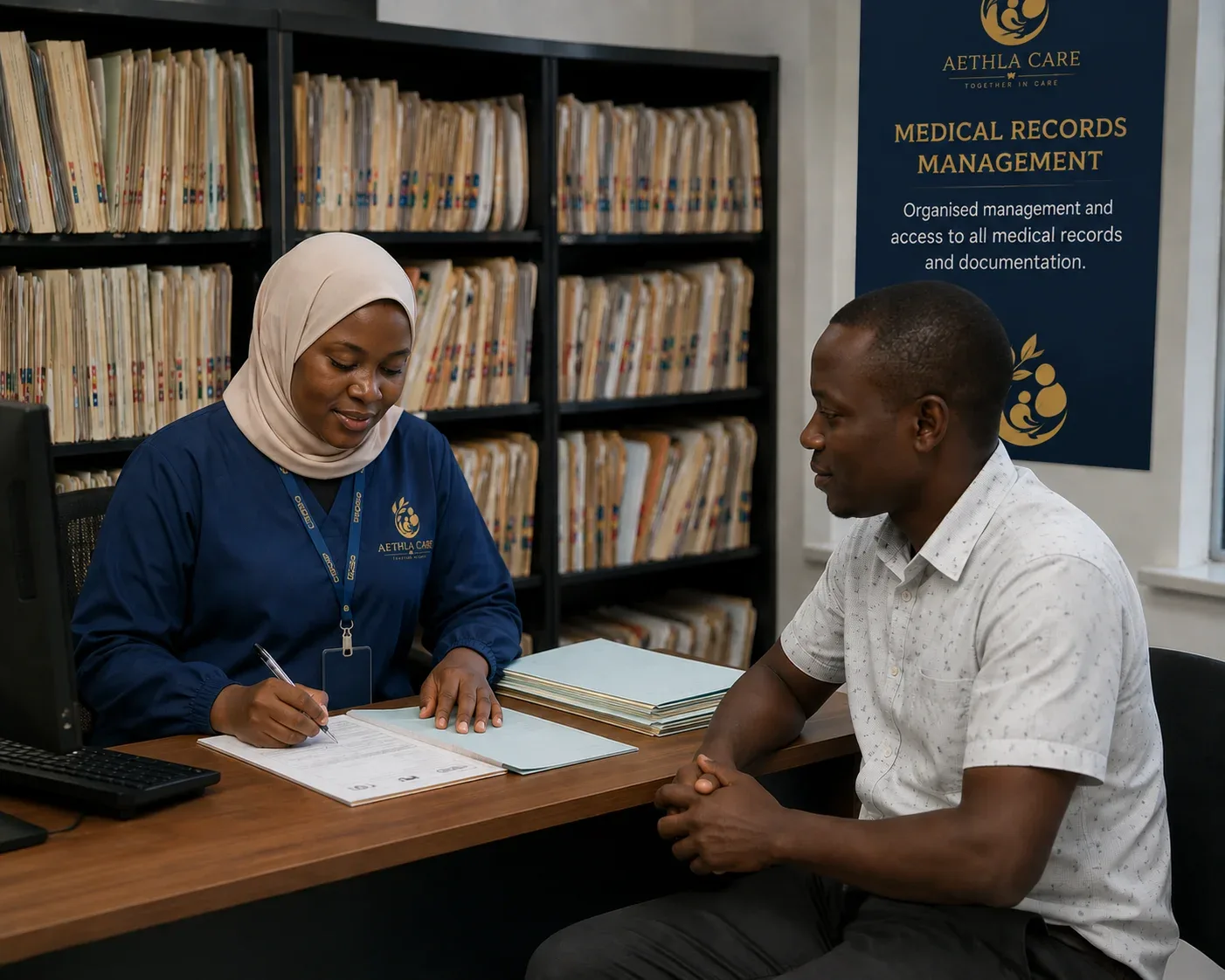
# How to Prepare for a Specialist Appointment in Uganda: A Complete Guide for Patients and Families
A specialist doctor appointment can be an important step in understanding a health problem, reviewing an existing condition, investigating symptoms, planning treatment or deciding what should happen next.
But getting the appointment is only part of the process.
**Good preparation can make it easier for the patient and family to communicate relevant information, bring the right documents, organize transport and understand the next steps.**
This is particularly important when the patient is:
- An older adult - Living with a disability - Recovering after hospitalization - Managing a long-term health condition - Travelling from outside Kampala - Attending several medical appointments - Being supported by family members living overseas
For families in Uganda, preparing for specialist care can sometimes involve more than simply arriving at a hospital or clinic.
You may need to organize referral information, previous medical records, laboratory or imaging reports, medicines, identification, transport, an accompanying person and questions for the healthcare professional.
For a family member living abroad, there may also be additional coordination between the patient, relatives, caregivers and healthcare providers.
This guide explains **how to prepare for a specialist appointment in Uganda**, what to take, what questions to prepare, how to support an elderly parent or disabled family member, and what to do after the consultation.
---
# Quick answer: how should I prepare for a specialist appointment?
Before a specialist appointment in Uganda, try to:
1. Confirm the appointment details. 2. Confirm whether a referral is required. 3. Find out what documents the facility requires. 4. Gather previous medical reports. 5. Gather relevant laboratory and imaging results. 6. Prepare an accurate list of current medicines and other treatments. 7. Write down the main reason for the consultation. 8. Prepare questions in advance. 9. Arrange transport. 10. Consider whether the patient needs someone to accompany them. 11. Plan for mobility or accessibility requirements. 12. Arrive with enough time to complete any required registration. 13. Take notes during the consultation where appropriate. 14. Record the specialist's recommended next steps. 15. Arrange follow-up appointments, investigations or other support as advised.
The exact requirements vary between facilities and medical specialties, so families should confirm appointment-specific instructions directly with the relevant healthcare provider.
---
# 1. Why preparation matters
A specialist appointment may be relatively short compared with the amount of time a family has spent waiting for it.
That means it helps to arrive prepared.
Patients sometimes remember only part of their medical history when they are sitting in front of a doctor.
Family members may also forget important dates, previous test results or medication information.
Writing things down beforehand can help.
Preparation can also reduce avoidable problems such as:
- Arriving at the wrong facility - Forgetting a referral letter - Leaving medical records at home - Not bringing previous test results - Forgetting important questions - Arriving without necessary transport - Missing follow-up instructions - Discovering that additional documents were required
Preparation does not guarantee a particular medical outcome.
It simply helps the patient and healthcare professional work with the information available.
---
# 2. Confirm the appointment before travelling
Do not assume that an appointment is confirmed simply because someone mentioned a date.
Where appropriate, confirm:
- Patient's name - Specialist's name - Department - Date - Time - Facility - Location - Appointment reference if one exists - Registration instructions - Documents required - Any preparation instructions - Whether a referral is required
This is especially important when the patient is travelling from another town.
A family in Mukono, for example, may need to plan transport into Kampala.
A patient travelling from Mbarara, Gulu, Jinja or another part of Uganda may need considerably more planning.
Before travelling a long distance, confirm the practical details.
---
# 3. Check whether a referral is required
Referral arrangements can differ depending on the healthcare facility, specialist and circumstances.
If the patient has been referred by another healthcare professional, keep the referral documentation safely.
Check:
- Who issued the referral - Which specialty is being requested - Whether a particular facility was recommended - Whether the referral contains important clinical information - Whether the receiving provider requires the original document - Whether any additional documentation is required
If you are uncertain, contact the relevant healthcare provider before the appointment.
Do not assume that every specialist appointment in Uganda follows exactly the same process.
---
# 4. Create a simple patient information summary
One of the easiest ways to prepare is to create a one-page summary.
For example:
**Patient:** Mary **Age:** 68 **Location:** Wakiso **Main reason for appointment:** Specialist review **Current concern:** Brief description **When it started:** Approximate date **Previous healthcare visits:** Dates/facilities if known **Relevant medical history:** Important conditions **Previous hospital admissions:** Relevant information **Current medicines:** List **Recent tests:** List **Referral:** Yes/No **Family contact:** Name and phone number
The purpose is not to create a medical diagnosis.
It is simply to organize information.
The specialist remains responsible for clinical assessment.
---
# 5. Bring previous medical records
Previous medical information can be important.
Depending on the patient's circumstances, bring relevant:
- Referral letters - Hospital discharge summaries - Specialist reports - Laboratory results - Imaging reports - Previous prescriptions - Treatment records - Medical correspondence - Relevant clinical notes
Do not overwhelm the healthcare professional with unrelated paperwork.
Focus on information relevant to the current appointment.
If you are unsure whether a particular record matters, it is generally safer to have relevant documentation available and allow the healthcare team to determine what is useful.
---
# 6. Organize laboratory and imaging results
If the patient has recently undergone investigations, keep the results together.
These could include:
- Blood-test results - Urine-test results - Imaging reports - X-ray reports - Ultrasound reports - CT reports - MRI reports - Other relevant investigations
Where imaging has been performed, find out whether the healthcare provider requires the report, the images, a digital copy, or another format.
Do not assume that having only a verbal description of a previous test is sufficient.
The specialist should receive the relevant information through appropriate channels.
---
# 7. Prepare an accurate medication list
Medication information can be important during medical consultations.
Prepare a list containing, where known:
- Medicine name - Strength - How often it is taken - Why it was prescribed - Who prescribed it - Any recent changes
If possible, bring the medication packaging or prescription information when appropriate.
Do not guess medication names or doses.
If you are uncertain, state that you are uncertain.
For an older person taking multiple medicines, keeping an up-to-date medication list can be particularly useful.
---
# 8. Do not stop medicines simply because of an appointment
Patients should not independently stop, change or alter prescribed medicines simply because they are preparing for a specialist consultation.
If the specialist or healthcare facility has given specific instructions before the appointment, follow those instructions.
If you are uncertain whether a medicine should be taken before an appointment, ask the relevant healthcare professional or facility.
This is especially important when an appointment involves a test or procedure that may require specific preparation.
---
# 9. Write down the main concern
Before the appointment, write down the primary reason for attending.
Try to describe:
- What has changed? - When did it begin? - Has it become more frequent? - Has it become more severe? - What makes it better or worse? - Has anything already been tried? - Has the patient seen another healthcare professional?
Avoid trying to diagnose the problem yourself.
Instead, describe what the patient has experienced as accurately as possible.
For example:
Instead of:
**“Mum has definitely developed arthritis.”**
write:
**“Mum has had increasing difficulty walking for approximately three months and reports pain in both knees.”**
The healthcare professional can then assess the situation appropriately.
---
# 10. Make a timeline of important events
A timeline can be extremely useful.
For example:
**January:** First noticed symptoms.
**February:** Visited local healthcare facility.
**March:** Underwent investigation.
**April:** Symptoms changed.
**May:** Hospital admission.
**June:** Discharged and referred for specialist review.
This can help the family remember the sequence of events.
It can be particularly valuable when a relative has multiple medical appointments.
---
# 11. Write down the patient's symptoms or concerns
Before attending, make a simple list.
For example:
- Difficulty walking - Pain - Reduced appetite - Difficulty sleeping - Changes in hearing - Vision concerns - Repeated falls - Fatigue - Changes in daily activities
Only include symptoms that are actually present.
Do not add symptoms simply because they appear in online articles.
Internet research can help families formulate questions, but it should not be used to diagnose the patient.
---
# 12. Prepare questions before seeing the specialist
People often think of important questions only after leaving the consultation.
Writing them down beforehand can help.
Questions may include:
- What is the purpose of this consultation? - What did you find? - What information do you need from us? - Are additional investigations needed? - What are the next steps? - Does the patient need follow-up? - When should the patient return? - Does another specialist need to be involved? - What changes should the family monitor? - Who should we contact if we have further questions?
The specific questions will depend on the patient's situation.
---
# 13. Encourage the patient to participate
If the patient is able and willing to participate, they should be involved in the consultation.
This is particularly important for older adults.
Family members may know the patient's history, but the patient may be the best person to describe:
- How they feel - What has changed - What concerns them - What support they want - What questions they have
Family support should not automatically replace the patient's voice.
WHO's current ICOPE approach emphasizes person-centred care and personalized planning, including attention to the individual's needs and involvement of families and caregivers where appropriate.
---
# 14. What if the patient is elderly?
Older adults may need additional practical preparation.
Consider:
### Mobility
Can the patient walk comfortably from the vehicle to the facility?
### Hearing
Can they hear conversations clearly?
### Vision
Can they read documents or navigate the facility?
### Communication
Can they explain their concerns?
### Memory
Would they benefit from having a trusted person present to help remember instructions?
### Fatigue
Will long waiting periods be difficult?
### Toileting
Will they need easy access to a bathroom?
### Food and drink
Does the facility have any specific instructions regarding eating or drinking before the appointment?
These are practical considerations, not assumptions about every older person.
Every patient is different.
---
# 15. Should an elderly parent have someone accompany them?
There is no universal requirement.
It depends on:
- The person's preferences - Mobility - Communication needs - Complexity of the appointment - Ability to travel independently - Whether family support is needed
An accompanying person may help with:
- Transport - Registration - Carrying documents - Taking notes - Remembering follow-up instructions - Communication support - Getting home safely
However, the older person should remain involved in their own care to the extent that they are able and wish to be.
---
# 16. Preparing a person with a disability for a specialist appointment
Preparation should be individualized.
A person with a disability may need:
- Accessible transport - Mobility assistance - Communication support - Additional time - A companion - Assistance navigating the facility - Specific equipment - A support person familiar with their communication preferences
Do not assume what the person needs.
Ask them.
For example:
**“What would make this appointment easier for you?”**
This simple question can be more useful than making assumptions based on a diagnosis or disability.
---
# 17. Arrange transport before appointment day
Transport should be treated as part of the appointment plan.
Ask:
- Where does the patient live? - How far is the facility? - What time should they leave? - Is traffic likely to affect arrival? - Does the patient need accessible transport? - Can they enter and leave the vehicle safely? - Does someone need to accompany them? - How will they return home?
For families arranging care from overseas, this is often one of the areas where local coordination is especially useful.
An appointment is only practical if the patient can actually get there and return safely.
---
# 18. Allow extra time
Do not plan the day as if the appointment will always take exactly the advertised amount of time.
Healthcare facilities may involve:
- Registration - Waiting - Medical assessment - Documentation - Additional investigations - Payment or administrative processes - Follow-up scheduling
Patients should therefore avoid arranging another important commitment immediately afterward unless the facility has specifically indicated that timing is predictable.
This is especially important for older people or people with mobility limitations.
---
# 19. Prepare financially and administratively
Before attending, establish what the family should expect administratively.
Depending on the facility, consider:
- Consultation charges - Investigation charges - Registration requirements - Insurance information - Payment methods - Additional services - Transport expenses
Do not assume that a specialist consultation automatically includes investigations or treatment.
Ask the facility about its current arrangements.
If prices are important to your decision, verify them directly with the relevant provider because fees can change.
---
# 20. Keep important contact information accessible
Save relevant contact details in your phone and keep a written copy where appropriate.
This may include:
- Healthcare facility - Specialist department - Referring healthcare provider - Family contact - Caregiver - Driver - Emergency contact
For an older person, it can also be useful for their accompanying person to have the relevant family contact information.
---
# 21. What should someone living abroad prepare?
Families living outside Uganda often need to prepare differently.
Suppose a daughter lives in Melbourne and her mother lives in Kampala.
The daughter may need to coordinate the appointment remotely.
Before the appointment, she can help ensure that:
- The appointment is confirmed - The parent knows where to go - Relevant documents are available - Transport is arranged - A trusted person can accompany the parent if needed - The family knows the appointment date - Follow-up arrangements are understood
She should not assume that remote coordination gives her authority to make clinical decisions for the patient.
The patient's healthcare team should handle clinical assessment and treatment.
---
# 22. Preparing for a specialist appointment from the UK, USA, Canada or UAE
The same basic principles apply whether the family member lives in:
- Australia - United Kingdom - United States - Canada - United Arab Emirates - South Africa - Another country
Distance creates a coordination problem rather than necessarily a medical one.
The family needs a reliable way to connect:
**Patient → local support → healthcare provider → overseas family**
A care coordination service can potentially help with the practical links between these participants.
---
# 23. What should you do on the morning of the appointment?
Use a checklist.
### Before leaving home
☐ Confirm appointment time ☐ Confirm location ☐ Confirm transport ☐ Check required documents ☐ Check referral letter if applicable ☐ Take medical reports ☐ Take relevant medication information ☐ Take identification ☐ Take questions ☐ Bring phone/contact details ☐ Check any specific preparation instructions
### For an elderly or disabled patient
☐ Confirm mobility support ☐ Confirm accompanying person ☐ Confirm accessibility requirements ☐ Allow extra travel time ☐ Pack anything needed during the journey
---
# 24. What should you do during the appointment?
The consultation belongs to the patient and healthcare professional.
Family members or caregivers can support where appropriate.
Helpful practices include:
- Listen carefully - Answer questions honestly - Avoid guessing - Ask for clarification when something is unclear - Take notes if appropriate - Confirm what happens next
If you do not understand a medical term, ask:
**“Could you explain that in simpler terms?”**
There is nothing wrong with asking for clarification.
---
# 25. Ask the specialist to explain the next step
Before leaving, make sure the family understands the practical next step.
For example:
- Another appointment? - Laboratory investigation? - Imaging? - Another specialist? - Follow-up with the referring doctor? - Hospital admission? - Rehabilitation? - Monitoring?
The exact answer depends on the clinical situation.
The goal is simply to avoid leaving without knowing what the healthcare professional has recommended.
---
# 26. Do not interpret medical results yourself
Patients and families increasingly have access to test results through paper documents, patient portals or electronic communication.
It can be tempting to search every unfamiliar term online.
Be careful.
A laboratory value, scan report or clinical term cannot always be interpreted correctly without understanding the patient's full medical history and the context in which the test was ordered.
Use online information to prepare questions—not to replace professional medical assessment.
---
# 27. What should happen after the appointment?
Within a short time after the consultation, write down:
**Date:** **Specialist:** **Facility:** **Main findings discussed:** **Tests recommended:** **Follow-up:** **Next appointment:** **Other healthcare provider involved:** **Questions remaining:**
Do not attempt to rewrite the doctor's assessment inaccurately.
Where possible, retain the original documentation provided by the healthcare professional.
---
# 28. Organize follow-up appointments immediately
If the specialist recommends another appointment, do not rely solely on memory.
Record:
- Date - Time - Provider - Facility - Purpose - Documents required - Transport arrangements
If another family member is responsible, tell them clearly.
For diaspora families, this can be especially important because multiple people may be involved in supporting the patient.
---
# 29. Build a simple family care record
For ongoing care, create a secure record.
It might contain:
### Patient information
Name, date of birth and relevant contacts.
### Healthcare providers
Names and facilities.
### Appointments
Dates and purposes.
### Reports
Where relevant documents are stored.
### Follow-up
What needs to happen next.
### Family responsibilities
Who is coordinating transport, appointments and communication.
This can prevent information from becoming scattered across WhatsApp messages, emails, paper documents and different family members' phones.
Sensitive health information should be handled securely and only shared with people who need it.
---
# 30. What if the specialist recommends another specialist?
This is not unusual.
A patient's needs may involve more than one area of healthcare.
For example, a specialist may recommend another professional for a separate or related issue.
If that happens:
1. Understand why the additional consultation is recommended. 2. Confirm which specialty is required. 3. Obtain any referral documentation. 4. Gather relevant reports. 5. Arrange the next appointment. 6. Coordinate transport if necessary. 7. Keep the patient's healthcare records organized.
A family coordinator can help with the logistics while clinical decisions remain with healthcare professionals.
---
# 31. What if the patient has just left hospital?
Post-hospital patients may have several follow-up requirements.
The family should carefully review the discharge information supplied by the healthcare team.
Depending on the case, there may be:
- Follow-up appointments - Medication instructions - Further tests - Specialist reviews - Rehabilitation - Home support requirements - Mobility issues - Transport needs
Do not discard the discharge documents.
Keep them organized and available for subsequent healthcare appointments.
---
# 32. Healthcare preparation for elderly parents in Uganda
For older parents, specialist appointments can become part of a broader care plan.
The family may need to coordinate:
**Home → Transport → Hospital/Clinic → Specialist → Follow-up → Home**
This is why elderly care and healthcare navigation can overlap.
An older person may not need full-time care but may still need assistance attending appointments.
Another person may need regular home support alongside specialist care.
The appropriate arrangement depends on the individual.
WHO's current integrated-care framework emphasizes looking beyond individual diseases and considering functional ability, social support and coordinated care across settings including homes, primary care and hospitals.
---
# 33. Healthcare preparation for diaspora families
If you live abroad, create a simple division of responsibilities.
For example:
### Parent
Communicates their concerns and participates in healthcare decisions.
### Local family member
Helps with appointments and practical support.
### Caregiver
Provides agreed practical assistance.
### Healthcare provider
Provides clinical assessment and recommendations.
### Overseas family member
Helps coordinate communication and practical arrangements remotely.
### Care coordinator
Where used, helps connect the logistical pieces.
This prevents one person from becoming responsible for everything.
---
# 34. How Aethla Care can support specialist appointment preparation
Aethla Care provides healthcare navigation and family-care coordination rather than replacing clinical professionals.
Depending on the family's situation, Aethla Care can help coordinate areas such as:
- Specialist appointment logistics - Healthcare navigation - Appointment preparation - Document organization - Transport coordination - Elderly appointment support - Disability mobility support - Family communication - Follow-up coordination - Practical support after hospital discharge
The exact service route depends on the family's needs and what support is available.
Aethla Care does not diagnose medical conditions or make clinical decisions.
The healthcare professional remains responsible for medical assessment and treatment.
The Aethla approach is:
**Tell us what you need → clarify the care route → coordinate support → keep the family informed.**
---
# 35. Common mistakes to avoid
## 1. Arriving without the referral
If one is required, this can delay the process.
## 2. Forgetting previous reports
Relevant history may be useful to the specialist.
## 3. Guessing medication names
Use accurate information wherever possible.
## 4. Searching symptoms and assuming a diagnosis
Online information should not replace clinical assessment.
## 5. Failing to confirm the appointment
Always verify important details before travelling.
## 6. Ignoring transport
A booked appointment does not solve the journey.
## 7. Not considering accessibility
Older and disabled patients may need additional support.
## 8. Forgetting questions
Write them down.
## 9. Leaving without understanding the next step
Ask for clarification.
## 10. Losing follow-up documents
Keep healthcare records organized.
---
# 36. Specialist appointment checklist
## Before booking
☐ Understand the reason for consultation ☐ Confirm appropriate specialist route ☐ Check referral requirements ☐ Identify suitable facility/provider
## Before the appointment
☐ Confirm date ☐ Confirm time ☐ Confirm location ☐ Prepare referral ☐ Gather medical records ☐ Gather test results ☐ Prepare medication list ☐ Write down symptoms/concerns ☐ Prepare questions ☐ Arrange transport ☐ Arrange companion if needed
## On appointment day
☐ Arrive with sufficient time ☐ Bring documents ☐ Bring relevant medication information ☐ Explain concerns clearly ☐ Ask questions ☐ Take appropriate notes ☐ Confirm next steps
## After the appointment
☐ Record recommendations ☐ Keep reports ☐ Book follow-up if required ☐ Arrange recommended investigations ☐ Coordinate transport ☐ Update relevant family members ☐ Review whether additional home or family support is needed
---
# 37. Frequently Asked Questions
## What should I take to a specialist appointment in Uganda?
Take any referral letter required, identification, relevant medical records, previous specialist reports, laboratory or imaging results, medication information and any documents requested by the healthcare facility.
## How do I prepare for a specialist doctor appointment?
Confirm the appointment, organize medical information, prepare questions, arrange transportation and ensure the patient understands where and when they need to attend.
## Should I bring previous medical reports?
If they are relevant to the current consultation, yes. Previous reports can provide useful background information for the healthcare professional.
## Should I bring my medicines to the appointment?
Where appropriate, bring the medication packaging, prescription information or an accurate medication list. Do not change or stop prescribed medicines unless instructed by a qualified healthcare professional.
## Should an elderly parent have someone accompany them?
It depends on their needs and preferences. An accompanying person may be useful for transport, mobility, communication, documentation and remembering follow-up instructions.
## How do I prepare a disabled person for a specialist appointment?
Ask the person what support they need. Consider accessibility, transport, mobility, communication, additional time and whether they want a trusted person to accompany them.
## What if I live overseas and my parent has a specialist appointment in Uganda?
You can help coordinate documents, transport, appointment details and communication remotely. A local care coordinator or trusted family member can provide practical assistance where necessary.
## Can Aethla Care arrange specialist appointments?
Aethla Care can assist with healthcare navigation and practical coordination. Appointment availability and confirmation remain dependent on the relevant healthcare provider or facility.
## Can Aethla Care accompany my elderly parent?
Depending on the service arrangement, location and support required, Aethla Care may be able to coordinate practical appointment and mobility support. Families should confirm the specific service route before relying on it.
## What happens after a specialist appointment?
Follow the recommendations provided by the healthcare professional. This may involve additional tests, treatment, another appointment, another specialist or follow-up with the patient's existing healthcare provider.
## Is online health information a substitute for a specialist?
No. Online information can help families prepare questions and understand general concepts, but it cannot replace an appropriate clinical assessment.
---
# Final Thoughts
Preparing for a specialist appointment in Uganda is about more than remembering the appointment date.
It means preparing the **person, information and journey**.
The person needs to understand why they are attending.
The healthcare professional needs access to relevant information.
The family needs to know what practical support is required.
And the patient needs a realistic way to reach the appointment and return home.
For an elderly parent, someone living with a disability or a relative whose children live overseas, these practical details can make healthcare coordination significantly more complicated.
A structured approach can help.
Start with the patient's needs.
Gather the relevant information.
Confirm the appointment.
Prepare the questions.
Arrange the journey.
Support the patient during the consultation.
Then record and coordinate the next steps.
For families across Kampala, Wakiso, Entebbe, Mukono and elsewhere in Uganda, Aethla Care can help coordinate the practical side of healthcare navigation where the appropriate service route is available.
For Ugandans living abroad, Aethla Care can also help connect overseas families with practical support for relatives in Uganda.
The goal is not to replace healthcare professionals.
It is to make the journey around healthcare easier to coordinate.
**Aethla Care — Trusted Care for Every Stage of Life.**
**Tell us what you need → clarify the care route → coordinate support → keep the family informed.**
---
## References and further reading
1. **World Health Organization — Integrated Care for Older People (ICOPE), 2nd edition, 2025.** WHO describes a person-centred pathway involving assessment, identification of health and social-support needs, development of a personalized care plan, implementation and monitoring.
2. **World Health Organization — Integrated Care for Older People.** WHO's ICOPE approach emphasizes coordinated care and considers areas such as mobility, cognition, vision, hearing, vitality, psychological capacity, social support and support for carers.
3. **World Health Organization — Person-centred and integrated care.** WHO describes a continuum of integrated services extending across older people's homes, primary care, hospitals and long-term-care settings, with communities playing an important role in supporting ageing in place.
4. **World Health Organization — Quality of care for older people.** WHO identifies principles including effectiveness, safety, people-centredness, equity, integration and timeliness, and highlights coordination and caregiver support as important areas in older-person care.
5. **Google Search Central — Creating Helpful, Reliable, People-First Content.** Google recommends content that is useful, reliable, original and comprehensive, with appropriate expertise and sourcing, rather than content produced primarily to manipulate search rankings.
6. **Google Search Central — Optimizing for Generative AI Features on Google Search.** Google states that foundational SEO remains relevant to generative AI search and recommends valuable, distinctive, people-first content rather than artificial AEO/GEO tactics.
7. **Google Search Central — AI Features and Your Website.** Google states that there are no additional technical requirements specifically for appearing in AI Overviews or AI Mode beyond being eligible for Google Search and following foundational SEO practices.
### Important note
This article provides general information about preparing for specialist healthcare appointments and coordinating practical support. It is not medical advice, diagnosis or treatment. Appointment procedures, referral requirements, provider availability, facility requirements and fees can vary in Uganda. Families should confirm current requirements directly with the relevant healthcare provider or facility.