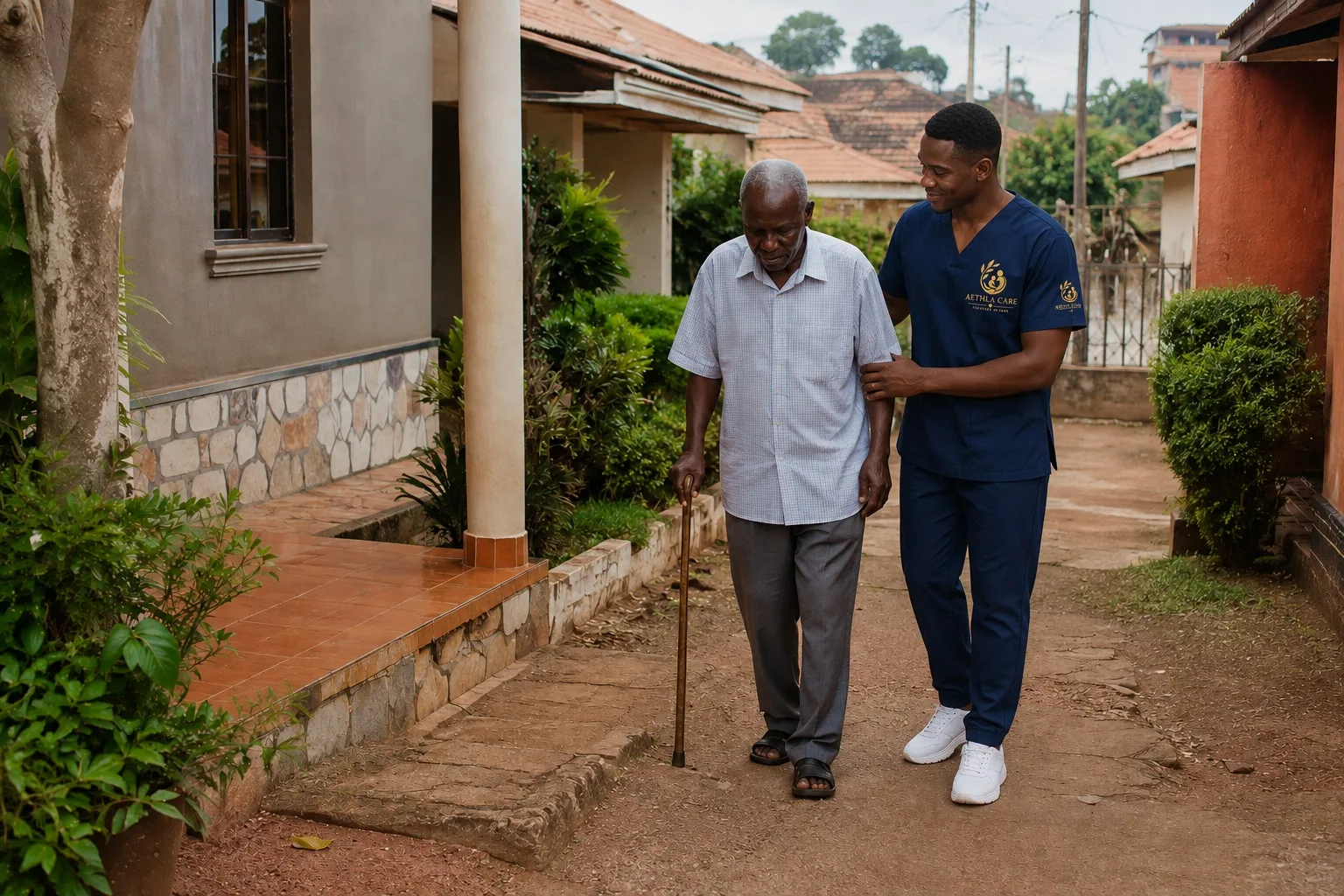
How to Find Reliable Elderly Care in Kampala
Finding reliable elderly care in Kampala can be challenging for families who want to support an ageing parent, grandparent or relative while allowing them to remain in a familiar environment.
The challenge is not simply finding someone who can visit the home. Families may need to consider companionship, household assistance, mobility, transport, appointments, personal routines, communication, safety and the older person's own preferences.
For families living overseas, the process can be even more complicated. A son or daughter living in Australia, the United Kingdom, the United States, Canada, the UAE or elsewhere may need to coordinate support for an elderly parent living in Kampala without being physically present.
The right approach is to start with the person's needs rather than simply searching for a "caregiver."
This guide explains **how to find reliable elderly care in Kampala, what to look for when assessing a care arrangement, questions to ask, warning signs to consider, how family members can stay involved, and how an integrated care coordination service such as Aethla Care can help families organize different parts of the support journey.
To find reliable elderly care in Kampala, first identify what the older person actually needs, distinguish practical support from clinical healthcare, assess the people or organization providing the service, clarify responsibilities and communication, confirm the geographical and service availability, and make sure the arrangement respects the older person's preferences and dignity.
What does elderly care mean in Kampala?
"Elderly care" can mean different things to different families.
For one household, it might mean having someone assist an older parent with shopping, meals and household routines.
For another, it might involve regular companionship, transport to appointments and help coordinating family responsibilities.
Another family may need support after a hospital stay or assistance organizing specialist appointments.
This means there is no single elderly-care arrangement that is automatically appropriate for every older person.
Support can potentially include:
- Companionship - Household assistance - Meal-related support - Shopping and errands - Assistance with everyday routines - Appointment coordination - Mobility support - Transport coordination - Accompaniment to appointments - Post-hospital practical support - Communication and coordination with family members - Navigation toward appropriate healthcare services
Clinical care is different.
Diagnosis, prescribing, treatment, nursing procedures and other medical responsibilities should be handled by appropriately qualified healthcare professionals.
A reliable care arrangement should make those boundaries clear.
Why finding reliable elderly care matters
As people age, their needs can change across several areas of daily life.
The World Health Organization's Integrated Care for Older People (ICOPE) approach recognizes that healthy ageing involves more than treating individual illnesses. Its framework considers areas including mobility, cognition, nutrition and vitality, vision, hearing, psychological wellbeing and social support, while emphasizing person-centred and coordinated care.
That has an important implication for families:
Reliable elderly support should look at the whole person, not just one task.
For example, a family may initially ask for someone to help an elderly parent with shopping.
But during the conversation, they may discover that the parent is also:
- Struggling to attend medical appointments - Spending long periods alone - Finding transport difficult - Having difficulty managing household tasks - Becoming less mobile - Needing more regular family contact
The right support plan may therefore involve more than a shopping service.
Step 1: Start by identifying exactly what your elderly relative needs
Before searching Google, asking friends or contacting a care provider, write down what is happening.
A simple needs assessment can make the search much easier.
Daily living
Ask:
- What activities are becoming difficult? - What can the person still do independently? - What would they like help with? - What tasks are physically tiring? - Are there household responsibilities they can no longer manage comfortably?
Mobility
Consider:
- Can they walk safely around the home? - Do they use a walking aid? - Are stairs difficult? - Can they get in and out of a vehicle? - Can they travel to appointments independently? - Do they need someone to accompany them?
Social needs
Consider:
- How often do they see other people? - Do they spend long periods alone? - Would regular companionship be useful? - Are they still involved in family or community activities?
Healthcare coordination
Ask:
- Are there regular medical appointments? - Are specialist appointments required? - Does someone need to organise transport? - Does a family member need help coordinating information?
Household needs
Consider:
- Cooking - Shopping - Laundry - Cleaning - Errands - Household organization - Obtaining essential supplies
This process helps the family move from a vague request such as "We need elderly care" to something much more useful:
"Our parent needs three visits each week for companionship, household assistance and help attending appointments."
Step 2: Decide whether you need a caregiver, household support or care coordination
These terms are sometimes used interchangeably, but they do not necessarily describe the same service.
Caregiver or home-support worker
A caregiver may provide agreed practical or personal support according to their role and qualifications.
Household support
Some families primarily need help with household tasks, errands, meals or general family assistance.
Care coordination
A coordinator may help families understand what support is needed and organize different components of the care journey.
This distinction matters because one person or organization may not provide every type of service.
For example, a family may need:
Home support + specialist appointment + transport + family communication
rather than simply "a caregiver."
Aethla Care is designed around this broader coordination model.
Step 3: Look for a provider that starts with assessment rather than a sales pitch
A reliable provider should want to understand the situation.
Be cautious if the conversation immediately focuses on selling a package without asking basic questions.
A useful initial discussion should explore:
- Who needs support? - Where do they live? - What assistance is required? - How frequently is support needed? - Are there mobility considerations? - Are there healthcare appointments? - Is the family based in Uganda or overseas? - What does the older person want? - What responsibilities are expected?
This is especially important because two families in Kampala may have completely different requirements.
A 75-year-old who lives independently in Ntinda but needs help with errands has a different support profile from an older person recovering after hospitalization in Makindye.
Step 4: Ask exactly what the service includes
One of the most important questions is:
"What exactly will the person be doing?"
Do not assume that every provider or caregiver offers the same services.
Ask whether the arrangement includes:
- Companionship - Household assistance - Meal preparation - Shopping - Errands - Appointment support - Transport coordination - Accompaniment - Mobility assistance - Personal-care tasks - Family updates
If personal or clinical tasks are involved, clarify who is qualified to perform them.
A written description of responsibilities can help prevent misunderstandings.
Step 5: Ask what is outside the provider's role
This question is just as important as asking what is included.
For example:
"What don't you provide?"
A transparent answer might clarify that the service does not:
- Diagnose medical conditions - Prescribe medication - Replace a doctor - Replace hospital care - Make clinical decisions - Provide specialist medical treatment unless an appropriately qualified professional is involved
Clear boundaries protect both the family and the older person.
Aethla Care's role includes care coordination and healthcare navigation, but it does not replace doctors, hospitals or other qualified healthcare professionals.
Step 6: Consider the older person's preferences
A care arrangement can look excellent on paper and still fail if the older person does not feel comfortable with it.
Ask your parent or relative:
- Who would you feel comfortable having in the home? - What kind of help would you like? - What do you want to continue doing yourself? - What times are convenient? - What household routines matter to you? - What information should family members receive? - Who should be involved in decisions?
The WHO's current ICOPE guidance emphasizes person-centred assessment, personalized care planning and attention to social support and carers.
That principle is useful for families in Kampala too.
The objective should not be to take control away from an older person.
It should be to provide appropriate support while preserving as much independence, choice and dignity as possible.
Step 7: Check how communication will work
Communication is one of the biggest issues for families arranging care.
Ask:
- Who is the main family contact? - Who receives updates? - How are routine updates provided? - How are urgent concerns communicated? - What happens if the support person cannot attend? - Who can the family contact when they have questions?
This becomes especially important when the person arranging care lives abroad.
For example, a daughter in Melbourne may need regular updates about her mother's support in Kampala.
The communication system should be agreed in advance rather than improvised later.
Step 8: If you live abroad, establish one clear coordination point
Diaspora families can face a unique problem: several relatives may be involved, but nobody is physically present to coordinate everything.
A family might have:
- One sibling in Australia - Another in the United Kingdom - A cousin in Kampala - A parent in Kampala - A doctor or hospital involved in healthcare - A separate driver or transport provider
Without coordination, everyone may have pieces of information but nobody has the full picture.
A clear coordination point can help.
The family can establish:
Primary family contact → care coordinator → relevant support provider → healthcare provider where necessary
This does not mean giving up family involvement.
It means making responsibilities clearer.
Step 9: Think about location within Kampala
"Kampala" covers a large metropolitan area, and practical travel requirements can affect how support is arranged.
The location of the older person matters.
So does:
- Where appointments take place - Transport availability - Frequency of visits - Travel time - Mobility requirements - Whether an accompanying person is needed
A service that looks suitable in general terms may not be appropriate for a particular location or schedule.
Families should confirm availability and service coverage rather than assuming that every type of support is available everywhere in Kampala.
Aethla Care's current early service footprint includes Kampala, Wakiso, Entebbe and Mukono, with availability depending on the specific type of support required.
Step 10: Look beyond the caregiver — consider the whole care network
One person cannot necessarily solve every care need.
A strong care arrangement may involve several roles.
Family
Family members may make decisions, communicate preferences and remain involved.
Healthcare professionals
Doctors, nurses, specialists and other qualified healthcare professionals handle clinical responsibilities within their professional scope.
Home-support workers
They may provide agreed practical or personal support according to their role.
Transport providers
Transport may be required for appointments, essential activities or mobility needs.
Care coordinators
A coordinator can help connect the different pieces.
This is why Aethla Care describes itself as an integrated care and family-support platform rather than simply a nursing service or domestic staffing agency.
How to assess whether elderly care is reliable
Reliability is broader than whether someone arrives on time.
Families should consider several dimensions.
1. Role clarity
You should know exactly what the service includes.
2. Communication
You should know who to contact and how updates are handled.
3. Continuity
Ask what happens if the usual support person is unavailable.
4. Transparency
The provider should be clear about what it can and cannot do.
5. Respect
The older person's preferences and dignity should be taken seriously.
6. Safety
The arrangement should recognize relevant risks and escalate issues appropriately.
7. Appropriate healthcare boundaries
A practical support provider should not present itself as a substitute for professional medical care.
8. Local practicality
The provider should be honest about the locations and services it can actually coordinate.
Questions to ask an elderly-care provider in Kampala
Before making arrangements, consider asking these questions.
About the service
1. What type of elderly support do you provide? 2. What areas of Kampala do you cover? 3. What types of support are available? 4. Is the support occasional or ongoing? 5. Can the service be tailored to the person's needs?
About the person providing support
6. What responsibilities will they have? 7. What qualifications or experience are relevant to the role? 8. Who supervises or coordinates the arrangement? 9. What happens if the person is unavailable?
About healthcare
10. Can you help coordinate specialist appointments? 11. Can someone accompany my parent to an appointment? 12. Who makes medical decisions? 13. What happens if a health concern is identified?
About communication
14. Who will update the family? 15. How frequently will updates be provided? 16. Can overseas family members remain involved?
About practical arrangements
17. How is the person's location considered? 18. Can transport or mobility support be coordinated? 19. What happens when the family's needs change? 20. How do we start?
A provider that is willing to answer these questions clearly gives the family a better basis for making an informed decision.
Warning signs when choosing elderly care
No single warning sign proves that a provider is unsuitable, but families should investigate concerns carefully.
Vague responsibilities
If nobody can clearly explain what the caregiver is expected to do, misunderstandings can develop.
Unclear communication
Families should know who to contact and how concerns are escalated.
Pressure to agree immediately
Families should have enough information to understand the arrangement before committing.
Claims that sound too broad
Be cautious about anyone presenting one service as a replacement for doctors, hospitals or all forms of professional healthcare.
No consideration of the older person's preferences
The older person's views should be part of the care discussion whenever possible.
No clear explanation of availability
Families should know whether the requested support is actually available in their location and under what circumstances.
Elderly care after hospital discharge
Families sometimes begin searching for elderly care immediately after a parent leaves hospital.
This can create confusion because the person's needs may have changed quickly.
Before arranging support, review the instructions provided by the healthcare team.
Consider practical questions such as:
- How will the person get home? - Does the home need preparation? - Will they need help with meals? - Do they have follow-up appointments? - Is transport required? - Will they need assistance with everyday routines? - Does the family need help coordinating appointments?
If clinical or nursing care is required, the family should arrange appropriately qualified professional care.
Aethla Care can help with practical coordination around the wider journey where the appropriate service route is available.
How elderly care can support independence
Good support should not automatically mean doing everything for an older person.
If your parent can safely continue doing certain activities, the goal may be to support rather than replace their independence.
For example:
Instead of automatically doing all household tasks, support might focus on the tasks that have become difficult.
Instead of taking over every decision, family members can involve the older person.
Instead of cancelling social activities because transport is difficult, the family might explore appropriate mobility support.
WHO's healthy-ageing approach emphasizes functional ability and person-centred care, rather than defining older people simply by disease or dependency.
When should a family reconsider an existing care arrangement?
An arrangement that worked six months ago may not work today.
Families should review support when there is a significant change in:
- Mobility - Daily activities - Social circumstances - Living arrangements - Healthcare needs - Family availability - Hospitalisation or recovery - Transportation needs
A review does not necessarily mean increasing care.
It means checking whether the current arrangement still matches the person's circumstances.
How Aethla Care can help families in Kampala
Aethla Care approaches elderly support as part of a wider family-care system.
The process begins with understanding the person's situation.
Tell us what you need
The family explains what is happening, where the person lives and what support appears necessary.
Clarify the care route
The requirement can then be considered across areas such as:
- Elderly care - Home and family support - Household assistance - Specialist appointments - Healthcare navigation - Mobility - Transport - Family coordination
Coordinate appropriate support
Where the relevant service route is available, Aethla Care coordinates the appropriate support.
Keep the family informed
Family members can remain involved in the care journey, including relatives who live elsewhere in Uganda or overseas.
This approach is particularly relevant when a family has several needs rather than one isolated requirement.
Finding elderly care in Kampala when your parent lives alone
If your parent lives alone, the family should think beyond the question of who will visit.
Consider the wider system.
Daily support
Who helps with ordinary household needs?
Healthcare
Who helps organize appointments?
Mobility
How does your parent get to essential destinations?
Communication
Who checks in regularly?
Family
Who makes decisions when needed?
Emergencies
What is the family's plan for situations that require urgent professional help?
A support arrangement is stronger when these questions are considered together.
What if my parent refuses elderly care?
This is a common family concern.
An older parent may associate "care" with losing independence.
Instead of beginning with:
"You need a caregiver."
Try:
"What would make things easier for you at home?"
The answer may reveal that the person does not want full-time assistance but would welcome help with:
- Shopping - Cleaning - Transport - Appointments - Household errands - Companionship
The objective is to find support that addresses genuine needs while respecting the person's preferences.
If there are serious concerns about a person's safety, decision-making capacity or health, the family should seek appropriate professional advice rather than trying to resolve a complex clinical issue through a household support arrangement.
Elderly care for Ugandan families living overseas
For diaspora families, reliability often includes something extra:
confidence that someone locally understands what has been arranged.
A family member abroad may not be able to:
- Attend every appointment - Visit the home regularly - Arrange transport - Shop for necessities - Check on household needs - Coordinate multiple providers
Care coordination can help bridge some of that practical distance.
Aethla Care supports families in Uganda and Ugandans abroad who need help coordinating support for relatives in Uganda.
This can include families in:
- Australia - United Kingdom - United States - Canada - United Arab Emirates - South Africa - Other countries with Ugandan families
The family remains involved; the local coordination simply helps turn decisions into practical arrangements.
Frequently Asked Questions
How do I find reliable elderly care in Kampala?
Start by identifying your relative's specific needs, then compare providers based on service scope, communication, role clarity, availability, approach to the older person's preferences and appropriate healthcare boundaries.
What should I look for in an elderly caregiver?
Look for clarity about responsibilities, appropriate experience or qualifications for the role, dependable communication, respect for the older person's preferences and a clear process for handling changes or concerns.
How much does elderly care cost in Kampala?
There is no single standard price for elderly care because arrangements vary according to the type, frequency and duration of support, location, mobility requirements and other factors. Families should request a clear description of what is included rather than relying on a generic price.
Can elderly care include household help?
Depending on the arrangement, household assistance may include tasks such as shopping, meals, cleaning, laundry and errands. The exact responsibilities should be agreed before support begins.
Can someone accompany my elderly parent to a doctor's appointment?
Appointment accompaniment or transport coordination may be possible depending on the service arrangement and location. Clinical decisions remain the responsibility of the relevant healthcare professionals.
Can I arrange elderly care for my parent in Kampala while living overseas?
Yes. Families living abroad can coordinate home support, household assistance, appointments, mobility and other practical needs for relatives in Kampala, depending on service availability.
Does elderly care mean a caregiver has to live with my parent?
No. Support can be occasional, scheduled or regular depending on the person's circumstances.
Can Aethla Care provide medical treatment?
Aethla Care does not replace doctors, hospitals or qualified healthcare professionals. Its role includes care coordination and healthcare navigation, alongside practical and family-support services.
Does Aethla Care cover all of Kampala?
Aethla Care's early service footprint includes Kampala, Wakiso, Entebbe and Mukono, with availability depending on the type of support required. Families should provide the person's location and needs so the appropriate route can be clarified.
What if my parent's needs change?
The care arrangement should be reviewed when circumstances change. Additional support, healthcare input, mobility assistance or a different care route may be appropriate depending on the situation.
Final checklist for families choosing elderly care in Kampala
Before arranging support, ask yourself:
- Have we clearly identified what our parent needs? - Have we involved them in the decision? - Do we know exactly what the service includes? - Do we know what is outside the service? - Are healthcare responsibilities clearly separated from practical support? - Do we know who coordinates the arrangement? - Do we know how family communication will work? - Have we considered transport and mobility? - Have we considered upcoming appointments? - Have we confirmed availability in the person's location? - Do we have a plan if the person's needs change? - Can family members overseas remain involved?
If you can answer these questions, you are in a much stronger position to arrange appropriate support.
Finding elderly care in Kampala: the most important principle
The most important thing to remember is that reliable elderly care is not simply about finding a person to be present in the home.
It is about matching the right type of support to the person's actual needs.
For some older people, that may mean companionship.
For others, it may mean household assistance, transport, mobility support or help coordinating appointments.
Some people may need professional healthcare alongside practical home support.
And some families may need a coordinator who can help bring several pieces together.
That is why Aethla Care begins with the person rather than a predefined package.
Tell us what you need → clarify the care route → coordinate support → keep the family informed.
For families in Kampala, Wakiso, Entebbe, Mukono and Ugandan families living overseas, the starting point is the same: understand the person, understand the need and then arrange the appropriate support.
Aethla Care — Trusted Care for Every Stage of Life.
Factual references
World Health Organization — Integrated Care for Older People (ICOPE), 2nd edition, 2025. WHO's current ICOPE handbook describes person-centred assessment, identification of social-care and support needs, personalized care planning and implementation/monitoring.
World Health Organization — Ageing and Health / ICOPE. WHO describes ICOPE as an approach intended to make health and social services more person-centred and coordinated, with attention to functional ability and intrinsic capacity in older age.
World Health Organization — Community-level interventions for older people. WHO's ICOPE guidance identifies areas including mobility, vitality, sensory capacity, cognitive and psychological wellbeing, falls and support for caregivers.
- home care for elderly parents in Uganda - arranging elderly home care - elderly parent support
`/blog/home-care-elderly-parent-uganda`
Healthcare Navigation & Specialist Appointments in Uganda
- healthcare navigation in Uganda - specialist appointment coordination - healthcare support for elderly parents
`/blog/healthcare-navigation-specialist-appointments-uganda`
Home Care and Domestic Support in Uganda
- home care in Uganda - household support - domestic assistance
`/blog/home-care-domestic-support-uganda`
Disability Support in Uganda
- disability support in Uganda - mobility and disability care
`/blog/disability-care-support-uganda`
Diaspora Family Support in Uganda**
- supporting elderly parents from abroad - diaspora family care - coordinating care overseas
`/blog/diaspora-care-uganda`
Travel and Mobility Support
- mobility support - transport assistance for appointments
`/blog/travel-mobility-support-uganda`
- Elderly Care Kampala - Elderly Care Uganda - Reliable Caregiver Uganda - Senior Care Uganda - Home Care Kampala - Elderly Parent Support - Older Adult Care Uganda - Care Coordination Uganda - Family Care Support - Elderly Home Support - Mobility Support Uganda - Healthcare Navigation Uganda - Diaspora Family Care - Caregiver Support - Kampala Home Care