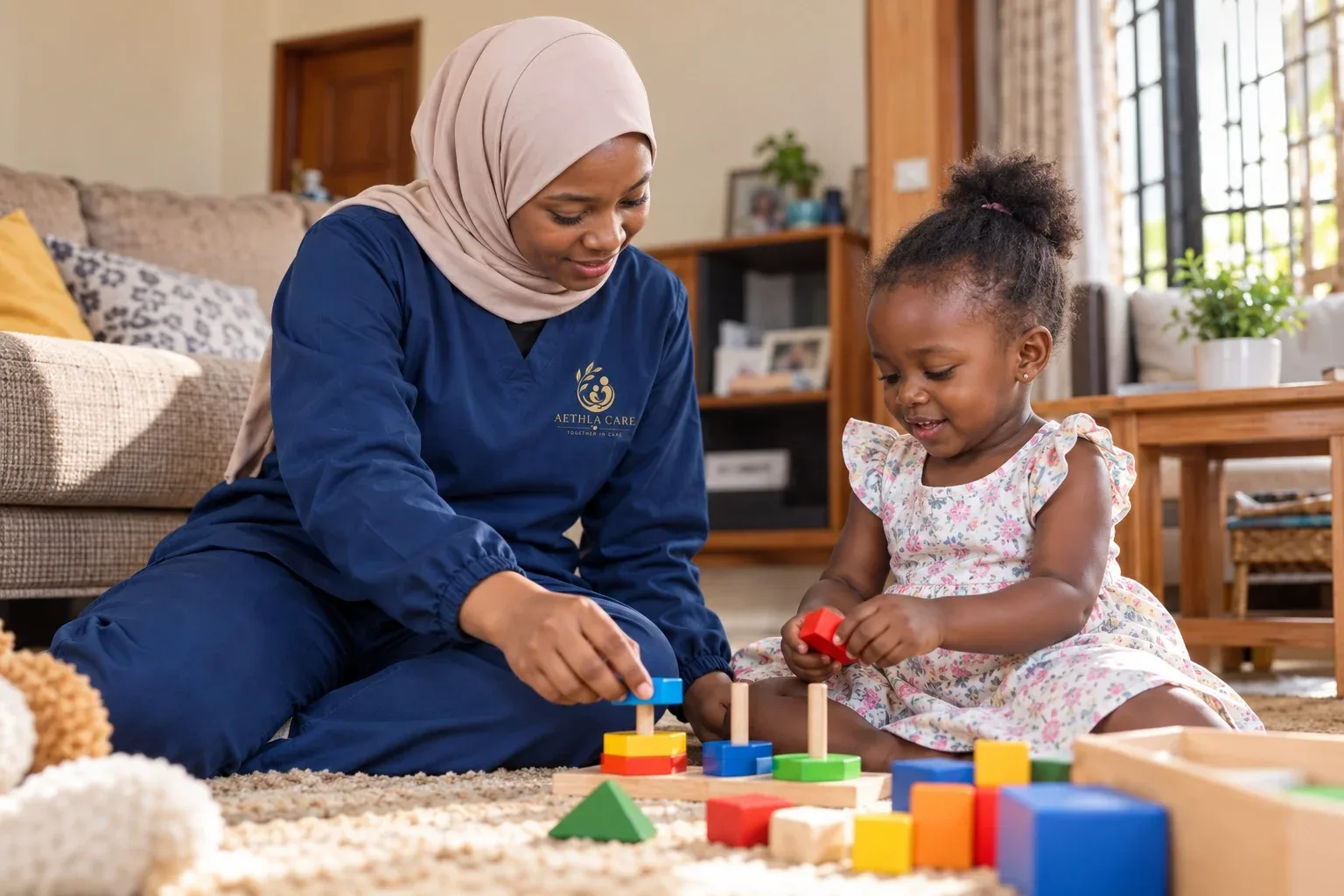
# How to Choose Childcare for Your Family in Uganda: Babysitters, Nannies, Daycare and Family Support
**Primary Keyword:** childcare in Uganda
Secondary Keywords:
- childcare Uganda - babysitter Uganda - babysitters in Kampala - nanny Uganda - nanny services Uganda - childcare services Kampala - reliable babysitter Uganda - how to find a babysitter in Uganda - how to choose a nanny Uganda - daycare Uganda - child care services Kampala - home childcare Uganda - childcare support Kampala - newborn childcare Uganda - family support Uganda - domestic help and childcare Uganda - nanny for newborn Uganda - babysitter for children Uganda - trusted childcare Uganda
**Search Intent:** Informational + commercial investigation + family support
---
# How to Choose Childcare for Your Family in Uganda
Finding the right childcare arrangement is one of the most important decisions a parent can make.
For some families, the solution may be a babysitter who provides occasional support.
For others, it may be a nanny who works regular hours.
Some families may prefer a daycare or early-childhood setting.
Others may need a combination of childcare, domestic assistance and family support.
The challenge is that these options are not interchangeable.
A person who is suitable for occasional babysitting may not be suitable for full-time childcare.
A domestic worker is not automatically a trained childcare professional.
A nanny caring for a newborn has different responsibilities from someone supervising older school-age children.
And childcare is not simply about keeping a child occupied.
Young children need safe environments, responsive caregiving, good health and nutrition, emotional security and opportunities for learning.
The World Health Organization's Nurturing Care Framework identifies five interconnected elements: **good health, adequate nutrition, security and safety, responsive caregiving, and opportunities for early learning**.
Uganda also has a National Integrated Early Childhood Development framework coordinated through the Ministry of Gender, Labour and Social Development. The national ECD system brings together multiple sectors rather than treating early childhood development as the responsibility of one service alone.
For parents, that means choosing childcare should begin with a broader question:
> **What type of care, supervision and environment does my child need, and which childcare arrangement can realistically provide it?**
---
# Quick Answer: How Do You Choose Childcare in Uganda?
Before choosing a babysitter, nanny or daycare, parents should:
1. Identify the child's age and care needs. 2. Decide how many hours of childcare are required. 3. Determine whether care is occasional, part-time or full-time. 4. Decide whether care will happen at home or elsewhere. 5. Define the child's daily routine. 6. Check the caregiver's experience and references. 7. Discuss child-safety expectations. 8. Clarify responsibilities in writing. 9. Establish emergency procedures. 10. Consider feeding, sleep and hygiene arrangements. 11. Understand how the caregiver will support age-appropriate play and learning. 12. Establish how parents will receive updates. 13. Have a clear process if the arrangement is not working. 14. Reassess the arrangement as the child grows.
The most important principle is:
**Choose the childcare arrangement around the child and family's needs, not simply around who happens to be available.**
---
# What Types of Childcare Are Available in Uganda?
Childcare can take several forms.
## Babysitter
A babysitter usually provides temporary or occasional supervision.
Examples might include:
- evening childcare - weekend childcare - supervision while parents attend an event - short-term support - school-holiday assistance
The exact responsibilities should be agreed beforehand.
## Nanny
A nanny generally provides more regular childcare, potentially for several hours each day.
Responsibilities might include:
- supervising children - preparing children's meals - helping with routines - assisting with school preparation - organising play - supporting hygiene routines - communicating with parents
The exact role depends on the employment arrangement.
## Daycare
Daycare provides childcare outside the child's home for defined periods.
Parents should investigate:
- operating arrangements - staffing - child-to-adult ratios where applicable - safety procedures - hygiene - feeding - rest - emergency procedures - communication with parents - policies for illness
## Family or relative support
Some Ugandan families rely heavily on:
- grandparents - aunts - uncles - older relatives - trusted family friends
This can be valuable, but parents should still be clear about responsibilities and child safety.
## Combined family support
Some households need several forms of support.
For example:
**nanny + domestic help + school transport + occasional babysitter**
rather than expecting one person to perform every role.
---
# Babysitter vs Nanny: What's the Difference?
The distinction is primarily about the nature and extent of responsibility.
### Babysitter
Often:
- occasional - shorter periods - temporary supervision - specific dates or times
### Nanny
Often:
- regular - scheduled - longer-term - broader responsibility for daily routines
However, job titles are not enough.
A person calling themselves a “nanny” does not automatically have professional childcare training.
Likewise, someone called a “babysitter” may have significant experience.
Parents should assess the individual rather than relying solely on the title.
---
# Childcare Should Be Age-Appropriate
A six-month-old baby does not have the same needs as a six-year-old.
A newborn may require:
- feeding support - sleep routines - careful hygiene - close supervision - soothing - safe handling
A toddler may need:
- close supervision - play - language interaction - meals - routines - safe exploration
A school-age child may need:
- supervision after school - meals - homework routines - play - school preparation - transport arrangements
The childcare plan should therefore change as the child develops.
---
# Why the Early Years Matter
The early years are a period of rapid development.
WHO states that children need nurturing care to grow and develop optimally, including health, nutrition, safety and security, responsive caregiving and opportunities for learning.
WHO's 2020 early-childhood-development guideline specifically recommends responsive caregiving and opportunities for early learning during the first three years of life.
This does not mean a nanny needs to turn every day into a formal classroom.
Early learning can occur through ordinary activities.
For example:
- talking to a baby - singing - reading - naming objects - playing - responding to the child's signals - allowing safe exploration - involving the child in simple everyday activities
Good childcare is therefore about much more than supervision.
---
# What Is Responsive Caregiving?
Responsive caregiving means noticing a child's signals and responding appropriately.
A young child may:
- cry - smile - reach - look away - become tired - become hungry - show excitement - become distressed
A responsive caregiver learns to notice these signals.
This is especially important for babies who cannot explain what they need using words.
WHO identifies responsive caregiving as a foundational component of nurturing care.
Parents choosing childcare should therefore consider not only:
> “Can this person watch my child?”
but also:
> **“How does this person interact with children?”**
---
# How to Find a Babysitter in Uganda
Parents commonly find babysitters through:
- personal referrals - family networks - community recommendations - childcare organisations - domestic staffing services - care-support platforms - professional networks - local advertisements
However, the method used to find someone does not eliminate the need for checks.
A recommendation can be helpful.
It is not a guarantee.
Before leaving a child with someone, parents should establish who the person is, what experience they have and whether they are suitable for the specific responsibility.
---
# How to Choose a Reliable Babysitter
Ask:
### 1. What experience do you have with children?
Find out:
- ages cared for - length of experience - type of responsibilities - previous childcare environments
### 2. Can references be checked?
Where appropriate, speak to previous families.
### 3. What would you do in an emergency?
Ask the person to explain what they would do if:
- the child falls - the child becomes unwell - the child cannot be reached - there is a household emergency
### 4. How do you handle a crying child?
This can provide useful insight into their approach to children.
### 5. Are you comfortable following our routines?
For example:
- feeding - sleep - screen rules - play - schoolwork - hygiene
---
# How to Choose a Nanny in Uganda
Choosing a nanny requires more consideration because the person may spend significant amounts of time with your children.
Parents should examine:
- experience - references - communication - reliability - childcare knowledge - ability to follow instructions - emergency awareness - understanding of boundaries - compatibility with the household - availability
If the nanny will live in the household, additional considerations apply.
These can include:
- accommodation - working hours - rest periods - privacy - household rules - days off - responsibilities
A live-in arrangement should not be interpreted as unlimited availability.
---
# Questions to Ask a Potential Nanny
Parents can ask:
1. How long have you worked with children? 2. What ages have you cared for? 3. Have you cared for newborns? 4. Have you cared for multiple children? 5. What responsibilities did your previous job involve? 6. Can we contact previous references? 7. How would you respond if a child became unwell? 8. How would you handle a child who is crying? 9. How do you keep children occupied? 10. What activities do you enjoy doing with children? 11. Are you comfortable following our household routines? 12. Are you comfortable communicating concerns to us? 13. Are you comfortable with our expectations around phones and screens? 14. What questions do you have for us?
The final question is often revealing.
Childcare should be a two-way conversation.
---
# What Should Parents Check Before Hiring Childcare?
A basic verification process can include:
## Identity
Confirm the person's identity.
## References
Check relevant previous employment or childcare references.
## Experience
Ask about actual childcare experience rather than accepting general claims.
## Availability
Confirm:
- days - hours - start date - holidays - school terms
## Responsibilities
Write down what the person is expected to do.
## Emergency arrangements
Make sure the caregiver knows:
- parent contact details - emergency contacts - relevant household information - what to do if the child becomes seriously unwell
---
# Childcare Safety: What Parents Should Discuss
Every family should establish basic safety rules.
These may include:
- who is allowed to collect the child - whether visitors are permitted - whether the child can leave the home - whether photos may be taken - whether social media posting is permitted - how medicines are handled - how food allergies are managed - what happens during emergencies - whether the caregiver may use their phone while supervising
These expectations should be discussed before employment begins.
---
# Children and Digital Safety
Parents should also consider phones, cameras and social media.
Discuss:
- whether the caregiver may photograph the child - where photographs can be stored - whether photos may be shared - whether the caregiver can post images online - whether video calls are allowed - how children's personal information is handled
A child's image and personal information should be treated carefully.
Parents should establish clear household rules rather than assuming everyone has the same understanding of privacy.
---
# What About Screen Time?
Parents may have different views about screens.
The important point for a caregiver is consistency.
Parents should explain:
- whether screens are allowed - which programmes are acceptable - when screens may be used - whether phones may be used around the child - whether meals are screen-free - whether screens are allowed before bedtime
The caregiver's role is to follow the family's agreed routine.
---
# Childcare and Early Learning
Childcare does not have to mean formal academic instruction.
Young children can learn through:
- talking - singing - reading - drawing - playing - sorting objects - naming colours - exploring safely - storytelling - everyday household activities
WHO's guidance emphasises responsive caregiving and opportunities for early learning as important elements of nurturing care.
Parents can therefore ask a potential caregiver:
> “What kinds of activities would you normally do with a child of this age?”
The answer may tell you more than a general statement such as “I love children.”
---
# Childcare and Meals
Food responsibilities should be clearly defined.
For young children, parents may need to communicate:
- meal times - foods the child should avoid - allergies - feeding methods - snacks - drinking water - food preparation expectations
For babies, feeding instructions should be followed carefully and parents should communicate any healthcare guidance provided by the child's qualified healthcare team.
A caregiver should not independently change a medically prescribed feeding plan.
---
# Childcare and Sleep
Sleep routines can be particularly important for babies and young children.
Parents should explain:
- usual sleep times - bedtime routine - where the child sleeps - what helps the child settle - what the caregiver should do if the child wakes
For infants, parents should follow current evidence-based safe-sleep guidance and any specific advice from the child's healthcare professional.
A babysitter should not improvise unsafe sleeping arrangements.
---
# Childcare for Newborns
Newborn childcare requires additional care and attention.
Parents should establish:
- feeding routines - sleep arrangements - hygiene - safe handling - visitors - illness precautions - emergency contacts - healthcare contacts
A newborn caregiver should know when to contact the parents and when an urgent medical situation requires professional healthcare.
A nanny should not be expected to diagnose a newborn.
---
# Nanny vs Domestic Worker
This distinction is important for Ugandan families.
A domestic worker may primarily perform:
- cleaning - cooking - laundry - ironing - errands
A nanny may primarily provide:
- childcare - supervision - routines - child-related activities - school preparation
Some employment arrangements combine the roles.
If they do, parents should explicitly discuss the workload.
For example:
> “Cleaning the entire house, cooking every meal, washing all clothes and providing full-time childcare”
may represent a very different workload from:
> “Childcare with light child-related household duties.”
Clear expectations protect both the family and worker.
---
# Can a Maid Also Be a Babysitter?
Sometimes, yes.
But parents should not assume that a domestic worker automatically has the appropriate skills for childcare.
If childcare is part of the role, discuss:
- age of children - number of children - supervision requirements - school transport - feeding - bathing - bedtime - emergency procedures
If the children are infants or have additional needs, the family should assess the person's relevant experience carefully.
---
# Childcare for Children With Disabilities
Children with disabilities may require additional support depending on their individual needs.
WHO and UNICEF's 2026 thematic guidance on nurturing care for children with developmental delays and disabilities emphasises coordinated, family-centred support and strengthening caregiver capabilities.
A childcare provider should therefore understand what the child needs and what their responsibilities actually are.
Depending on the child, this might involve coordination with:
- parents - healthcare professionals - therapists - educators - other support providers
A babysitter should not be expected to replace a therapist or healthcare professional.
---
# What If a Child Has a Medical Condition?
This is another situation where role boundaries matter.
If a child requires:
- regular medical treatment - specialised medication - medical equipment - clinical monitoring - therapy - complex feeding support
parents should establish who is appropriately qualified to provide that support.
A babysitter may be able to provide ordinary supervision.
That does not automatically qualify them to provide clinical care.
---
# Childcare When Parents Work Full-Time
Working parents often need childcare that fits around:
- commuting - school hours - work meetings - travel - early starts - late finishes
Before hiring someone, create a realistic weekly schedule.
For example:
**Monday–Friday**
7:00–9:00 Morning routine and school preparation
9:00–15:00 School/daycare period
15:00–18:30 Collection, snack, homework, play
Evening Parent takes over
The exact schedule will differ by household.
The key is to make the expected hours realistic.
---
# Childcare for School-Age Children
School-age childcare can include:
- school collection - homework supervision - meals - play - activities - preparation for the next school day
Parents should establish whether the caregiver is expected to:
- teach - supervise homework - transport the child - prepare meals - supervise extracurricular activities
These responsibilities should be clearly separated.
A nanny is not automatically a qualified teacher.
---
# Transporting Children
If a caregiver is expected to transport a child, parents should establish:
- who provides the vehicle - who drives - whether the driver is appropriately licensed - safety arrangements - approved destinations - collection permissions - emergency contacts
Transportation should never be treated as an informal addition without discussing responsibility.
---
# Childcare and Emergencies
Every caregiver should know what to do if something unexpected happens.
Parents should provide:
- primary contact - secondary contact - emergency contact - relevant medical information - address - preferred healthcare facility where appropriate
The caregiver should understand the difference between:
**calling the parent**
and
**seeking urgent professional help.**
For a serious emergency, the priority should be appropriate emergency assistance rather than waiting for a parent to respond to a phone call.
---
# How Parents Can Monitor a Childcare Arrangement
Good childcare does not require parents to micromanage every minute.
Instead, establish regular communication.
Parents can ask:
- How did the day go? - Did the child eat? - Did the child sleep? - Was anything unusual? - What activities did they do? - Were there any concerns?
For younger children, these updates can be particularly useful.
For older children, parents should also maintain direct communication with the child.
---
# Warning Signs Parents Should Not Ignore
Parents should investigate concerns such as:
- unexplained injuries - sudden changes in behaviour - repeated unexplained fear - unexplained changes in eating or sleeping - frequent unexplained absences - inappropriate punishment - secrecy around the child's care - caregiver refusing reasonable communication - unexplained changes in household routines
A single unusual event does not necessarily establish wrongdoing.
However, repeated or serious concerns should be addressed promptly.
Where there is an immediate safety concern, prioritise the child's safety and seek appropriate help.
---
# What Makes Good Childcare?
Good childcare is not simply:
> “Someone is watching the child.”
Good childcare should provide an environment where the child is:
- safe - appropriately supervised - cared for - listened to - supported - encouraged to learn - treated respectfully
WHO's nurturing-care approach places safety, health, nutrition, responsive caregiving and early learning together rather than treating them as completely separate areas.
---
# How Much Does Childcare Cost in Uganda?
There is no single nationwide childcare price.
Costs can vary according to:
- location - child's age - hours - number of children - live-in/live-out arrangement - experience - responsibilities - transport - specialist requirements - daycare versus home-based care
Parents should compare arrangements based on what is actually included.
A lower quoted price may reflect fewer hours or fewer responsibilities.
A higher price may include additional services.
The correct comparison is therefore:
> **What are we receiving for the agreed cost?**
---
# Childcare in Kampala, Wakiso, Entebbe and Mukono
Families searching for:
- babysitters in Kampala - nannies in Kampala - childcare in Wakiso - childcare in Entebbe - childcare in Mukono
should still verify the actual service location.
A provider saying it serves “Uganda” does not necessarily mean a particular caregiver is currently available in every district.
Aethla Care currently identifies **Kampala, Wakiso, Entebbe and Mukono** as its early service footprint, while asking families outside those areas to provide their location and support requirement so availability can be assessed.
This is particularly important for local search.
Parents should look for:
- actual service areas - clear contact information - identifiable provider roles - current availability - transparent responsibilities
rather than relying only on a generic “we serve Uganda” statement.
---
# How Aethla Care Approaches Childcare
Aethla Care positions itself as a coordination point rather than simply a directory of unrelated providers.
Its broader platform brings together:
- childcare - home support - elderly care - healthcare navigation - mobility support - family coordination
The purpose is to help families explain the situation and identify the practical next step rather than forcing every need into one service category.
This can be particularly useful when a family has several connected needs.
For example:
> “We have a newborn, both parents work, grandmother lives with us and we also need occasional transport support.”
That is not simply a “babysitter” question.
It is a family-support question.
---
# What Aethla Care Can and Cannot Do
Aethla's model distinguishes between different service roles.
Support may be:
- directly operated - coordinated - delivered by a partner - information-only
The specific route should be clarified before the family proceeds.
Aethla is not a hospital or clinic, and childcare coordination should not be confused with medical treatment.
Where a child requires clinical care, appropriately qualified healthcare professionals remain responsible for clinical decisions.
---
# When Parents Should Consider More Than One Service
A family may need several types of support simultaneously.
### Example 1: Working parents
- nanny - household assistance - occasional babysitter
### Example 2: New baby
- newborn support - household help - postnatal family support
### Example 3: Child and elderly grandparent
- childcare - domestic support - elderly support - appointment coordination
### Example 4: Parent living overseas
- local childcare - household support - family communication - local coordination
A platform that can understand the whole family situation may be more useful than searching for every service independently.
---
# Childcare Checklist for Ugandan Parents
Before hiring a babysitter or nanny:
### About the child
- [ ] What is the child's age? - [ ] What routine does the child follow? - [ ] What does the child eat? - [ ] What are the sleep arrangements? - [ ] Are there allergies or medical needs?
### About the caregiver
- [ ] What childcare experience do they have? - [ ] Have references been checked? - [ ] Is their identity verified? - [ ] Are they comfortable with the child's age? - [ ] Can they explain how they handle emergencies?
### About the job
- [ ] What hours are required? - [ ] Is it live-in or live-out? - [ ] Are household duties included? - [ ] Is transport included? - [ ] Are school runs included?
### Safety
- [ ] Who can collect the child? - [ ] What are the visitor rules? - [ ] What are the photo/social-media rules? - [ ] What happens in an emergency? - [ ] Who should be contacted?
### Communication
- [ ] How will parents receive updates? - [ ] What issues should be reported immediately? - [ ] How often will the arrangement be reviewed?
---
# Frequently Asked Questions About Childcare in Uganda
## How do I find a babysitter in Uganda?
Families can use referrals, childcare networks, staffing services, care organisations and other trusted sources. Regardless of how the babysitter is found, parents should verify identity, experience, references and suitability.
## How do I find a babysitter in Kampala?
Start by defining the hours and responsibilities, then look for a provider or caregiver who can actually serve your location and schedule. Check references and clearly agree the role before childcare begins.
## What is the difference between a babysitter and a nanny?
A babysitter is commonly used for occasional or temporary childcare, while a nanny generally provides more regular and ongoing childcare. The actual responsibilities should be agreed rather than assumed from the title.
## What should I ask a nanny before hiring?
Ask about childcare experience, ages cared for, previous responsibilities, references, emergency procedures, availability and how they approach children's routines and behaviour.
## Can a domestic worker also be a nanny?
Potentially, if childcare is explicitly included in the employment arrangement and the person is suitable for the responsibility. Parents should avoid adding substantial childcare duties without discussing the workload and expectations.
## Can a nanny look after a newborn?
A nanny with relevant newborn experience may provide childcare, but parents should verify their experience and establish clear feeding, sleep, hygiene and emergency procedures. Clinical care should remain with appropriately qualified healthcare professionals.
## What is the best childcare option in Uganda?
There is no single childcare arrangement that is right for every family. Parents should compare babysitting, nanny, daycare, family and combined-support options based on the child's age, family schedule, safety needs and practical circumstances.
## How much does a nanny cost in Uganda?
There is no single nationwide rate. Costs depend on location, hours, experience, responsibilities, live-in or live-out arrangements and other conditions.
## Can a babysitter take my child to school?
They may, if transportation is explicitly part of the arrangement and appropriate safety, driver and vehicle requirements are satisfied.
## Can a babysitter give medicine to a child?
Parents should be very clear about any medication responsibilities and should not assume that a babysitter has clinical qualifications. For medical treatment or specialised medication requirements, follow the child's healthcare professional's instructions.
## Can Aethla Care help me find childcare in Uganda?
Aethla Care's integrated family-support model includes childcare and practical family support. Families can explain their needs, location and circumstances so the appropriate route can be clarified where available.
## Does Aethla Care provide medical care for children?
Aethla Care is not a hospital or clinic. Where a child requires clinical assessment or treatment, appropriately qualified healthcare professionals should provide that care.
## Can someone living abroad arrange childcare in Uganda?
Families living overseas can coordinate practical family support in Uganda, but the child's exact needs, location and available service route should be established before arrangements are made.
---
# A Simple Childcare Decision Framework
If you are unsure what type of childcare you need, start here.
### If you need occasional supervision
Consider a **babysitter**.
### If you need regular childcare at home
Consider a **nanny**.
### If you need childcare outside the home
Consider a **daycare or early-childhood setting**.
### If your household needs cleaning and childcare
Consider whether you need **separate domestic and childcare responsibilities** or a carefully defined combined role.
### If your child has additional needs
Consider **specialised support and professional coordination** where appropriate.
### If your family has several connected needs
Consider a **family-support or care-coordination route** rather than searching for each service separately.
---
# Childcare Should Support the Whole Family
Parents sometimes think of childcare as simply solving the question:
> “Who will watch my child while I am at work?”
But good family support can be broader.
It can help parents manage:
- work - school - household routines - appointments - newborn care - elderly relatives - transport - family responsibilities
That is why Aethla Care's model connects childcare with broader home and family support rather than treating every family need as a completely separate service.
The goal is not to replace parents.
It is to help families organise appropriate support around them.
---
# Final Thoughts: Choosing Childcare in Uganda
Choosing childcare is ultimately a decision about trust, safety, responsibility and fit.
Whether you are looking for a:
- babysitter - nanny - newborn caregiver - daycare - domestic helper with childcare duties - family-support service
the same basic principles apply:
**Know what your child needs.**
**Define the job clearly.**
**Check who you are hiring.**
**Verify relevant experience and references.**
**Establish safety procedures.**
**Keep communication open.**
**Know where childcare ends and professional healthcare begins.**
Uganda's national early-childhood-development framework recognises that children's development involves multiple sectors and forms of support.
WHO's evidence-based guidance similarly places health, nutrition, safety, responsive caregiving and early learning within the broader concept of nurturing care.
For parents, this means childcare should be viewed as more than supervision.
The right childcare arrangement should create a safe, supportive environment in which children can grow, learn and develop while parents have confidence that their household responsibilities are being managed appropriately.
For families in **Kampala, Wakiso, Entebbe, Mukono and other parts of Uganda**, the first step is to explain the actual situation rather than simply searching for the word “nanny” or “babysitter.”
Tell the provider:
- your child's age - where you live - the hours you need - the type of childcare required - any special considerations - whether domestic help is also needed - whether other family members require support
From there, the appropriate childcare and family-support route can be explored.
**Aethla Care — Trusted Care for Every Stage of Life.**
---
# Factual References
### Uganda Ministry of Gender, Labour and Social Development — National Integrated Early Childhood Development
Uganda established the National Integrated Early Childhood Development Secretariat under the Ministry of Gender, Labour and Social Development to coordinate implementation of the country's integrated ECD policy framework.
### Uganda Ministry of Gender, Labour and Social Development — National Child Policy
The Ministry lists Uganda's National Child Policy 2020 among its national policy documents relating to children.
### World Health Organization — Improving Early Childhood Development
WHO's 2020 guideline recommends responsive caregiving and opportunities for early learning, particularly during the first three years of life, alongside other interventions supporting children's development.
### WHO / UNICEF / World Bank — Nurturing Care Framework
The Nurturing Care Framework identifies health, nutrition, security and safety, responsive caregiving and opportunities for early learning as interconnected requirements for young children's development.
### WHO — Children With Developmental Delays and Disabilities
WHO and UNICEF's 2026 thematic guidance emphasises nurturing care and coordinated, family-centred support for children with developmental delays and disabilities.
### Aethla Care — Integrated Family Support
Aethla Care describes its platform as a coordination point connecting childcare, home support, healthcare navigation, elderly support and mobility needs, with clear distinctions between operated, coordinated, partner and information-only routes.
---
## Childcare and Health Information Note
This article provides general information about childcare and family support in Uganda. It is not medical advice, child-development diagnosis, legal advice or a substitute for professional assessment.
Children's needs differ according to age, development, health and family circumstances. Where a child has a medical condition, developmental concern, disability or other specialised need, parents should seek advice from an appropriately qualified professional.
Childcare providers, caregiver availability, costs, operating arrangements and geographic coverage can change. Families should verify current details before making an employment or service decision.
Where there is an immediate concern about a child's safety or health, seek appropriate urgent professional assistance.