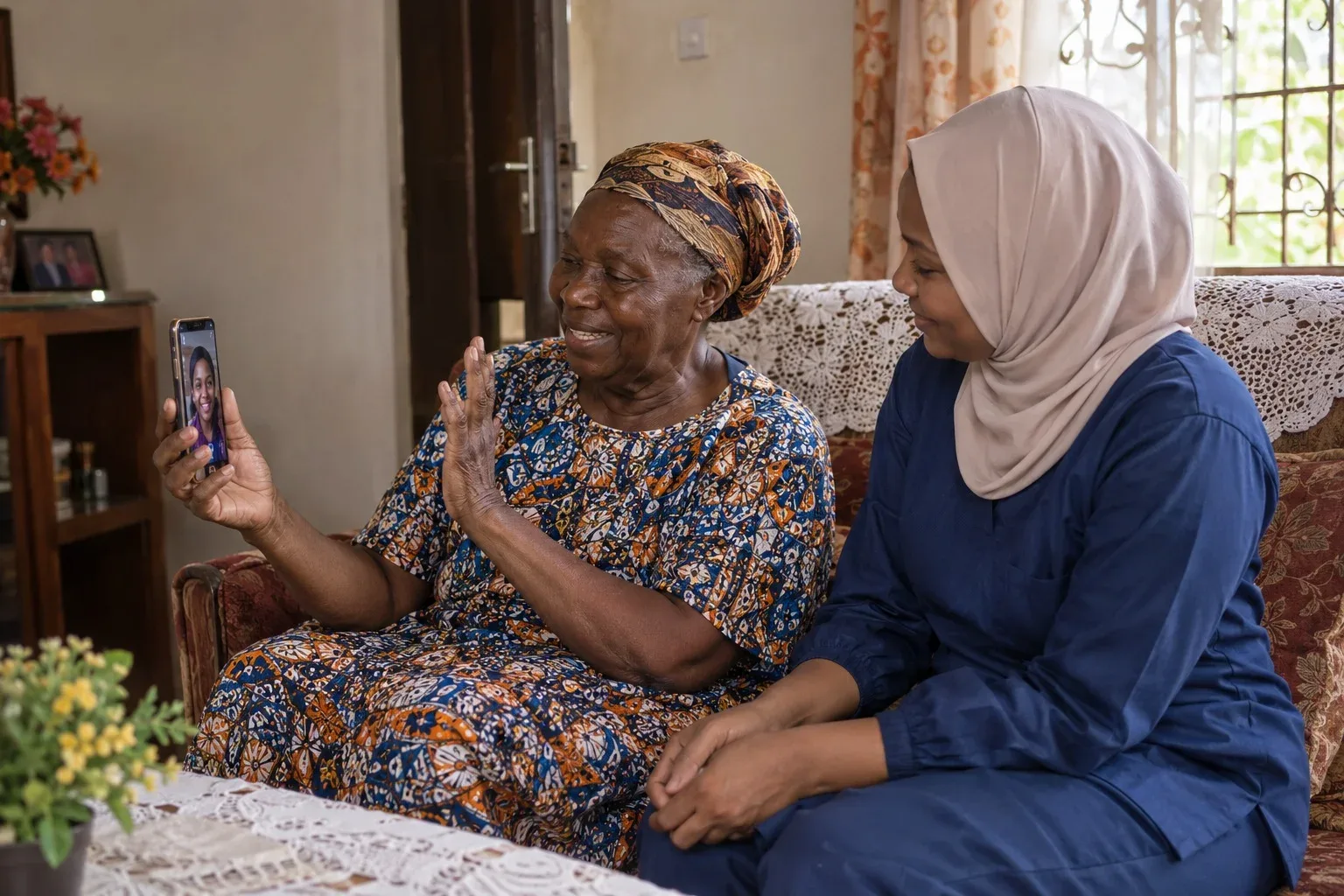
# How to Care for an Ageing Parent in Uganda When You Live Abroad: A Complete Diaspora Family Guide
**Primary Keyword:** care for ageing parent in Uganda from abroad
Secondary Keywords:
- care for parents in Uganda from abroad - elderly care Uganda from abroad - caring for parents in Uganda - care for parents in Uganda - Uganda diaspora elderly care - home care for parents in Uganda - elderly care Kampala - care for elderly parents in Uganda - healthcare for parents in Uganda - arrange care for parents in Uganda - care coordination Uganda - parent care Uganda - elderly support Uganda - care for parents from Australia - care for parents from UK - care for parents from USA - care for parents from Canada - Ugandan diaspora care - remote family care Uganda
**Search Intent:** Informational + high-intent service research + diaspora family coordination
---
# How to Care for an Ageing Parent in Uganda When You Live Abroad
Caring for an ageing parent in Uganda when you live overseas can be difficult for one simple reason:
**You cannot always be physically present when something needs to be done.**
You may live in Australia, the United Kingdom, the United States, Canada, the UAE, South Africa or another country while your parent lives in Kampala, Wakiso, Entebbe, Mukono or elsewhere in Uganda.
You may call regularly.
You may send money.
You may speak with relatives.
You may help arrange hospital appointments.
But there are some things that require someone on the ground.
Who takes your parent to an appointment?
Who checks whether they got home safely?
Who helps with household routines?
Who coordinates transport?
Who notices when their needs have changed?
Who helps after hospital discharge?
Who keeps you informed?
These are not necessarily medical questions.
They are often **care-coordination questions**.
That distinction is important.
The World Health Organization's current Integrated Care for Older People (ICOPE) guidance promotes person-centred assessment, identification of social-care and support needs, personalised care planning, implementation and monitoring. It also gives greater attention to community-level involvement and support for carers.
For Ugandan families living abroad, the practical challenge is translating that principle into everyday life:
> **How do you organise appropriate support for a parent in Uganda when you are thousands of kilometres away?**
The answer usually begins with a care plan—not with a single caregiver.
---
# Quick Answer: How Do I Care for My Parent in Uganda From Abroad?
A practical approach is to:
1. Understand your parent's current situation. 2. Speak directly with your parent about what they want. 3. Identify what has changed. 4. Separate medical needs from practical support. 5. Identify trusted people already involved. 6. Establish your parent's location and living situation. 7. Determine whether home support is needed. 8. Plan appointments and transportation. 9. Establish a communication system. 10. Verify any caregiver or service provider. 11. Create an emergency and escalation plan. 12. Review the arrangement regularly.
The key is to avoid trying to manage everything remotely through scattered phone calls.
Instead, create **one clear care picture**.
---
# Why Caring for Parents From Overseas Is Different
When you live in Uganda, you may be able to respond quickly to everyday situations.
You might be able to:
- visit your parent - accompany them to hospital - buy groceries - organise household help - speak directly with a doctor - check the home - arrange transport - notice changes in their mobility or wellbeing
Distance removes many of those options.
An overseas family member can still coordinate and support a parent financially and emotionally, but physical tasks require a local solution.
This is why diaspora care is not simply about sending money.
It is about creating a **reliable local support structure**.
---
# The First Question: What Does Your Parent Actually Need?
Avoid starting with:
> “I need someone to look after my mother.”
That statement is too broad.
Instead ask:
### Daily life
- Can Mum prepare meals? - Can she clean? - Can she shop? - Can she manage her normal routine?
### Mobility
- Can she walk safely? - Does she need help getting to appointments? - Does she use mobility equipment?
### Healthcare
- Does she have regular appointments? - Does she need specialist care? - Has she recently left hospital?
### Social needs
- Does she spend long periods alone? - Does she have regular contact with family or friends?
### Household
- Is the home being maintained? - Is there someone helping with errands?
### Family
- Who currently checks on her? - Who is the local emergency contact?
These answers will help determine what kind of support is actually required.
---
# Talk to Your Parent Before Designing Their Care
One of the most important principles of ageing support is person-centred care.
WHO's ICOPE approach emphasises active involvement of the older person, family and caregivers in developing personalised care plans.
This means your parent should not simply become the subject of a family discussion happening thousands of kilometres away.
Ask:
- What would make life easier? - What help would you welcome? - What help would you dislike? - Do you want someone coming into your home? - Would you prefer a few hours of assistance? - Would you like someone to accompany you to appointments? - Which routines are important to you? - What do you want to continue doing independently?
An ageing parent may need support without wanting to feel that they have lost independence.
That distinction matters.
---
# Do Not Assume That Age Automatically Means Full-Time Care
Getting older does not automatically mean someone needs a full-time caregiver.
An older person may remain independent while needing occasional assistance with:
- shopping - household tasks - transport - appointments - errands - companionship
Another person may need daily support.
Another may have significant medical or functional needs requiring professional healthcare.
The right level of support should therefore be based on the person's circumstances.
Uganda's Ministry of Gender, Labour and Social Development maintains national guidelines on healthy ageing, while the National Council for Older Persons has a statutory role relating to the welfare and service delivery of older people.
---
# Create a Simple Parent Care Assessment
If you live overseas, write down the following.
## 1. Parent
- Name - Age - Location - Living arrangements - Preferred contact method
## 2. Daily activities
- Cooking - Cleaning - Shopping - Laundry - Personal routines - Mobility
## 3. Healthcare
- Current healthcare provider - Regular appointments - Specialists - Recent hospitalisation - Follow-up requirements
## 4. Family
- Local relatives - Neighbours - Friends - Primary contact - Overseas family members
## 5. Practical support
- Household help - Caregiver - Transport - Appointment support - Errands
## 6. Emergencies
- Who should be contacted? - Where should your parent go? - Who can reach them locally?
This simple document can become the foundation of the family's care plan.
---
# Understand the Difference Between Care and Healthcare
This is one of the most important distinctions for diaspora families.
### Practical care may involve:
- companionship - household routines - errands - shopping - appointment coordination - transport - family communication
### Healthcare may involve:
- diagnosis - treatment - nursing procedures - clinical assessment - rehabilitation - medication decisions - specialist management
These are not the same thing.
A family coordinator or caregiver should not replace a doctor, nurse, therapist or other qualified healthcare professional.
Uganda's 2024 National Essential Health Care Package provides a national framework for planning and investment in healthcare services and is aligned with Uganda's broader universal-health-coverage objectives.
For diaspora families, the practical lesson is:
> **Coordinate healthcare; do not attempt to provide healthcare remotely yourself.**
---
# What If Your Parent Needs a Doctor?
If your parent reports a health problem, the first question should be:
**Does this require urgent medical attention?**
If yes, appropriate urgent healthcare should take priority.
If it is a routine concern, the next steps may include:
- identifying an appropriate healthcare facility - contacting an existing healthcare provider - arranging an appointment - organising transport - ensuring your parent has relevant documents - arranging someone to accompany them if necessary
Aethla Care's healthcare-navigation service can help families explore specialist appointment routes and practical coordination, while clinical decisions remain with qualified healthcare professionals.
---
# Arranging Specialist Appointments From Abroad
This can be particularly difficult when you are overseas.
A parent may say:
> “The doctor told me to see a specialist.”
But you may not know:
- which specialist - where to go - what referral is required - what documents are needed - whether an appointment has actually been confirmed - how your parent will get there
A practical process is:
### Step 1
Understand the reason for the specialist visit.
### Step 2
Establish whether there is a referral or existing recommendation.
### Step 3
Identify an appropriate provider or facility.
### Step 4
Confirm the appointment.
### Step 5
Arrange transport if required.
### Step 6
Ensure relevant records and documents are available.
### Step 7
Arrange follow-up and communicate the outcome to the family.
Aethla's healthcare-navigation model specifically separates appointment coordination from clinical decision-making.
---
# Do Not Confuse an Appointment Request With a Confirmed Appointment
This is especially important when coordinating care remotely.
A website, WhatsApp message or enquiry does not automatically mean a doctor has confirmed an appointment.
Families should establish:
- provider - facility - date - time - location - appointment confirmation - documents required
Aethla does not display live specialist availability unless connected to a relevant scheduling system; where appropriate, its coordinator confirms requests with the provider or partner.
This is a useful distinction for anyone arranging healthcare for a parent from overseas.
---
# How to Arrange Transport for an Elderly Parent in Uganda
Transportation can become a major challenge as a parent ages.
Your parent may be able to attend an appointment but not be comfortable travelling alone.
Consider:
- distance - mobility - vehicle accessibility - appointment time - whether an accompanying person is required - return journey - waiting time
A transport plan should answer:
**Who picks Mum up?**
**Where do they take her?**
**Who stays with her?**
**How does she get home?**
This is particularly important for:
- specialist appointments - hospital visits - rehabilitation - post-discharge follow-up - diagnostic appointments
---
# Post-Hospital Care When You Live Overseas
Hospital discharge can be one of the most difficult moments for diaspora families.
Your parent may suddenly need:
- help at home - transport - follow-up appointments - rehabilitation - household assistance - caregiver support - family monitoring
The Ministry of Health's health-service standards emphasise discharge planning and communication around transitions between healthcare and other support. Uganda's National Essential Health Care Package also provides a framework for national healthcare delivery.
Before your parent leaves hospital, ask:
- What happens after discharge? - What follow-up is required? - Who will take the parent home? - What practical support is needed? - Does the parent require professional care? - Who should be contacted if the condition changes?
Do not wait until your parent is already home to begin planning.
---
# How to Care for a Parent Living Alone in Uganda
Living alone does not automatically mean that an older person cannot remain independent.
But it does mean families should consider how support will work.
A practical plan may include:
### Daily
- phone contact - meal support - household assistance where needed
### Weekly
- in-person check - shopping - appointments - errands
### As required
- transport - specialist appointments - home visits - post-hospital support
### Emergency
- local contact - healthcare contact - family escalation
The appropriate frequency depends on the individual.
---
# How to Monitor an Elderly Parent From Overseas
Remote monitoring should not mean constant surveillance.
It can simply mean establishing predictable communication.
For example:
**Parent → local contact → overseas family**
Or:
**Parent → care coordinator → family**
The family might agree that:
- urgent issues are reported immediately - appointment updates are sent after visits - routine updates happen weekly - significant changes trigger a family review
This reduces the chance that information becomes fragmented between multiple relatives.
---
# What If Several Family Members Are Involved?
Large Ugandan families may have several people involved in supporting an older parent.
That can be helpful.
But it can also create confusion.
One sibling may believe another has:
- arranged transport - paid a bill - booked the appointment - checked the home - contacted the doctor
A simple responsibility matrix can help.
| Responsibility | Person | |---|---| | Primary local contact | Relative A | | Overseas family contact | Daughter | | Appointments | Coordinator/relative | | Transport | Assigned provider | | Household support | Caregiver/domestic support | | Emergency escalation | Family contact |
The exact structure depends on the family.
The purpose is simply to remove ambiguity.
---
# Caring for Parents in Uganda From Australia
Families in Australia may face substantial time-zone differences and long travel distances.
A practical approach is to establish a local care contact who can handle tasks that cannot wait for an overseas family member.
You can still remain involved in:
- care decisions - finances - communication - appointment discussions - family planning
But local tasks should have local responsibility.
Aethla Care's diaspora-care pathway is designed to allow families outside Uganda to explain a care need and explore practical coordination in Uganda.
---
# Caring for Parents in Uganda From the UK
The same principle applies to families living in the UK.
Start by documenting:
- parent's location - current health and support situation - local relatives - household needs - appointments - mobility - desired level of communication
Then determine what requires physical presence in Uganda.
---
# Caring for Parents in Uganda From the USA
For families in the United States, distance can make direct involvement particularly difficult.
A local coordination structure can help with practical matters such as:
- home support - appointments - transport - family communication - elderly support
However, medical decisions should remain with qualified healthcare professionals and the family.
---
# Caring for Parents in Uganda From Canada
Canadian-based families can use the same framework:
**Assess → plan → coordinate → communicate → review.**
Do not begin by hiring a person simply because someone recommended them.
First determine the actual need.
---
# Caring for Parents in Uganda From the UAE
For Ugandans living in the UAE, travel to Uganda may be easier than from some other countries, but physical distance still exists.
A local support structure can be valuable when:
- you are working - you cannot travel immediately - your parent needs regular appointments - there is no close relative nearby
---
# Caring for Parents in Uganda From South Africa
South Africa-based family members may also need local coordination for relatives in Uganda.
The key is not the country you live in.
The key is the **gap between your physical location and your parent's daily needs**.
---
# How to Arrange a Caregiver for Your Parent in Uganda
If your parent genuinely needs regular personal or daily support, define the role first.
Ask:
- What tasks are required? - How many hours? - What experience is needed? - Is personal care involved? - Is mobility assistance required? - Is companionship required? - Are appointments involved? - Does the caregiver need to live in?
Then establish:
- identity - experience - references - responsibilities - working arrangements - communication - supervision
A “caregiver” should not automatically be expected to provide nursing care.
---
# What About a Maid?
Sometimes the parent does not actually need a caregiver.
They may simply need:
- cleaning - cooking - laundry - shopping - errands
In that case, domestic support may be appropriate.
The distinction is important because adding medical or personal-care responsibilities to a domestic-worker role can create an inappropriate arrangement.
---
# What If My Parent Needs Both a Maid and a Caregiver?
This is possible.
For example:
### Domestic support
- cleaning - cooking - laundry
### Care support
- companionship - mobility support - daily routines
### Healthcare
- professional nursing - doctor appointments - rehabilitation
### Mobility
- transport - appointment accompaniment
These services can be coordinated as separate components.
Trying to make one person responsible for all four categories may not be appropriate.
---
# Caring for an Elderly Parent With a Disability
An older person may also have mobility or disability-related needs.
Uganda's healthcare planning recognises rehabilitation and related support within the wider health system.
WHO's ICOPE approach also considers domains including cognition, mobility, vitality, vision, hearing and psychological capacity as part of a broader assessment of older people's functioning.
Families should therefore consider:
- mobility - accessibility - transport - home environment - rehabilitation - communication - personal support
The exact requirements should be assessed individually.
---
# What If Your Parent Has Multiple Health Conditions?
Older adults can have more than one health condition.
That can make coordination harder.
You may have:
- one specialist - another specialist - a primary healthcare provider - medications - laboratory appointments - rehabilitation - transport requirements
WHO's ICOPE framework specifically supports integrated, person-centred approaches for older people rather than fragmented care pathways.
For families, that means maintaining a central record of:
- appointments - providers - important documents - family contacts - support arrangements
can be useful.
---
# Create a Parent Care Folder
Whether digital or physical, maintain a central folder containing:
### Identification
- relevant identification information - emergency contacts
### Healthcare
- provider information - appointment details - referral documents - relevant medical records
### Family
- local contacts - overseas contacts
### Care
- caregiver details - domestic support - transport arrangements
### Communication
- preferred family update method
The goal is not to create unnecessary paperwork.
It is to avoid searching through dozens of WhatsApp messages when something important happens.
---
# Using WhatsApp for Family Care Coordination
WhatsApp is widely used for family communication in Uganda.
A family group can be useful for:
- appointment reminders - transport arrangements - updates - family decisions - practical coordination
But sensitive information should be handled thoughtfully.
Families should also avoid assuming that a WhatsApp message is equivalent to a formal healthcare record.
Important medical documents should be stored appropriately.
---
# How Often Should You Call Your Parent?
There is no universal number.
The appropriate frequency depends on:
- independence - health - living situation - support available - family preference
The important thing is consistency.
For example:
**Daily:** brief check-in
**Weekly:** longer conversation
**Monthly:** care review
Again, this is an example rather than a universal prescription.
---
# Signs That Your Parent's Support Needs May Be Changing
Families living overseas should pay attention to changes such as:
- missed appointments - difficulty managing household tasks - increasing dependence on neighbours - repeated falls - difficulty getting around - unexplained weight changes - increasing isolation - frequent hospital visits - confusion about routine matters - inability to manage previously familiar activities
These observations do not establish a diagnosis.
They indicate that the family's support plan may need review.
---
# What Should You Do If Your Parent Refuses Help?
This can be emotionally difficult.
An older person may say:
> “I don't need anyone.”
Avoid treating independence as a problem that needs to be defeated.
Start by asking:
**What kind of help would feel acceptable?**
Perhaps your parent does not want a full-time caregiver.
But they may accept:
- a cleaner - someone to help with shopping - transport to appointments - occasional companionship
Small changes can sometimes be easier to accept than a major change in routine.
Person-centred care means involving the older person rather than designing everything around them without their participation.
---
# What If Your Parent Is Not Safe at Home?
This is where families should seek appropriate professional advice.
If there are serious concerns involving:
- repeated falls - major functional decline - significant confusion - inability to manage essential activities - serious medical problems
do not rely solely on a domestic worker or informal family arrangement.
A healthcare professional may need to assess the situation.
The appropriate solution may involve additional home support, rehabilitation, medical care, environmental changes or another care arrangement.
---
# How Aethla Care Can Support Diaspora Families
Aethla Care's diaspora-care model is designed for families who live outside Uganda but need to coordinate practical support for relatives in Uganda.
The family can explain:
- who needs support - where they live - what has changed - what help is already available - what additional help may be required
From there, the care route can be clarified.
Depending on the situation, this may involve:
- elderly support - home support - appointment coordination - healthcare navigation - transport and mobility support - family communication - practical coordination
Aethla does not make clinical decisions on behalf of the family or replace qualified healthcare professionals.
---
# What Makes Care Coordination Different From a Caregiver?
A caregiver performs agreed care tasks.
A coordinator helps organise the broader picture.
For example, imagine your mother needs:
- a specialist appointment - transport - household support - a family update
A caregiver might help with some daily tasks.
A coordinator may help organise the different components.
This distinction can be particularly valuable when the primary family member is overseas.
---
# Aethla Care's Role in Diaspora Care
Aethla's wider model is designed around four possible roles:
### Operated
Aethla directly provides the service where applicable.
### Coordinated
Aethla helps organise support.
### Partner delivered
A suitable independent partner may deliver a service.
### Information only
Aethla provides information to help the family understand possible options.
The actual role should be confirmed before any service begins.
---
# Where Can Diaspora Families Request Support?
Aethla currently highlights an early service footprint covering:
- Kampala - Wakiso - Entebbe - Mukono
For families elsewhere in Uganda, the location and care requirement can be submitted so the available route can be assessed.
This is important because “care in Uganda” does not mean that every type of support is automatically available in every district.
---
# A Step-by-Step Diaspora Care Plan
Here is a practical process families can use.
## Step 1: Talk to your parent
Understand what they want.
## Step 2: Assess the current situation
Identify practical and healthcare needs.
## Step 3: Map existing support
Who is already helping?
## Step 4: Identify gaps
What still needs to be done?
## Step 5: Separate roles
Domestic help?
Caregiver?
Nurse?
Transport?
Specialist?
Coordinator?
## Step 6: Establish local responsibility
Who can physically respond?
## Step 7: Establish overseas responsibility
Who manages communication and decisions?
## Step 8: Document important information
Keep the key details together.
## Step 9: Arrange support
Use appropriate and verified providers.
## Step 10: Review
Care needs can change.
---
# Diaspora Parent-Care Checklist
Before arranging support, check:
### Parent
- [ ] Parent's wishes understood - [ ] Current living situation known - [ ] Current support identified - [ ] Mobility considered - [ ] Healthcare needs documented
### Family
- [ ] Local contact identified - [ ] Overseas contact identified - [ ] Emergency contact established - [ ] Communication method agreed
### Services
- [ ] Domestic support considered - [ ] Caregiver support considered - [ ] Healthcare needs separated - [ ] Transport considered - [ ] Appointment needs considered
### Verification
- [ ] Provider identity checked - [ ] Experience reviewed - [ ] References considered - [ ] Responsibilities agreed
### Review
- [ ] Regular review scheduled - [ ] Changes reported - [ ] Emergency escalation understood
---
# Frequently Asked Questions
## How can I care for my elderly parent in Uganda while living abroad?
Start by understanding your parent's needs, identifying local support and creating a clear system for appointments, household assistance, transport, communication and emergencies.
## Can I arrange elderly care in Uganda from Australia?
Yes. A family member in Australia can coordinate practical support for a parent in Uganda. The specific service and availability should be confirmed based on the parent's location and needs.
## How can I care for my parents in Uganda from the UK?
Establish what your parents need locally, identify a trusted local contact and coordinate appropriate household, elderly, healthcare-navigation and mobility support where required.
## How can I arrange care for my parents in Uganda from the USA?
Begin with an assessment of your parents' actual needs and establish a local support structure. This may involve home support, elderly care, appointments, transport and family coordination.
## Can I arrange care for my parents in Uganda from Canada?
Yes. The same care-coordination approach can be used: assess, plan, coordinate, communicate and review.
## Can someone check on my parent at home?
Depending on the available service route, practical home-support or elderly-care arrangements may be possible. The exact service should be confirmed based on location and need.
## Can someone take my parent to a hospital appointment?
Appointment and mobility support can potentially be coordinated depending on the circumstances and available provider route.
## Can someone arrange a specialist appointment for my parent?
Aethla's healthcare-navigation service can help families explore specialist appointment requests and practical coordination. Appointment confirmation remains subject to the relevant healthcare provider.
## Can Aethla Care provide medical advice to my parent?
No. Clinical assessment, diagnosis and treatment remain the responsibility of appropriately qualified healthcare professionals.
## Can Aethla Care arrange a caregiver for my parent?
Aethla can help families explore elderly-care and practical support routes where available. The exact role, provider and service arrangement should be confirmed before proceeding.
## Can Aethla Care help if I live outside Uganda?
Yes. Aethla has a diaspora-care pathway specifically intended for families outside Uganda who need to coordinate practical support for relatives in Uganda.
## What if my parent lives outside Kampala?
Aethla's current early footprint highlights Kampala, Wakiso, Entebbe and Mukono. Families outside those areas can provide their location and care requirements so the appropriate route can be checked.
## How much does elderly care in Uganda cost?
There is no single nationwide price. Costs depend on the type of support, location, hours, qualifications, transport and other requirements.
## What if my parent refuses a caregiver?
Start by understanding why. Your parent may be willing to accept a smaller form of support, such as help with shopping, transport or household tasks, rather than full-time care.
---
# A Simple Example of Diaspora Care Coordination
Imagine a daughter living in Melbourne whose 78-year-old mother lives in Kampala.
Her mother:
- lives alone - still manages most daily activities - needs occasional household assistance - has two specialist appointments each year - no longer likes travelling alone - has a nearby relative who can help occasionally
The daughter does not necessarily need to hire a live-in caregiver.
A more appropriate support structure might involve:
**Household support**
Someone helps with agreed domestic routines.
**Appointment support**
Someone coordinates or accompanies the parent when required.
**Transport**
A suitable journey is arranged for important appointments.
**Family contact**
The local relative provides additional support.
**Overseas communication**
The daughter receives agreed updates.
This example illustrates why care planning should start with the actual need.
---
# What Happens When Care Needs Increase?
A care plan should be capable of changing.
Perhaps your parent initially needs:
**monthly appointment support.**
Later they need:
**weekly household assistance.**
Later still:
**more frequent care and professional healthcare.**
A family should not wait for a crisis before reviewing the arrangement.
WHO's ICOPE approach includes implementation and monitoring as part of the personalised care pathway, rather than treating a care plan as a one-time decision.
---
# The Importance of Continuity
For an ageing parent, constantly changing caregivers can be disruptive.
Where possible, families should consider:
- consistency - clear communication - familiar routines - documented preferences - reliable replacement arrangements
Continuity does not mean that one person must provide every service.
It means the overall care experience should be understandable and coordinated.
---
# What a Good Overseas Care Arrangement Looks Like
A strong diaspora care arrangement should answer five questions:
### 1. Who is receiving support?
Your parent.
### 2. What support is required?
Specific practical, social or healthcare needs.
### 3. Who provides each part?
Caregiver, domestic worker, healthcare professional, driver, coordinator or family member.
### 4. Who makes decisions?
The older person, family and appropriate professionals according to the situation.
### 5. Who communicates with whom?
There should be a clear communication pathway.
If these five questions cannot be answered, the arrangement may still be too unclear.
---
# Final Thoughts: Caring From Abroad Starts With Local Understanding
Being overseas does not mean you cannot be deeply involved in your parent's care.
But it does mean you need to recognise what you can manage remotely and what requires someone physically present in Uganda.
You can:
- stay connected - help make decisions - organise finances - communicate with family - coordinate appointments - monitor the overall plan
But someone locally may need to:
- visit the home - accompany your parent - arrange transport - assist with household routines - coordinate practical support - respond when something changes
Uganda's National Council for Older Persons exists specifically to guide, monitor and advise stakeholders on service delivery for older people, reflecting the country's recognition that older-person welfare requires organised support.
WHO's current ICOPE approach likewise emphasises person-centred and coordinated care, social support, carers and personalised care planning.
For diaspora families, the most useful mindset is therefore not:
> **“How can I personally do everything from overseas?”**
It is:
> **“How can I build a reliable local support system while remaining actively involved from abroad?”**
That approach can make caring for a parent in Uganda more structured, transparent and manageable.
Whether you are living in **Australia, the United Kingdom, United States, Canada, UAE, South Africa or elsewhere**, the process can start with a simple conversation:
**Who needs help?**
**Where are they?**
**What has changed?**
**What support is already available?**
**What is missing?**
From there, the appropriate care route can be explored.
**Aethla Care — Trusted Care for Every Stage of Life.**
---
# Factual References
### Uganda Ministry of Gender, Labour and Social Development — National Council for Older Persons
The National Council for Older Persons was established under the National Council of Older Persons Act 2013 and is mandated to guide, monitor and advise stakeholders on quality service delivery to older persons in Uganda.
### Uganda Ministry of Gender, Labour and Social Development — National Guidelines on Healthy Ageing
The Ministry of Gender, Labour and Social Development lists Uganda's National Guidelines on Healthy Ageing among its official guidelines.
### Uganda Ministry of Health — National Essential Health Care Package
Uganda's Ministry of Health published the National Essential Health Care Package in August 2024 as a framework for directing planning and investment in health-service delivery and supporting Uganda's wider health-system objectives.
### World Health Organization — ICOPE, Second Edition
WHO's second-edition ICOPE handbook, published in September 2025, provides a person-centred pathway involving assessment, identification of social-care and support needs, personalised care planning, implementation and monitoring.
### World Health Organization — Person-Centred Care Planning
WHO's ICOPE materials emphasise active involvement of older people, families and caregivers in developing personalised care plans and shared decision-making.
### Aethla Care — Diaspora Care
Aethla Care's diaspora-care pathway is designed for families outside Uganda who need to coordinate practical care and support for relatives in Uganda, while clinical decisions remain with qualified healthcare professionals.
---
## Medical and Care Information Note
This article provides general information about coordinating care for ageing parents in Uganda. It is not medical advice, diagnosis, treatment advice or legal advice.
Older people's needs differ substantially. Where a parent has a medical concern, significant change in functioning, serious mobility problem, emergency symptoms or another clinical issue, appropriately qualified healthcare professionals should be involved.
Aethla Care is not a hospital or clinic and does not replace qualified healthcare professionals. Healthcare-navigation and care-coordination activities should not be interpreted as diagnosis or treatment.
Caregiver availability, provider arrangements, costs, transport options and geographic coverage can change. Families should confirm the current service arrangement before making commitments.
For urgent or potentially life-threatening situations, seek appropriate emergency medical assistance rather than relying on routine care coordination.