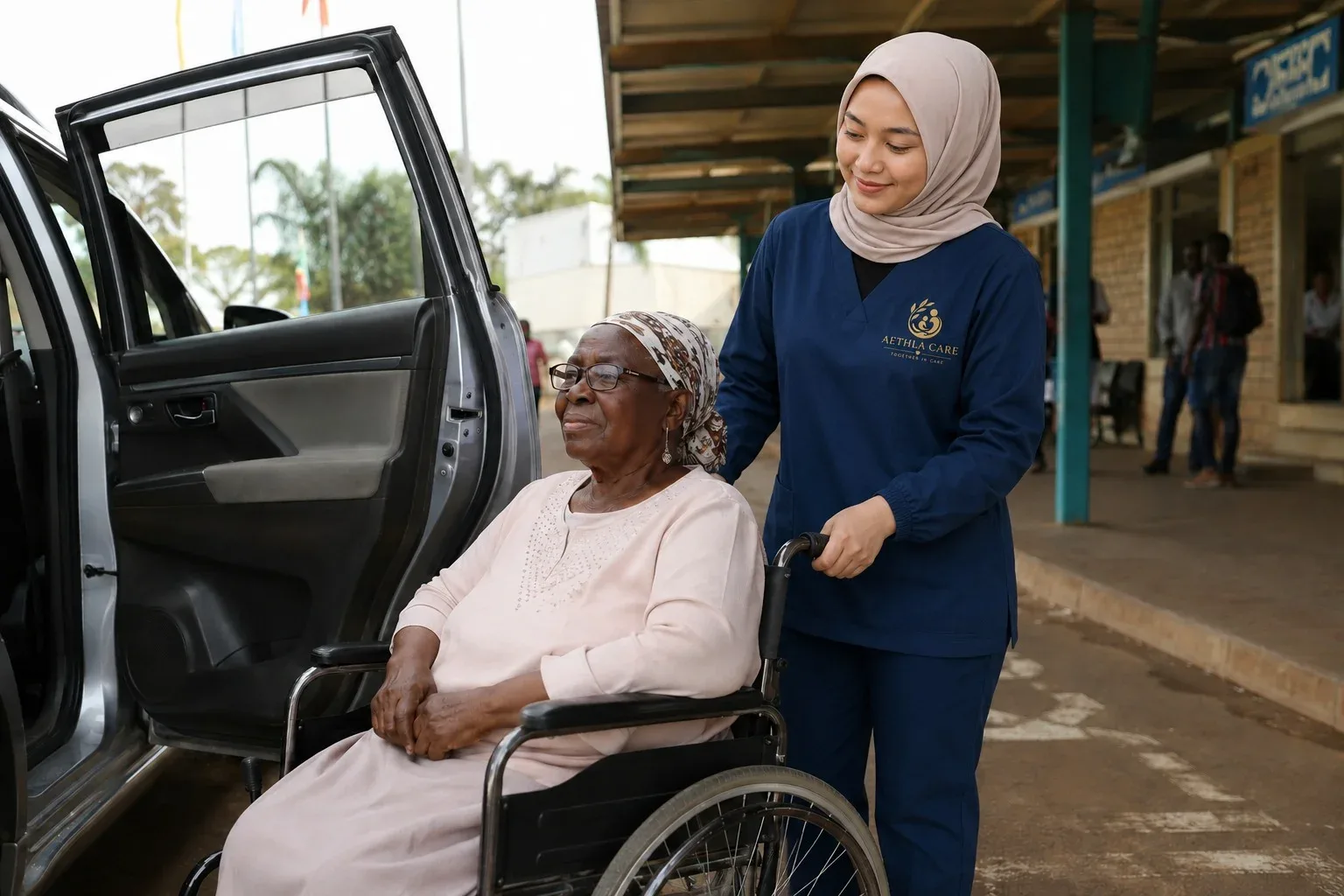
# How to Arrange Transport for an E
# lderly Person in Uganda: A Complete Guide to Medical, Assisted and Mobility Transport
**How do you arrange safe and reliable transport for an elderly person in Uganda?**
For many families, getting an older parent or relative from home to a hospital, specialist appointment, clinic, pharmacy, community activity or other essential destination can be more complicated than simply finding a vehicle.
An older person may have:
- Difficulty walking - Reduced mobility - Vision or hearing difficulties - A disability - Difficulty using public transport - Difficulty getting into or out of a vehicle - A need for someone to accompany them - Anxiety about travelling alone - Regular hospital or specialist appointments - A need for transport after hospital discharge - Family members living overseas who cannot provide transport themselves
In Kampala and surrounding areas such as Wakiso, Entebbe and Mukono, traffic, distance, timing and the patient's physical needs can all affect the journey.
For families outside the capital, distance can become an even more important consideration.
This is why elderly transport should be treated as part of the person's **care and mobility plan**, rather than simply as a taxi booking.
The World Health Organization identifies transport and mobility as important factors in helping older people maintain independence, participate in society and access health and social services. WHO's age-friendly guidance also emphasizes safe, accessible, appropriate and reliable transport.
For people with disabilities, transportation can be an even greater barrier. WHO reports that persons with disabilities may face substantial limitations from inaccessible and unaffordable transportation.
This guide explains how families in Uganda can plan transport for elderly people, what to consider before booking a vehicle, when an accompanying person may be needed, how to prepare for medical appointments, what diaspora families should know and how Aethla Care can help coordinate travel and mobility support.
---
# Quick answer: how do I arrange transport for an elderly person in Uganda?
Start by identifying **what the person can safely do during the journey and what assistance they need**.
Then:
1. Identify the destination. 2. Establish the date and time. 3. Determine whether the journey is routine, medical or urgent. 4. Assess the person's mobility. 5. Determine whether they can enter and exit a normal vehicle safely. 6. Decide whether they need an accompanying person. 7. Arrange an appropriate vehicle and driver. 8. Allow sufficient travel time. 9. Plan pickup and drop-off carefully. 10. Confirm the return journey. 11. Make sure the patient's documents and essential belongings are ready. 12. Provide the driver or accompanying person with relevant logistical information. 13. Have a contingency plan if the appointment or journey takes longer than expected.
The right transport option depends on the person's needs.
**A normal car, assisted journey and medical emergency transport are not the same thing.**
---
# 1. Why elderly transport requires more planning
An older person may technically be able to travel but still need assistance.
For example, someone might be able to walk from their bedroom to the front door but struggle to:
- Walk down a long driveway - Stand while waiting for transport - Climb into a high vehicle - Get out of a vehicle safely - Walk through a large hospital - Sit for a long journey - Carry medical documents - Navigate an unfamiliar facility
These practical details can determine whether a journey is manageable.
Transport planning should therefore begin with:
**“What does this person need to complete the whole journey safely and comfortably?”**
not simply:
**“What car can pick them up?”**
---
# 2. What types of journeys might an elderly person need?
Elderly transport in Uganda can involve many different journeys.
### Medical appointments
For example:
- Specialist appointments - Hospital outpatient visits - Clinic appointments - Follow-up consultations - Diagnostic investigations - Rehabilitation appointments
### Hospital discharge
An older person may need help travelling home after being discharged.
### Pharmacy or healthcare-related errands
Some families may need assistance with practical journeys related to healthcare.
### Family visits
Transport can also help older people maintain social connections.
### Religious or community activities
Mobility support may allow an older person to continue participating in activities that matter to them.
### Shopping and essential errands
Depending on the person's independence, transport may support everyday life.
### Airport or intercity journeys
Some older people may need assistance travelling between cities or preparing for international travel.
Each journey should be assessed according to the person's needs.
---
# 3. Medical transport is not the same as emergency ambulance transport
This distinction is essential.
A family may use the term “medical transport” to describe a vehicle taking an elderly parent to a doctor's appointment.
That does not necessarily mean an ambulance is required.
For a routine specialist appointment, the appropriate arrangement may be:
**Private vehicle + driver + accompanying caregiver**
For someone requiring clinical monitoring or emergency intervention, the situation may be completely different.
If someone is experiencing a medical emergency, families should use the appropriate emergency healthcare pathway rather than treating a routine care-coordination service as an ambulance service.
Aethla Care's travel and mobility coordination should not be understood as a substitute for emergency medical transport.
---
# 4. Start by assessing mobility
Before arranging a vehicle, understand how the person moves.
Ask:
- Can they walk independently? - Do they use a cane? - Do they use a walker? - Do they use a wheelchair? - Can they climb steps? - Can they stand from a chair independently? - Can they get into a car? - Can they get out of a car? - Can they sit comfortably for the expected journey? - Do they tire easily?
Do not assume that someone who walks independently inside their home can automatically manage every type of transport.
The entire journey matters.
---
# 5. Consider the journey from door to destination
One of the most useful ways to plan elderly transport is to think through the journey step by step.
### Step 1: Bedroom
Can the person get ready independently?
### Step 2: Inside the home
Can they safely reach the entrance?
### Step 3: Entrance
Are there stairs, uneven surfaces or narrow passages?
### Step 4: Pickup point
Can the vehicle stop close enough?
### Step 5: Getting into the vehicle
Can the person safely sit down?
### Step 6: Travel
Can they tolerate the expected journey?
### Step 7: Arrival
Can the vehicle stop close enough to the destination?
### Step 8: Getting out
Can they safely exit?
### Step 9: Facility
Can they reach the appropriate department?
### Step 10: Return
How will they get home?
This approach identifies problems before they become emergencies.
---
# 6. Does an elderly person need an accompanying person?
Not always.
Some older adults are perfectly capable of travelling independently.
Others may benefit from someone accompanying them.
An accompanying person can help with:
- Walking - Documents - Registration - Communication - Finding the correct department - Waiting - Carrying belongings - Remembering practical instructions - Returning home
The decision should be based on the person's needs and preferences.
It should not be based solely on age.
---
# 7. When an accompanying person may be particularly useful
An accompanying person may be worth considering if the older person:
- Has significant mobility limitations - Has difficulty navigating unfamiliar places - Has communication difficulties - Has vision or hearing difficulties - Becomes confused in unfamiliar environments - Is attending a complex medical appointment - Has recently been discharged from hospital - Has several appointments on the same day - Is travelling a long distance - Is anxious about travelling alone
Again, this is not a medical rule.
It is a practical planning consideration.
---
# 8. Transport for elderly specialist appointments
Specialist healthcare is one of the most common reasons families need organized transport.
Uganda's Ministry of Health describes a tiered health referral structure that includes Health Centres, district hospitals, regional referral hospitals and national referral hospitals. Regional referral hospitals provide advanced healthcare services and specialist services.
This means a patient may sometimes need to travel beyond the facility where they normally receive care.
For an elderly person, the journey itself can become part of the care challenge.
A family should therefore plan:
**Home → vehicle → facility → specialist department → vehicle → home**
rather than thinking only about the appointment time.
---
# 9. Transport from Wakiso to Kampala for medical appointments
Families living in Wakiso may need to travel into Kampala for specialist appointments or other healthcare services.
When arranging the journey, consider:
- Appointment time - Traffic conditions - Patient mobility - Pickup location - Drop-off point - Waiting time - Return journey - Whether the patient needs an accompanying person
Do not plan to arrive exactly at the appointment time.
Allow enough time for unexpected delays.
An older person may also need additional time getting into and out of the vehicle.
---
# 10. Transport from Entebbe to Kampala
A family in Entebbe may also need to coordinate travel to Kampala for specialist or hospital services.
For an older person, a longer journey can involve additional considerations.
Before departure:
- Confirm the appointment - Confirm the facility - Prepare documents - Confirm transport - Allow enough travel time - Consider whether the patient needs a companion - Plan the return
If the patient is physically uncomfortable during longer journeys, discuss appropriate arrangements with their healthcare provider where relevant.
---
# 11. Transport from Mukono to Kampala
For families in Mukono, similar planning applies.
A patient may be travelling to Kampala for:
- Specialist review - Diagnostic investigations - Hospital follow-up - Rehabilitation - Other healthcare appointments
A family should consider the total time away from home.
If the appointment could involve significant waiting, the person may need:
- Water or appropriate refreshments - Medication according to their prescribed routine - Mobility support - A companion - A plan for returning home
Any medical preparation instructions from the healthcare provider should take priority.
---
# 12. What if the elderly person uses a wheelchair?
Wheelchair users require specific transport planning.
Before booking, establish:
- Is the wheelchair manual or powered? - Can the person transfer into a vehicle? - Does the wheelchair fold? - Does the vehicle have enough space? - Can the person sit safely during the journey? - Does the vehicle provide appropriate secure storage? - Is assistance needed at pickup? - Is assistance needed at drop-off?
Never assume that every vehicle can safely accommodate a wheelchair.
Confirm the arrangement in advance.
---
# 13. What if the person uses a walking frame or cane?
A walking aid may make independent walking possible while still creating transport challenges.
A walking frame may need to be stored in the vehicle.
A cane needs to remain accessible without becoming a hazard.
The passenger may also need extra time to enter and exit the vehicle.
Tell the driver or coordinator about these requirements before the journey.
---
# 14. What if the elderly person has poor vision?
Vision limitations can affect the whole journey.
The person may need:
- Clear verbal directions - Assistance locating the vehicle - Help entering the vehicle - A companion in unfamiliar environments - Assistance finding the correct hospital department
Do not assume that simply dropping someone at the entrance means they can safely navigate the rest of the facility.
---
# 15. What if the elderly person has hearing difficulties?
Communication can become difficult during travel and at healthcare facilities.
The person may benefit from:
- Written information - Clear face-to-face communication - A trusted companion - Repeating important logistical information - Confirming appointment details in writing
The person should be asked what communication method works best for them.
---
# 16. Transport after hospital discharge
Hospital discharge can be a vulnerable transition for an older person.
Someone who previously travelled independently may temporarily need additional support.
Before leaving hospital, establish:
- Where the person is going - Who will receive them - Whether they can enter their home safely - Whether transport is appropriate - Whether they need an accompanying person - Whether additional home support is needed - Whether follow-up appointments are scheduled
Do not assume that getting the person into a car is the end of the process.
The destination must also be prepared.
---
# 17. Planning the destination matters
Imagine an older person arrives home after hospital.
The car stops outside.
But there are six steps to the entrance.
The person cannot climb them safely.
The transport was successful.
The journey home was not.
This demonstrates why transport planning should consider the complete route.
Ask:
- Where exactly will the vehicle stop? - How far is the entrance? - Are there stairs? - Is there someone waiting? - Can the person reach their room safely?
This is especially important following illness, injury or hospitalization.
---
# 18. Elderly transport for people living alone
If the older person lives alone, transport planning may need additional coordination.
For example:
**Pickup:** 8:00 a.m.
**Driver:** Confirmed.
**Appointment:** 10:00 a.m.
**Companion:** Confirmed.
**Return:** After appointment.
**Home contact:** Family member.
**Emergency contact:** Relative.
This creates a simple chain of responsibility.
The overseas family member can then know who is responsible for each stage.
---
# 19. Transport for elderly parents when children live abroad
This is a major issue for diaspora families.
A son in London may need to arrange transport for his father in Kampala.
A daughter in Melbourne may need to organize her mother's appointment in Entebbe.
A family member in Toronto may need to help coordinate a parent's hospital follow-up.
The family may not need a complicated solution.
They need someone locally to help coordinate the practical journey.
A structured plan can look like:
**Overseas family**
↓
**Local care coordinator**
↓
**Driver / mobility support**
↓
**Healthcare facility**
↓
**Return journey**
This allows the family member abroad to remain involved without physically travelling to Uganda for every appointment.
---
# 20. How to arrange transport for a parent in Uganda from Australia
If you live in Australia and need to arrange transport for a parent in Uganda, begin by gathering:
- Parent's full name - Home location - Destination - Appointment date - Appointment time - Mobility needs - Whether they use a wheelchair or walking aid - Whether they need an accompanying person - Return requirements - Local emergency contact
Then confirm the practical arrangements.
Do not rely on a vague message such as:
**“Someone will pick Mum up.”**
Instead establish:
- Who? - When? - Where? - In what vehicle? - Going where? - Who accompanies her? - What happens after the appointment?
Clear information reduces confusion.
---
# 21. How to arrange elderly transport from the UK, USA, Canada or UAE
The same principles apply to diaspora families living in:
- United Kingdom - United States - Canada - United Arab Emirates - South Africa - Australia - Other countries
Distance makes local coordination important.
The family member abroad may be able to organize payment and communication, but someone locally may still need to manage the physical journey.
That is where a care coordination service can be useful.
---
# 22. What information should you give the driver?
Only provide information that is necessary for the journey.
Useful logistical information can include:
- Pickup address - Destination - Appointment time - Passenger name - Mobility requirements - Whether another person is accompanying them - Special pickup instructions - Family contact number
Be careful with sensitive medical information.
A driver does not necessarily need a detailed medical history.
Share only what is needed to provide the appropriate practical support.
---
# 23. What should the elderly passenger take?
Depending on the journey, the person may need:
- Identification - Appointment information - Referral letter if applicable - Medical records - Relevant test results - Medication information - Phone - Emergency contact information - Walking aid - Wheelchair - Personal essentials
For medical appointments, use the facility's instructions as the primary guide.
---
# 24. How much time should you allow?
There is no universal travel time.
It depends on:
- Distance - Traffic - Appointment time - Patient mobility - Facility registration - Parking - Walking distance - Possible waiting
For an elderly person, it is generally better to avoid creating a rushed journey.
A rushed passenger may become stressed or physically uncomfortable.
Build reasonable flexibility into the plan.
---
# 25. What if the appointment takes longer than expected?
This is a common practical issue.
If the driver is only scheduled to drop the patient off, who brings them home?
Before the appointment, establish the return plan.
Options might include:
- Driver waits - Driver returns at an agreed time - Another family member collects the patient - A care coordinator arranges return transport - Another appropriate transport arrangement is made
Do not leave the return journey until the patient is ready to go home.
---
# 26. Transport should support independence
Transport assistance does not necessarily mean taking over.
An older person may still be able to:
- Choose where they want to go - Speak with the healthcare provider - Carry some belongings - Walk independently - Make everyday decisions
Support should be adjusted to what they actually need.
WHO's ICOPE approach emphasizes person-centred care and functional ability, rather than viewing older people only through diagnoses. Its 2025 guidance includes mobility among the areas considered when assessing older people's functioning and support needs.
Transport can therefore be a tool for maintaining independence rather than simply moving someone from one place to another.
---
# 27. Mobility and dignity
An older person may feel uncomfortable asking for help.
They may worry that needing transport means they are losing independence.
Families can frame support differently.
Instead of:
**“You can't go by yourself anymore.”**
try:
**“Let's make the journey easier so you can still attend the appointment yourself.”**
This maintains the person's role in their own life.
Good care is not only about safety.
It is also about dignity and choice.
---
# 28. What if the person has a disability?
Transportation planning for people with disabilities should be individualized.
WHO notes that people with disabilities can experience significant barriers related to inaccessible and unaffordable transport, which can affect access to health and other services.
Ask:
- What mobility support does the person use? - What type of vehicle works? - Can they transfer independently? - Do they need a companion? - What communication support is required? - How will they enter the destination? - What happens during the return journey?
The person should be involved in answering these questions whenever possible.
---
# 29. Don't confuse transport with clinical care
A driver may be excellent at transporting passengers.
That does not automatically make the driver a caregiver or healthcare professional.
Similarly:
**Driver ≠ nurse**
**Driver ≠ doctor**
**Driver ≠ physiotherapist**
**Driver ≠ emergency medical team**
A driver may assist with practical movement according to the agreed service, but families should clearly establish what support is and is not included.
This is particularly important when transporting someone with complex healthcare needs.
---
# 30. What is assisted travel?
Assisted travel generally means the journey includes additional practical support beyond simply driving.
Depending on the service arrangement, this could involve:
- Helping the person get ready for the journey - Accompanying them - Helping them navigate the destination - Supporting mobility - Waiting during an appointment - Helping coordinate the return journey
The exact service should be defined before the journey.
Aethla Care's travel and mobility support is intended to help families coordinate practical journeys based on the person's needs.
---
# 31. What if an elderly person needs to travel between cities?
Long-distance travel requires additional planning.
Consider:
- Journey duration - Breaks - Toileting - Food and drink requirements - Medication schedule as prescribed - Mobility - Accommodation if necessary - Destination access - Return journey
For a patient with significant medical needs, families should discuss travel suitability with the appropriate healthcare professional.
A routine car journey should not be assumed to be suitable for every medical condition.
---
# 32. Transport for elderly people travelling to the airport
Older people may also need assistance travelling to or from an airport.
Planning may include:
- Home pickup - Luggage support - Mobility assistance - Airport arrival - Check-in timing - Accompanying person - Destination pickup - Connecting travel
Airline and airport requirements can vary.
Families should confirm relevant requirements with the airline and airport rather than assuming that a general transport service provides all necessary airport assistance.
Aethla Care's role, where appropriate, can focus on the local journey and practical coordination.
---
# 33. How transport fits into elderly care at home
Transport should not be viewed separately from elderly care.
Consider an older parent receiving home support.
They may need:
- Home caregiver - Companionship - Household assistance - Specialist appointments - Transport - Mobility support - Family communication
These services can sometimes work together.
For example:
**Monday:** caregiver visits.
**Wednesday:** specialist appointment with assisted transport.
**Friday:** household support.
The care plan should reflect the person's actual routine.
---
# 34. How transport fits into disability support
Mobility can also affect:
- Employment - Education - Healthcare - Social participation - Family activities - Community participation
A disability support plan may therefore need to consider transportation as part of broader independence.
The question is not simply:
**“How do we get this person from A to B?”**
It is:
**“What transport support enables this person to participate in the activities that matter to them?”**
That is a more useful way of thinking about mobility.
---
# 35. A practical elderly transport checklist
## Before booking
☐ Identify destination ☐ Confirm date ☐ Confirm time ☐ Understand journey purpose ☐ Assess mobility ☐ Determine whether a companion is required ☐ Identify wheelchair/walking-aid needs ☐ Identify accessibility requirements
## Before the journey
☐ Confirm driver ☐ Confirm vehicle ☐ Confirm pickup location ☐ Confirm destination ☐ Confirm appointment ☐ Prepare documents ☐ Prepare mobility aids ☐ Share essential contact information ☐ Confirm return arrangements
## During the journey
☐ Allow sufficient time ☐ Assist according to agreed needs ☐ Keep essential belongings accessible ☐ Avoid rushing the passenger
## After arrival
☐ Confirm passenger reaches the appropriate destination ☐ Confirm companion/support arrangements ☐ Confirm return journey
## After the appointment
☐ Confirm patient is ready to leave ☐ Arrange return transport ☐ Ensure they reach home safely ☐ Communicate with family where appropriate
---
# 36. Questions to ask a transport provider
Before booking elderly transport, ask:
1. What type of vehicle will be used? 2. Can the vehicle accommodate the person's mobility needs? 3. Can a wheelchair or walking aid be carried? 4. Will the driver assist with getting into and out of the vehicle? 5. Can someone accompany the passenger? 6. Can the driver wait during an appointment? 7. Is return transport included? 8. What happens if the appointment runs late? 9. Who should the family contact if plans change? 10. What information does the provider need before the journey?
If the answers are unclear, clarify them before the journey.
---
# 37. Questions families should ask themselves
Before arranging transport, ask:
### About the passenger
- What can they do independently? - What assistance do they need? - What makes them uncomfortable?
### About the vehicle
- Can they enter safely? - Can they sit comfortably? - Can mobility equipment be accommodated?
### About the destination
- Where exactly should they be dropped? - How far is the entrance? - Is assistance required after arrival?
### About the return
- Who brings them home? - What happens if the appointment takes longer?
### About family
- Who is the local contact? - Who is responsible for communication? - Is anyone coordinating remotely?
These questions can reveal gaps before the journey begins.
---
# 38. How Aethla Care can help coordinate elderly transport in Uganda
Aethla Care's travel and mobility service is designed to help families coordinate practical journeys for elderly people, people with disabilities and other clients who need assistance.
Depending on the person's needs and the available service route, support may involve:
- Transport coordination - Appointment travel - Elderly mobility assistance - Disability-related journey support - Accompanying-person coordination - Hospital and specialist appointment journeys - Practical travel planning - Family communication - Return-journey coordination
The exact arrangement should be clarified before the journey.
Aethla Care is not an emergency ambulance service unless a specific service is separately and explicitly identified as such.
Likewise, transport coordination does not replace clinical care.
The goal is practical support:
**Tell us what you need → clarify the care route → coordinate support → keep the family informed.**
---
# 39. Why local coordination matters for diaspora families
For a family member overseas, the hardest part may not be paying for transport.
It may be knowing:
**Who is actually helping Mum?**
A family member in Australia may need confidence that:
- The driver arrived - The parent left home - The appointment was attended - The parent returned safely - The family knows what needs to happen next
Good coordination creates a clear chain of responsibility.
This is one reason transport can form part of a broader diaspora-care arrangement rather than being treated as a completely separate service.
---
# 40. Common mistakes when arranging elderly transport
## Mistake 1: Booking any available car
The cheapest or nearest vehicle may not meet the person's needs.
## Mistake 2: Not asking about mobility
A person who uses a wheelchair or walker may require different arrangements.
## Mistake 3: Forgetting the return journey
The trip home is just as important.
## Mistake 4: Dropping the person at the entrance and leaving
Some older people need assistance reaching the actual department.
## Mistake 5: Not allowing enough time
Older passengers may need more time.
## Mistake 6: Assuming a driver is a caregiver
Clarify responsibilities.
## Mistake 7: Treating a medical emergency as routine transport
Emergency medical situations require the appropriate emergency healthcare response.
## Mistake 8: Not communicating changes
If the appointment changes, everyone involved should be informed.
---
# 41. What if the appointment is cancelled?
Have a process for changes.
If the healthcare provider changes the appointment:
1. Confirm the new appointment. 2. Notify the transport provider. 3. Notify the accompanying person. 4. Notify relevant family members. 5. Update the care calendar. 6. Reconfirm the new transport arrangements.
This is particularly important when several people are coordinating from different locations.
---
# 42. What if the elderly person becomes uncomfortable during the journey?
Do not ignore significant changes in the person's condition.
If the person develops an acute or potentially serious medical problem during travel, the appropriate response may be different from completing the planned journey.
The driver or accompanying person should follow appropriate emergency procedures and seek urgent medical assistance when necessary.
Transport coordination should never prevent someone from receiving emergency medical care.
---
# 43. Planning elderly transport in Kampala and Greater Kampala
For families around Kampala, Wakiso, Entebbe and Mukono, transport planning can involve significant variability in journey time.
The exact route, appointment location and patient's condition should therefore be considered when scheduling.
For example, a family should not necessarily assume that:
**“The hospital is only a short distance away.”**
The relevant journey may include:
**Home → local road → traffic → parking/drop-off → hospital entrance → department**
For an older person, each stage matters.
---
# 44. Transport is part of access to care
An appointment is not truly accessible if the patient cannot realistically reach it.
This is why transport is closely connected to healthcare navigation.
Uganda's health system includes different levels of facilities, and some patients may need to move between levels of care depending on their needs.
For an older or disabled person, the practical ability to travel between home and healthcare services can therefore influence whether they can make use of those services.
WHO's work on age-friendly environments similarly treats transport and mobility as important to access, independence and participation.
---
# 45. Frequently Asked Questions
## How do I arrange transport for an elderly person in Uganda?
Start by assessing the person's mobility, identifying the destination and confirming the date and time. Then arrange a vehicle and any accompanying support needed for the complete journey, including the return trip.
## Can Aethla Care arrange transport for elderly people?
Aethla Care can help coordinate travel and mobility support depending on the person's needs, location and available service route.
## Can Aethla Care transport someone to a hospital?
Where the appropriate travel-support route is available, Aethla Care can help coordinate journeys to healthcare appointments and other essential destinations. Emergency medical transport should be arranged through the appropriate emergency healthcare service.
## Can an elderly person use a normal car?
Some can. The appropriate vehicle depends on mobility, ability to enter and exit the vehicle, wheelchair or walking-aid requirements and the length of the journey.
## Can someone accompany my elderly parent?
Depending on the service arrangement, an accompanying person may be coordinated where the older person requires practical assistance.
## How do I transport an elderly person who uses a wheelchair?
First establish whether the person can transfer into a vehicle and whether the wheelchair folds or requires specialized accommodation. Confirm vehicle suitability before the journey.
## How do I arrange transport for my parent in Uganda while I live overseas?
Provide the local coordinator or transport provider with the passenger's location, destination, appointment details, mobility needs and return requirements. Confirm who is responsible for each stage of the journey.
## Can I arrange elderly transport from Australia to Uganda?
You can coordinate transport for a parent or relative in Uganda while living in Australia. The actual journey is carried out locally, so you should ensure that the local transport arrangement is clearly confirmed.
## Can elderly transport include hospital appointments?
Yes, transport can be coordinated for routine medical, hospital and specialist appointments, subject to the service arrangement.
## Is elderly transport the same as an ambulance?
No. Routine elderly transport and assisted travel are different from emergency ambulance services.
## What should I tell the driver?
Provide the essential logistical information needed for the journey, such as pickup location, destination, appointment time, mobility requirements and contact details. Avoid sharing unnecessary private medical information.
## What if my parent cannot walk far?
Tell the transport coordinator in advance. The arrangement may need to include a vehicle that can stop closer to the destination and an accompanying person or mobility support.
## What if the hospital appointment takes longer than expected?
Arrange a return-transport contingency before the journey. The driver may need to wait, return later or another transport arrangement may need to be made.
---
# Elderly Transport Checklist for Families in Uganda
### Passenger
☐ Mobility assessed ☐ Walking aid identified ☐ Wheelchair identified ☐ Communication needs considered ☐ Companion requirement established
### Appointment
☐ Date confirmed ☐ Time confirmed ☐ Facility confirmed ☐ Department confirmed ☐ Referral/document requirements checked
### Transport
☐ Vehicle confirmed ☐ Driver confirmed ☐ Pickup location confirmed ☐ Drop-off location confirmed ☐ Return journey confirmed ☐ Contingency plan established
### Family
☐ Local contact identified ☐ Overseas family informed where appropriate ☐ Relevant documents prepared ☐ Communication plan established
---
# Final Thoughts
For an older person, transportation is often much more than getting into a car.
It can determine whether they can:
- Attend a specialist appointment - Return home after hospital - Access healthcare - Maintain social connections - Continue participating in their community - Remain independent - Stay connected with family
That is why elderly transport should be planned around the person rather than around the vehicle.
Start by understanding their mobility.
Then consider the complete journey.
**Home → pickup → vehicle → destination → appointment/activity → return journey → home.**
For families in Kampala, Wakiso, Entebbe, Mukono and elsewhere in Uganda, careful planning can make journeys easier to coordinate.
For families living overseas, local support can be particularly valuable because relatives cannot always be physically present.
Aethla Care can help families coordinate practical travel and mobility support according to the person's needs and the available service route.
The role is not to replace doctors, nurses, hospitals or emergency services.
It is to help families organize the practical side of getting where they need to go.
**Tell us what you need → clarify the care route → coordinate support → keep the family informed.**
**Aethla Care — Trusted Care for Every Stage of Life.**
---
## References and further reading
1. **Uganda Ministry of Health — Frequently Asked Questions.** The Ministry describes Uganda's health referral system as a tiered structure including Health Centre I through IV, district hospitals, regional referral hospitals and national referral hospitals.
2. **Uganda Ministry of Health — Guidelines for Regional Referral Hospital Management Boards.** The Ministry describes regional referral hospitals as providing specialized clinical services including medicine, surgery, paediatrics, obstetrics and gynaecology, psychiatry, ENT and ophthalmology, alongside laboratory, imaging and pathology services.
3. **World Health Organization — Transport and Mobility.** WHO's age-friendly guidance identifies safe, accessible, appropriate and reliable transport as important for maintaining mobility, independence and social connections among older people.
4. **World Health Organization — Disability and Health.** WHO identifies inaccessible and unaffordable transportation as a significant barrier for people with disabilities and describes wider health inequities associated with disability.
5. **World Health Organization — Integrated Care for Older People (ICOPE), 2nd edition, 2025.** WHO's ICOPE guidance supports person-centred assessment, identification of social-care and support needs, personalized care planning and monitoring, with mobility among the areas considered in older people's functioning.
6. **World Health Organization — Person-centred and integrated care for older people.** WHO describes a continuum of integrated care extending across homes, primary care, hospitals and long-term-care settings and highlights the importance of coordinated services that support ageing in place.
7. **Google Search Central — Optimizing for Generative AI Features on Google Search.** Google states that foundational SEO remains relevant to generative AI search and emphasizes unique, valuable, non-commodity, people-first content rather than separate AEO/GEO “hacks.”
8. **Google Search Central — AI Features and Your Website.** Google says there are no additional technical requirements specifically for appearing in AI Overviews or AI Mode beyond being eligible for Search and following foundational SEO practices.
### Important note
This article provides general information about elderly transport, mobility and practical care coordination. It is not medical advice and does not determine whether a particular person is medically fit to travel. Emergency medical situations require appropriate emergency healthcare services. Transport arrangements, accessibility, vehicle suitability, provider availability and pricing should be confirmed before a journey.