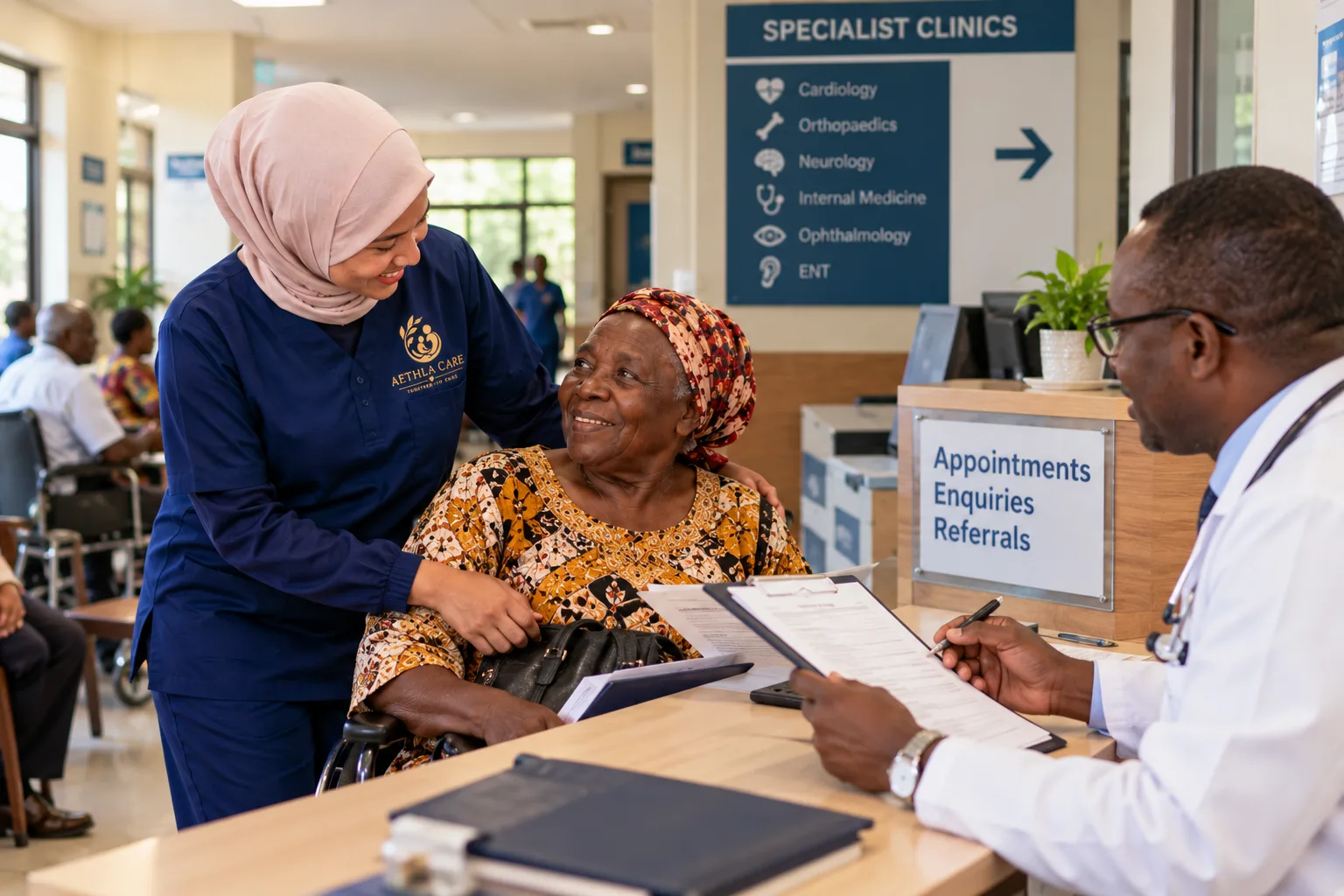
# How to Arrange Specialist Doctor Appointments in Uganda: A Complete Guide for Patients and Families
# How to Arrange a Specialist Doctor Appointment in Uganda
Finding the right specialist doctor can be difficult when you are dealing with a new health concern, a chronic condition, an elderly parent, a disability, a hospital discharge or a family member who lives outside Uganda.
The challenge is often not simply finding the doctor's name.
Families may also need to understand:
* whether a specialist is actually required * which type of specialist may be appropriate * whether a referral is needed * which healthcare facility provides the relevant service * what documents to take * how to book the appointment * how to get the patient to the facility * whether someone should accompany them * what happens after the consultation * how an overseas family member can coordinate everything from abroad
Uganda's healthcare system includes different levels of facilities, from lower-level health centres through general and referral hospitals. The Ministry of Health also maintains standards and guidance intended to improve quality, accessibility and accountability across healthcare delivery.
For families, this means that **specialist appointment coordination is often a process rather than a single phone call**.
Aethla Care can help families navigate and coordinate the practical side of this process where an appropriate route is available, while medical diagnosis and treatment decisions remain with qualified healthcare professionals.
---
# Quick Answer: How Do You Arrange a Specialist Doctor Appointment in Uganda?
A practical process is:
1. **Understand the healthcare need.** 2. **Confirm whether specialist assessment is required.** 3. **Identify the appropriate specialist or healthcare route.** 4. **Check whether a referral or medical records are required.** 5. **Identify a suitable healthcare facility.** 6. **Confirm appointment arrangements directly with the provider or through the appropriate booking route.** 7. **Prepare medical records and relevant documents.** 8. **Arrange transport and assistance if needed.** 9. **Attend the appointment.** 10. **Understand the follow-up plan.** 11. **Coordinate additional investigations, referrals or appointments where instructed by the healthcare professional.**
For elderly people, people with disabilities and families living abroad, additional support may be needed around transport, communication and appointment logistics.
---
# What Is a Specialist Doctor?
A specialist doctor is a medical practitioner with advanced training and expertise in a particular area of medicine.
Examples can include specialists in:
* cardiology * neurology * orthopaedics * ophthalmology * ENT * psychiatry * obstetrics and gynaecology * paediatrics * surgery * internal medicine * oncology * dermatology * urology
The exact availability of specialties differs between healthcare facilities.
Uganda Ministry of Health guidance for Regional Referral Hospitals identifies specialised clinical services including medicine, surgery, paediatrics, obstetrics and gynaecology, psychiatry, ear, nose and throat, and ophthalmology, as well as laboratory, medical imaging and pathology services.
This is one reason it is important to identify the **actual healthcare need before choosing a facility**.
---
# Do You Always Need a Specialist?
No.
Not every health concern requires a specialist.
A primary-care or general medical practitioner may be able to assess the initial concern and determine whether specialist input is necessary.
A specialist referral may be appropriate when:
* the condition requires specialised expertise * a diagnosis is uncertain * symptoms are persistent or complex * a specialist procedure may be required * a condition requires ongoing specialist management * another healthcare professional recommends specialist review
The correct route depends on the patient's individual circumstances.
Families should not use an online article to diagnose themselves or decide what specialist is medically necessary.
---
# Understanding Referrals in Uganda
Healthcare systems use referral pathways to connect patients with the appropriate level of care.
In Uganda, the Ministry of Health operates a tiered health-service structure that includes health centres, general hospitals and referral hospitals.
A patient may therefore begin at one level of care and be referred to another when more specialised assessment or treatment is required.
This can be particularly relevant when a patient needs services that are not available at their first point of contact.
Families should ask the healthcare provider:
> “Do we need a referral for this appointment?”
and:
> “Which facility or specialist should we be referred to?”
The answer can depend on the patient's circumstances, the facility and the service required.
---
# Why Choosing the Right Specialist Matters
The word **“specialist”** is not enough.
A family may know that their parent needs “a specialist” without knowing which specialty is appropriate.
For example, symptoms involving:
* vision * hearing * mobility * neurological function * heart health * mental health * reproductive health * bones and joints
may involve very different medical specialties.
This is why the first step should be understanding the healthcare concern rather than searching randomly for a doctor.
---
# How to Start the Appointment Process
Begin with the basic facts.
Write down:
### Who needs the appointment?
For example:
* an older parent * a child * a person with a disability * yourself * another family member
### What is the reason for the appointment?
Describe the concern in straightforward terms.
### Has the person already seen a doctor?
If so:
* when? * where? * what was recommended? * was a referral made?
### Is there an existing diagnosis?
If there is one, document it accurately.
### Are there previous medical records?
Collect them before contacting the specialist.
---
# What Information Should You Have Before Booking?
Before arranging the appointment, gather:
* patient's full name * age * contact details * location * reason for consultation * previous diagnosis if known * current healthcare provider * referral letter if applicable * previous test results * imaging reports * medication information * discharge summary if recently hospitalised * relevant insurance or payment information
Do not assume that the specialist will automatically have access to all previous medical records.
Patients and families should ask what documentation is required.
---
# What Documents Should You Take to a Specialist Appointment?
The exact requirements vary, but useful documents may include:
* referral letter * previous consultation notes * laboratory results * imaging reports * scans or other diagnostic records * hospital discharge documents * medication list * previous prescriptions * relevant identification * insurance documentation where applicable
If you are unsure, ask the healthcare facility before the appointment.
---
# Why Previous Medical Records Matter
Medical records can help the specialist understand the patient's history.
For example, the specialist may need to know:
* what has already been investigated * which tests have been performed * what treatments have been tried * what medications are currently being used * whether the patient has previously been admitted * what another doctor has recommended
Good documentation can help avoid unnecessary confusion.
It also gives the patient and family a clearer record of the healthcare journey.
---
# How to Book a Specialist Doctor in Kampala
The exact booking process varies by facility.
Depending on the provider, an appointment may involve:
* calling the facility * using an online booking system * contacting a clinic directly * receiving a referral * visiting the facility * coordinating through an authorised healthcare or care-navigation service
Families should confirm:
* appointment date * appointment time * doctor's name * specialty * facility location * documents required * expected payment arrangements * whether the appointment has actually been confirmed
Do not assume that submitting an enquiry automatically means an appointment is booked.
---
# Appointment Enquiry vs Confirmed Appointment
This distinction is important.
A family may contact a healthcare facility and ask whether a specialist is available.
That is an **enquiry**.
A confirmed appointment is different.
Families should have clear confirmation of:
* date * time * specialist * location * patient details
A care coordinator should not claim that an appointment is confirmed unless the appropriate healthcare provider or scheduling system has actually confirmed it.
---
# How Aethla Care Can Help With Specialist Appointment Coordination
Aethla Care's role is to help families navigate the practical side of healthcare.
Depending on the circumstances, this may include:
* clarifying the healthcare-navigation need * helping identify the appropriate route * organising appointment enquiries * helping families understand what information to prepare * coordinating transport * arranging accompaniment where appropriate * helping coordinate follow-up logistics * keeping family members informed
Aethla Care does **not** diagnose medical conditions.
It does not replace a doctor.
It does not independently determine medical treatment.
The healthcare professional remains responsible for clinical assessment, diagnosis and treatment.
---
# Why Healthcare Navigation Matters for Elderly Parents
An older person may find healthcare logistics difficult even when they are medically capable of making their own decisions.
For example, they may struggle with:
* long journeys * finding a facility * remembering appointment details * organising documents * moving around the hospital * arranging transport * managing multiple appointments
The family may therefore need someone to coordinate the practical side.
WHO's ICOPE approach specifically recognises the importance of coordination between health and social-care workers and appropriate referral pathways to specialised services.
This is particularly relevant to older adults whose needs can involve several services at the same time.
---
# Specialist Appointments for Elderly People in Uganda
Older adults may interact with multiple parts of the healthcare system.
Depending on their circumstances, they may require care involving:
* general medicine * cardiology * ophthalmology * ENT * orthopaedics * rehabilitation * mental health * nutrition * other specialist services
WHO's current ICOPE framework highlights areas such as mobility, cognition, vision, hearing, nutrition, psychological wellbeing and social-support needs as part of a broader person-centred assessment approach for older adults.
This reinforces why elderly care should not be reduced to a single diagnosis.
The person may have several interconnected needs.
---
# Specialist Appointments for People With Disabilities
A person with a disability may need specialist healthcare for reasons related to:
* mobility * communication * vision * hearing * rehabilitation * pain * neurological conditions * assistive technology * other health concerns
Families should consider accessibility before the appointment.
Ask:
* Is the facility physically accessible? * Can the patient enter and exit safely? * Is accessible transport required? * Does the person need a communication support arrangement? * Will an accompanying person be helpful? * Are mobility aids required?
Healthcare access is not only about having a doctor available.
The patient must also be able to **reach and use the service**.
---
# Arranging Transport to a Specialist Appointment
Transport should be considered early rather than on the morning of the appointment.
For an older or disabled patient, ask:
### Can the person walk independently?
### Do they use a walking aid?
### Can they get into a standard vehicle?
### Do they need assistance transferring?
### Will someone accompany them?
### Is the journey long?
### Will they need assistance at the destination?
Transport requirements should be explained accurately.
Do not assume that ordinary taxi transport is suitable for every patient.
---
# Appointment Day Checklist
The evening before the appointment, check:
* [ ] Appointment date confirmed * [ ] Appointment time confirmed * [ ] Facility confirmed * [ ] Specialist confirmed * [ ] Transport arranged * [ ] Accompanying person arranged if needed * [ ] Referral letter packed * [ ] Medical records packed * [ ] Medication list prepared * [ ] Identification available * [ ] Insurance/payment information available * [ ] Contact number for facility available
This simple checklist can prevent unnecessary problems.
---
# What Questions Should You Ask the Specialist?
Patients often remember only part of what is discussed during a consultation.
Writing questions down beforehand can help.
Consider asking:
### About the concern
* What could be causing this problem? * What does the examination show? * What information is still needed?
### About tests
* Is further testing required? * Why is the test needed? * When will the results be available?
### About treatment
* What treatment options are available? * What are the intended benefits? * What are the important risks or side effects? * What should we do if the problem changes?
### About follow-up
* When should we return? * Who should we contact if there is a concern? * Is another specialist required?
Patients should ask the healthcare professional to explain anything they do not understand.
---
# What If the Specialist Recommends More Tests?
This is common in healthcare.
The next step may involve:
* laboratory testing * imaging * specialist review * another clinical assessment * rehabilitation * additional consultation
Families should ask:
**What is the next step?**
Then confirm:
* where it should happen * whether an appointment is needed * what preparation is required * when results are expected * whether another appointment is needed afterwards
A care coordinator can help with the logistics without making the clinical decision.
---
# What If a Second Opinion Is Needed?
Patients sometimes want another professional opinion.
The decision to seek a second opinion should be discussed appropriately with healthcare professionals.
From a coordination perspective, the family may need to organise:
* previous records * test results * imaging * referral documentation * a new appointment * transport
A second opinion is most useful when the new clinician has enough relevant information to understand the case.
---
# How to Arrange Specialist Appointments for Parents From Abroad
This is one of the most important issues for Ugandan diaspora families.
Imagine a daughter living in Melbourne whose mother lives in Kampala.
The daughter may know:
> “Mum needs to see a specialist.”
But she may not know:
* which specialist * where to go * how to get Mum there * what documents are required * whether Mum needs someone to accompany her * what happens after the consultation
This is where healthcare navigation can become valuable.
The overseas family member can remain involved without having to personally manage every local step.
---
# A Practical Diaspora Appointment Process
## Step 1: Speak With the Parent
Find out what is happening.
Do not rely only on second-hand information if the parent can communicate directly.
## Step 2: Gather Existing Information
Collect:
* previous records * referral letters * test results * medication information
## Step 3: Clarify the Healthcare Route
Determine what type of specialist appointment is being sought.
## Step 4: Identify a Suitable Facility
Consider:
* specialty * location * accessibility * appointment process
## Step 5: Confirm the Appointment
Get the actual date and time.
## Step 6: Arrange Transport
Consider the parent's mobility.
## Step 7: Arrange Accompaniment
If the parent would benefit from someone attending with them, organise this.
## Step 8: Prepare Questions
Help the parent make a list.
## Step 9: Arrange Follow-Up
Find out what happens after the appointment.
---
# How Families Can Stay Involved From Overseas
Technology can make communication easier, but it should be used thoughtfully.
Before the appointment, the family can:
* help prepare questions * organise documents * confirm logistics
After the appointment, the parent can share:
* what the doctor explained * what tests were requested * what follow-up is required
Where appropriate and with the patient's consent, a family member may participate remotely in communication.
Privacy and consent should always be respected.
---
# Healthcare Coordination Is Not Medical Decision-Making
This distinction is fundamental.
A care coordinator may help with:
* appointment logistics * transport * documentation * communication * follow-up coordination
A healthcare professional determines:
* diagnosis * treatment * clinical interpretation * medication decisions * medical procedures
Aethla Care's role is to help connect the practical pieces.
It is not a substitute for clinical care.
---
# What If the Patient Misses an Appointment?
If an appointment is missed:
1. Contact the healthcare provider. 2. Ask whether it can be rescheduled. 3. Confirm the new date and time. 4. Review why the appointment was missed. 5. Adjust transport or accompaniment if necessary.
If missed appointments are becoming frequent, the family should consider whether the person needs additional practical support.
---
# What If an Elderly Parent Cannot Travel Alone?
Several options may be considered depending on the person's circumstances.
The person may need:
* an accompanying family member * a caregiver * a support worker * assisted transport * another appropriate arrangement
The family should not assume that an older adult can manage a complicated hospital journey simply because they can manage at home.
The journey itself can be the difficult part.
---
# What If the Appointment Is Outside Kampala?
Uganda's specialist healthcare services are distributed across different facilities and levels of the health system.
Regional Referral Hospitals, for example, provide specialised clinical services and supporting diagnostic services.
A patient may therefore need to travel from one district or city to another depending on the service required.
Families should plan for:
* travel time * accommodation where necessary * transport * appointment timing * accompanying support * return journey * follow-up
Do not assume that every specialist service is available in the patient's nearest facility.
---
# Specialist Healthcare and the Uganda Referral System
The referral system exists partly because different health facilities have different capabilities.
A lower-level facility may manage many common healthcare needs.
A patient requiring more specialised assessment may be referred onward.
The Ministry of Health's current Health Service Delivery Standards 2025–2030 are intended to establish minimum standards for quality, accessible and accountable healthcare services across Uganda.
For families, the practical lesson is:
**Start with the appropriate healthcare route rather than simply searching for the most specialised-sounding doctor.**
---
# What Should You Do Before Searching for a Specialist?
Prepare a short summary.
For example:
> “My father is 74 and lives in Kampala. He has been experiencing persistent difficulty with walking. He was assessed previously and has a referral for further evaluation. We need help understanding the appointment and transport arrangements.”
This is more useful than:
> “I need a specialist.”
The more clearly the practical situation is explained, the easier it becomes to identify what coordination is required.
---
# How Aethla Care Fits Into the Process
Aethla Care is designed as an integrated care and family-support platform rather than simply a directory of doctors.
The healthcare-navigation service can connect with other forms of practical support.
For example:
**Specialist appointment + transport + accompaniment + family updates**
or:
**Post-hospital support + follow-up appointment + transport + home assistance**
or:
**Elderly care + specialist appointment + diaspora family coordination**
This is where integrated coordination can become more useful than treating every task as a separate problem.
---
# Aethla Care's Healthcare Navigation Process
### Tell us what you need.
Explain the situation.
### Clarify the care route.
Understand what practical coordination is required.
### Coordinate support.
Where an appropriate route exists, coordinate the relevant appointment, partner or support service.
### Keep the family informed.
Maintain agreed communication with the family.
The exact service depends on the patient's location, needs and the availability of the relevant provider or partner.
---
# Common Mistakes Families Make
## Mistake 1: Choosing a specialist before understanding the problem
The correct specialty matters.
## Mistake 2: Assuming every facility offers every specialty
Services vary.
## Mistake 3: Forgetting previous medical records
Relevant records can be important.
## Mistake 4: Arranging the appointment but forgetting transport
The appointment is only one part of the journey.
## Mistake 5: Not confirming the appointment
An enquiry is not necessarily a booking.
## Mistake 6: Sending an elderly parent alone when support is needed
Consider mobility and communication.
## Mistake 7: Failing to plan the next step
Ask what happens after the consultation.
## Mistake 8: Treating a coordinator as a medical professional
Coordination and clinical decision-making are different roles.
---
# Specialist Appointment Checklist for Uganda
## Before Booking
* [ ] Understand the healthcare concern * [ ] Determine whether a referral exists * [ ] Gather previous records * [ ] Identify the appropriate healthcare route * [ ] Identify potential facility
## When Booking
* [ ] Confirm specialist * [ ] Confirm date * [ ] Confirm time * [ ] Confirm location * [ ] Ask about required documents * [ ] Ask about payment arrangements
## Before the Appointment
* [ ] Arrange transport * [ ] Arrange accompaniment * [ ] Pack records * [ ] Prepare medication list * [ ] Prepare questions * [ ] Confirm appointment again if necessary
## After the Appointment
* [ ] Record the doctor's instructions * [ ] Arrange recommended tests * [ ] Arrange follow-up * [ ] Coordinate transport if needed * [ ] Update relevant family members * [ ] Store records safely
---
# Frequently Asked Questions
## How do I book a specialist doctor in Uganda?
The process depends on the healthcare provider. You may need to contact the facility, obtain a referral, use its appointment system or follow another booking process. Always confirm the appointment date, time, specialist and location.
## Do I need a referral to see a specialist in Uganda?
It depends on the specialist, healthcare facility and circumstances. Ask the healthcare provider whether a referral is required before booking.
## Where can I find specialist doctors in Uganda?
Specialist services are provided through different healthcare facilities, including referral hospitals and other public, private and not-for-profit providers. The appropriate facility depends on the specialty required and the patient's circumstances.
## Can I arrange a specialist appointment for my elderly parent?
Yes, practical appointment coordination can often be arranged with the parent's involvement and appropriate consent. Transport and accompaniment may also need to be considered.
## Can someone arrange a specialist appointment for a parent living abroad?
Yes. A family member overseas can help coordinate the practical process, although the patient's privacy, consent and healthcare-provider requirements must be respected.
## What should I take to a specialist appointment?
Useful documents can include referral letters, previous medical records, laboratory results, imaging reports, discharge documents, medication information and relevant identification or insurance documentation.
## Can Aethla Care arrange specialist appointments?
Aethla Care can assist with healthcare navigation and appointment coordination where an appropriate route and provider/partner pathway are available. It does not diagnose conditions or make treatment decisions.
## Can Aethla Care arrange transport to a specialist appointment?
Transport and assisted-journey coordination may be available depending on the patient's needs, location and the relevant service route.
## What if my parent cannot travel alone?
Consider arranging an appropriate accompanying person or assisted transport based on the person's mobility and support requirements.
## What happens if the specialist requests more tests?
Follow the healthcare professional's instructions and ask where, when and how the tests should be completed. Additional appointments may then be required depending on the results and clinical advice.
## Can I get a second opinion in Uganda?
Patients may seek another qualified medical opinion where appropriate. Relevant medical records and test results can help the second clinician understand the case.
## Does Aethla Care provide medical advice?
No. Aethla Care's healthcare-navigation role is practical and coordinative. Diagnosis, treatment and other clinical decisions remain with qualified healthcare professionals.
---
# Final Thoughts
Arranging a specialist appointment in Uganda involves more than finding a doctor's telephone number.
For many families, the real challenge is coordinating the entire journey:
**Need → referral or healthcare route → specialist → appointment → documents → transport → consultation → follow-up.**
This becomes even more important when the patient is:
* elderly * living alone * living with a disability * recovering from hospitalisation * travelling from another district * supported by family living overseas
Uganda's healthcare system includes multiple levels of care, and specialist services are provided through facilities with different capabilities. The Ministry of Health's current 2025–2030 standards emphasise quality, accessibility and accountability across healthcare delivery.
WHO's current integrated-care guidance similarly emphasises coordination, personalised care planning and appropriate pathways between primary, specialised and social-care services.
For families, the most useful approach is therefore to think beyond the appointment itself.
Ask:
**Who needs to attend?**
**Where should they go?**
**What information should they take?**
**How will they get there?**
**Who will accompany them?**
**What happens afterwards?**
For families who are managing care across distance, good coordination can make the healthcare journey easier to understand and manage.
At Aethla Care, the starting point is simple:
**Tell us what you need.**
We help clarify the care route, coordinate appropriate support and keep the family informed.
**Trusted Care for Every Stage of Life.**
---
# Factual References and Further Reading
### Uganda Ministry of Health — Health Service Delivery Standards 2025–2030
Published in February 2026, these standards outline minimum standards for quality, accessible and accountable healthcare service delivery in Uganda.
### Uganda Ministry of Health — Guidelines for Regional Referral Hospital Management Boards
The Ministry's guidance describes Regional Referral Hospitals as providing specialised services including medicine, surgery, paediatrics, obstetrics and gynaecology, psychiatry, ENT and ophthalmology, together with laboratory, imaging and pathology services and rehabilitative services.
### World Health Organization — Integrated Care for Older People (ICOPE), 2nd Edition, 2025
WHO's 2025 handbook provides a person-centred pathway involving assessment, identification of social-care and support needs, personalised care planning, implementation and monitoring.
### World Health Organization — Person-Centred and Integrated Care
WHO's integrated-care approach emphasises coordination across health and social-care settings and appropriate referral pathways to specialised services.
### Google Search Central — AI Features and Your Website
Google states that normal SEO fundamentals remain relevant to AI Overviews and AI Mode, including crawlability, internal linking, textual content, page experience and accurate structured data. There are no additional technical requirements specifically for AI features.
### Google Search Central — Optimizing for Generative AI Features
Google's 2026 guidance recommends valuable, unique, non-commodity content and reinforces that SEO remains foundational for visibility in generative AI search experiences.
---
## Medical Information Note
This article is for general information about healthcare navigation and specialist appointment coordination in Uganda. It is not medical advice, diagnosis or treatment.
The appropriate specialist, healthcare facility, referral pathway, tests and treatment depend on the individual patient's circumstances and should be determined by qualified healthcare professionals.
Appointment availability, provider schedules, fees, referral requirements and services can change. Families should confirm current information directly with the relevant healthcare provider before travelling or making arrangements.
For an emergency or potentially life-threatening medical situation, seek urgent medical care rather than waiting for a routine specialist appointment.