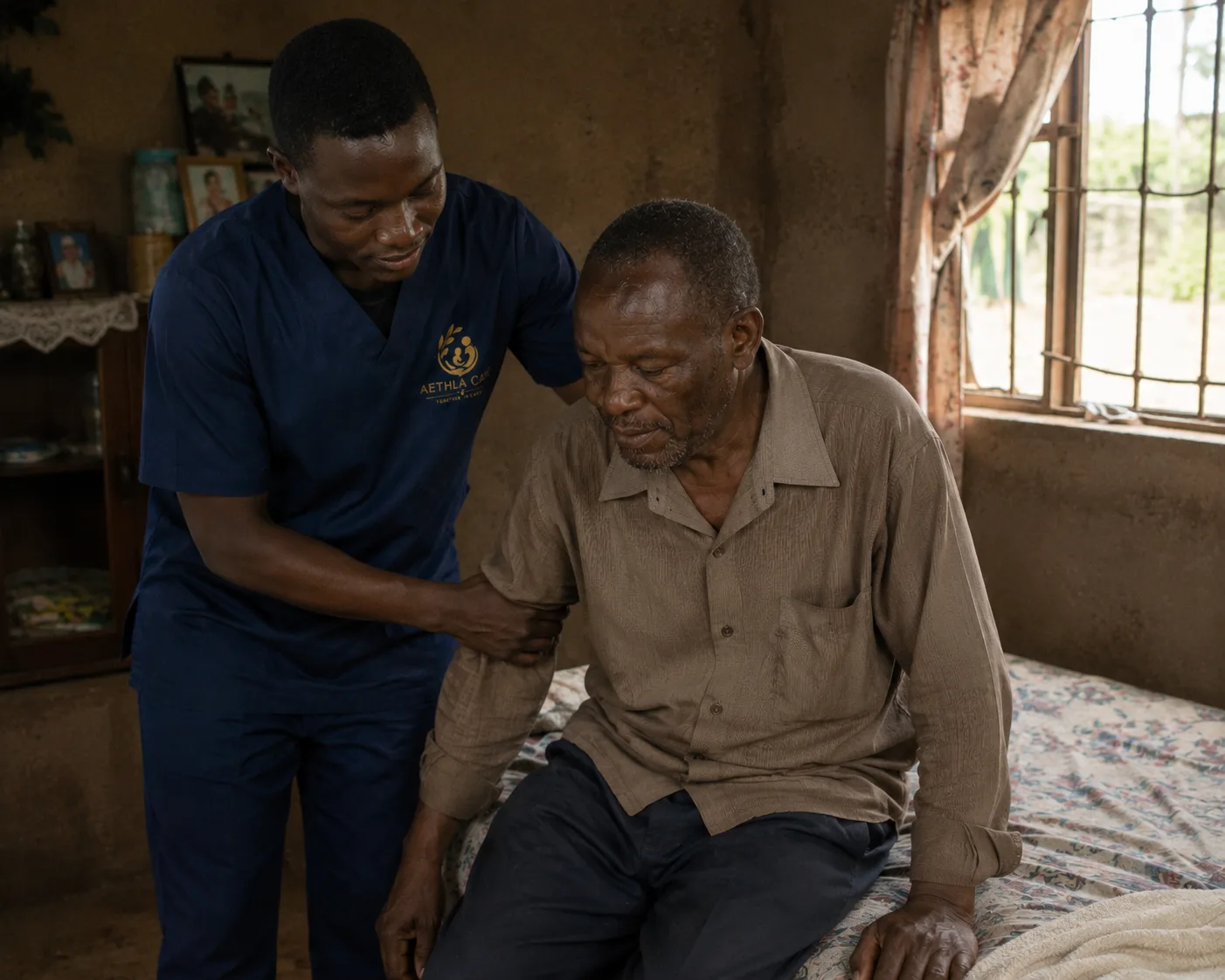
How to Arrange Home Care for an Elderly Parent in Uganda
Arranging care for an elderly parent can be difficult, particularly when family members are working, living in another part of Uganda, or living overseas. The challenge is not simply finding someone to help around the house. Families may need to coordinate companionship, household support, mobility, appointments, meals, errands, personal routines and communication between relatives.
For many families in Uganda, the preferred starting point is to help an older parent remain in a familiar home environment for as long as that arrangement is safe, appropriate and practical.
This guide explains how to assess an elderly parent's needs, what types of home care and family support may be appropriate, how to arrange support in Uganda, what questions to ask, and how families can coordinate care when they cannot be physically present every day.
Aethla Care helps families in Uganda coordinate elderly care, home and family support, specialist appointment navigation, mobility assistance and related care needs. Our approach starts by understanding the person and the family's situation before recommending a care route.
What is home care for an elderly person?
Home care generally means arranging appropriate support for an older person in their own home or familiar environment rather than automatically moving them into another setting.
The exact support required can vary considerably.
One older person may only need help with household routines, shopping, meals and companionship. Another may need regular assistance with mobility, appointments and family coordination. Someone recovering after a hospital stay may require a more structured period of support.
Home care can therefore include practical and social support such as:
- Companionship and regular check-ins - Help with household routines - Meal preparation and food-related errands - Shopping and essential errands - Assistance coordinating appointments - Transport and mobility coordination - Support attending healthcare appointments - Communication between family members - Assistance with everyday routines - Post-hospital practical support - Coordination with appropriate healthcare professionals or partners where required
The appropriate arrangement depends on the older person's circumstances.
Home support should not automatically be treated as a substitute for professional medical or nursing care. When a person needs clinical assessment, diagnosis, treatment or nursing services, the family should use appropriately qualified healthcare professionals.
Why families choose home care for elderly parents
Remaining at home can be important to many older people because their home is associated with familiarity, routines, neighbours, belongings, memories and family life.
The World Health Organization's approach to healthy ageing emphasizes person-centred, integrated care that responds to the needs and preferences of older people rather than focusing only on individual medical conditions.
This is particularly relevant when families are considering support for an elderly parent.
The question should not simply be:
"Does my parent need a caregiver?"
A better starting point is:
"What does my parent need help with, and what type of support would allow them to remain safe, comfortable and involved in everyday life?"
That distinction can lead to a more appropriate care arrangement.
Step 1: Start by understanding your parent's needs
Before searching for a caregiver or care provider, make a basic assessment of what is happening at home.
Consider your parent's:
Daily routine
What does a normal day look like?
Consider:
- Getting up and preparing for the day - Meals - Household activities - Shopping - Medication routines - Appointments - Social activities - Rest - Evening routines
Understanding the existing routine helps the family identify where assistance is actually needed.
Mobility
Consider whether your parent has difficulty:
- Walking around the home - Using stairs - Getting into or out of a vehicle - Travelling to appointments - Going shopping - Moving around outside the home - Attending community or family activities
Mobility requirements can affect the type of support and transport arrangement required.
Household responsibilities
An older person may still be independent but struggle with physically demanding household tasks.
Support might include:
- Cleaning - Laundry - Shopping - Meal preparation - Errands - Organizing household supplies - General household assistance
This type of practical support can sometimes make a significant difference without requiring intensive personal care.
Social connection
Families should also consider companionship.
An older person who spends long periods alone may benefit from regular social contact, conversation, shared activities or assistance maintaining connections with family and community.
Social support is not the same as clinical care, but it can be an important part of an overall family-support plan.
Step 2: Separate practical support from healthcare needs
One of the most important steps is understanding the difference between care coordination, home support and clinical healthcare.
For example, a family may need someone to:
- Accompany an elderly parent to a doctor's appointment - Help organise transport - Coordinate appointment information with relatives - Assist with household tasks - Provide companionship - Help with everyday routines
Those are different from clinical responsibilities such as:
- Diagnosing an illness - Prescribing medication - Performing medical procedures - Making clinical decisions - Providing specialist medical treatment
If a medical issue is involved, the family should seek appropriate professional healthcare.
Aethla Care's role is to help families understand and coordinate the appropriate route rather than replace doctors, nurses, hospitals or other licensed healthcare professionals.
Step 3: Decide what type of support is required
Once the family's needs are clearer, group them into practical categories.
Companionship
This may be appropriate when the main concern is social isolation, lack of regular contact or simply having someone available for conversation and everyday support.
Household assistance
Some families primarily need help with:
- Cleaning - Laundry - Shopping - Cooking - Errands - Household organization
This can be particularly useful when an elderly parent remains independent but finds certain tasks physically difficult.
Appointment support
An elderly person may need assistance arranging or attending appointments.
Support can include:
- Helping organize appointment details - Coordinating transport - Accompanying the person where appropriate - Helping family members understand the logistics - Keeping relatives informed about arrangements
The healthcare provider remains responsible for medical assessment and clinical decisions.
Mobility and transport support
Transport can become an important consideration when an older person has difficulty travelling independently.
Families should think about:
- Where the person needs to go - Whether they need an accompanying person - Whether there are mobility limitations - How long the journey will take - Whether appointments require return transport - Who will communicate with the family
This is particularly relevant for specialist appointments, hospital visits and essential errands.
Step 4: Consider whether the support should be occasional or regular
Not every family needs full-time assistance.
Depending on the situation, an elderly parent might require:
- Occasional assistance - Specific days each week - Appointment-based support - Regular household help - Companionship visits - Increased support following illness or hospital discharge
The correct arrangement should reflect the actual need.
Families should avoid paying for or arranging a level of support that is unnecessary simply because it sounds more comprehensive.
At the same time, they should not underestimate the amount of help required if an older person's needs have changed significantly.
Step 5: Involve your parent in the decision
One of the most important considerations is the older person's own preference.
Whenever possible, involve your parent in conversations about:
- What help they want - What help they do not want - Who they feel comfortable receiving support from - Their preferred routines - Their privacy - Their household preferences - How family members should communicate with them
Care should not become something that happens to an older person without considering their wishes.
A person-centred approach means understanding the individual rather than treating every elderly person as having the same needs.
This is consistent with the broader WHO approach to integrated care for older people, which emphasizes care that responds to people's needs and preferences.
Step 6: Consider safety at home
Families should look at the home environment as part of the care discussion.
Consider potential hazards such as:
- Poor lighting - Loose rugs or obstacles - Difficult-to-access bathrooms - Cluttered walkways - Unsafe stairs - Frequently used items stored too high or too low - Difficulty accessing essential rooms
The objective is not to turn the home into a clinical environment.
It is to identify practical problems that could make everyday activities more difficult or unsafe.
If there are significant mobility, cognitive or medical concerns, families should seek appropriate professional assessment.
Step 7: Think about healthcare coordination
An elderly parent may have several appointments or healthcare needs that require family coordination.
This can become particularly challenging when children or relatives are not living nearby.
A family may need to coordinate:
- Specialist appointments - Hospital visits - Diagnostic appointments - Follow-up appointments - Transport - Documentation - Communication between relatives
Aethla Care's Specialist & Healthcare Navigation service is designed around this coordination role.
The purpose is not to diagnose or prescribe. It is to help families understand what needs to be organized and coordinate the appropriate route with the relevant healthcare providers or partners.
Step 8: If your parent lives alone, consider the wider support network
Home care should not necessarily be viewed as one person solving everything.
An elderly parent's support network may include:
- Adult children - Relatives - Neighbours - Friends - Community members - Healthcare professionals - Caregivers - Transport providers - Specialist providers - Care coordination services
The family can map out who is responsible for what.
For example:
Family member: major decisions and family communication
Healthcare professional: clinical assessment and treatment
Caregiver/support person: agreed practical and personal support
Transport provider: agreed transportation
Care coordinator helps organize the different parts of the support plan
Step 9: Families living abroad need an additional layer of coordination
Arranging care becomes more complicated when the person's children live overseas.
A daughter in Australia, a son in the United Kingdom, or another family member in the United States may be responsible for helping an elderly parent in Kampala or elsewhere in Uganda.
Distance can make ordinary tasks more difficult.
A family member abroad may need to arrange:
- Home support - Household assistance - Specialist appointments - Transport - Hospital-related support - Regular family updates - Mobility assistance - Follow-up arrangements
The overseas family member may also need someone locally who can help coordinate practical matters.
This is one reason care coordination can be particularly valuable for diaspora families.
The objective is not to remove the family from the care process.
Instead, it can help the family remain involved while practical support is coordinated locally.
What should you ask before arranging elderly home care?
Before agreeing to a care arrangement, ask practical questions.
About the person's needs
- What exactly does my parent need help with? - How frequently is support required? - Which tasks are essential? - Which tasks are optional? - Are there mobility concerns? - Are there upcoming medical appointments?
About the person providing support
- What responsibilities will they have? - What responsibilities are outside their role? - How will communication work? - Who should be contacted if circumstances change? - What happens if the assigned person is unavailable?
About healthcare
- Does my parent require professional medical or nursing care? - Who is responsible for clinical decisions? - Are there specialist appointments to coordinate? - Does transport need to be arranged?
### About family communication
- Who receives updates? - How frequently should family members be informed? - What information requires immediate communication? - Has the older person's consent been considered?
These questions can prevent misunderstandings later.
How much does elderly home care cost in Uganda?
There is no single price that applies to elderly home care in Uganda.
The cost of support can depend on factors such as:
- Type of support - Frequency - Duration - Location - Number of tasks involved - Mobility requirements - Transport requirements - Whether specialist or professional healthcare services are required - Whether support is occasional or ongoing
Families should therefore be cautious about relying on a generic online figure without understanding what is included.
A practical care assessment should come before discussing the appropriate arrangement.
Aethla Care can help families clarify the type of support required before a care route is confirmed.
Elderly home care in Kampala, Wakiso, Entebbe and Mukono
Aethla Care's current early service footprint includes Kampala, Wakiso, Entebbe and Mukono, with availability depending on the type of support required.
Families outside these areas can still contact Aethla Care with the person's location and care requirements so that the appropriate route can be clarified.
This is important because not every type of care or support can be assumed to be available everywhere.
Families should receive clear information about what can actually be coordinated before making arrangements.
What if an elderly parent needs more care than home support can provide?
Sometimes a family's initial plan may not be enough.
For example, an older person's needs may change following:
- Hospitalization - Injury - A significant change in mobility - A new health concern - Increasing difficulty with daily activities - Changes in memory or cognition - Increasing dependence on other people
In these situations, families should not simply increase household assistance and assume the problem is solved.
A healthcare professional may need to assess the person's changing needs.
The appropriate arrangement may involve a combination of professional healthcare, family support, home assistance, transport and care coordination.
Post-hospital support for an elderly parent
Returning home after hospitalization can create additional practical challenges.
Families may need to organize:
- Transport home - Household preparation - Meals - Essential errands - Appointment follow-up - Family communication - Mobility support - Additional home assistance
The exact requirements depend on the person's condition and the instructions provided by their healthcare team.
If clinical care is required, the family should follow the instructions of the relevant healthcare professionals.
Aethla Care can help families coordinate appropriate non-clinical support and navigation around the wider care journey.
---
How Aethla Care helps families coordinate elderly care in Uganda
Aethla Care takes a family-first approach to care coordination.
Rather than starting with a list of services, the process starts with the person's situation.
1. Tell us what you need
The family explains what is happening and what support they believe may be required.
2. Clarify the care route
Aethla Care helps distinguish between practical home support, household assistance, mobility, appointment coordination, specialist navigation and situations that require professional healthcare.
3. Coordinate support
Where the appropriate route is available, the relevant support can be coordinated.
4. Keep the family informed
Families can remain involved and understand what has been arranged.
This can be particularly useful for families who live in different parts of Uganda or overseas.
Aethla Care is not simply a nursing company, hospital or domestic staffing agency. It is designed as an integrated care and family-support platform that helps families coordinate different aspects of care.
Questions to ask your elderly parent today
If you are unsure where to start, sit down with your parent and ask:
1. What is becoming difficult for you at home? 2. What would you like help with? 3. What do you still want to do independently? 4. Are you finding it difficult to attend appointments? 5. Do you need help with transport? 6. Are household tasks becoming difficult? 7. Do you feel you are spending too much time alone? 8. Is there anything about the home that makes daily life difficult? 9. Who would you like involved in decisions about your support? 10. What would make you feel more comfortable at home?
These questions can provide a much better starting point than simply asking whether your parent "needs a caregiver."
Frequently Asked Questions
What is the best type of home care for an elderly parent in Uganda?
There is no single type that is best for every older person. The appropriate arrangement depends on the person's needs, preferences, mobility, health situation, household circumstances and family support network.
Can an elderly person receive care at home?
Yes, depending on their circumstances and the type of support they require. Some older people may benefit from practical household assistance, companionship, mobility support or appointment coordination while continuing to live at home.
How do I arrange elderly care in Kampala?
Start by identifying what your parent actually needs help with. You can then determine whether the requirement is household assistance, companionship, mobility support, appointment coordination, professional healthcare or a combination of these.
Aethla Care can help families clarify and coordinate appropriate support in Kampala and its current service footprint.
Can I arrange care for my parent in Uganda while living abroad?
Yes. Families living overseas can coordinate different types of support for parents and relatives in Uganda. This may include home support, household assistance, appointment coordination, mobility and transport, and family communication.
Can Aethla Care arrange medical treatment?
Aethla Care does not replace doctors, hospitals or other healthcare professionals. Its role includes care coordination and healthcare navigation, such as helping families organize appropriate appointments and support around the healthcare journey.
Does elderly care always mean having someone live with my parent?
No. Support can be occasional, scheduled or task-specific depending on the person's circumstances. The appropriate arrangement should reflect actual needs.
Can elderly home care include transport to appointments?
Depending on the support route and location, mobility and transport coordination may be part of the wider support plan. Families should clarify the exact requirements before arrangements are confirmed.
What if my parent needs both home support and specialist appointments?
These needs can sometimes be coordinated as part of a wider family-support plan. The healthcare provider remains responsible for clinical decisions, while practical coordination can help the family manage the overall process.
Does Aethla Care support families outside Kampala?
Aethla Care's early service footprint includes Kampala, Wakiso, Entebbe and Mukono, with availability depending on the type of support required. Families elsewhere in Uganda can provide their location and requirements so the appropriate route can be clarified.
Start with the person, not the service
Arranging care for an elderly parent is not simply about finding someone to come to the house.
It is about understanding the person's life, routines, preferences, challenges and support network.
For some families, the answer may be a small amount of household assistance. For others, it may involve regular companionship, mobility support, appointment coordination, healthcare navigation or a broader care plan.
The most useful first step is therefore to understand **what your parent actually needs.
At Aethla Care, our approach is:
Tell us what you need → clarify the care route → coordinate support → keep the family informed.
Whether you are in Kampala, Wakiso, Entebbe, Mukono or overseas and coordinating care for a family member in Uganda, the starting point is the same: understand the person, understand the need and then determine the appropriate support.
Aethla Care — Trusted Care for Every Stage of Life.
Sources and factual references
World Health Organization — Integrated care for older people (ICOPE). WHO's ICOPE approach focuses on person-centered assessment and integrated care designed around older people's needs and preferences.
World Health Organization — Healthy Ageing. WHO's healthy-ageing framework emphasizes maintaining functional ability and enabling older people to live well in environments that support their needs.
Uganda Ministry of Health — Health Sector Development / Strategic Planning. Uganda's health-sector planning provides national context for improving access, quality and delivery of health services.
Healthcare Navigation & Specialist Appointments in Uganda
- healthcare navigation in Uganda - specialist appointment coordination - healthcare support for elderly parents
`/blog/healthcare-navigation-specialist-appointments-uganda`
Home Care and Domestic Support in Uganda
- home care in Uganda - domestic support - household assistance
`/blog/home-care-domestic-support-uganda`
Disability Support in Uganda
- disability support in Uganda - mobility and disability care - support for people with disabilities
Link: `/blog/disability-care-support-uganda`
Diaspora Family Support in Uganda
- supporting parents in Uganda from abroad - diaspora family care - coordinating care from overseas
`/blog/diaspora-care-uganda`
Travel & Mobility Support
- mobility support in Uganda - transport assistance for appointments
`/blog/travel-mobility-support-uganda`
Family Support in Uganda
- family support in Uganda - coordinated family care
`/blog/maternity-family-support-uganda`
- Elderly Care Uganda - Home Care Uganda - Elderly Parent Support - Senior Care Uganda - Elderly Home Support - Caregiver Support Uganda - Older Adult Care - Family Care Coordination - Elderly Healthcare Support - Home Assistance Uganda - Ageing Support Uganda - Mobility Support Uganda - Healthcare Navigation Uganda - Diaspora Care Uganda - Kampala Elderly Care - Elderly Support Services - Care Coordination Uganda - Parent Care Uganda