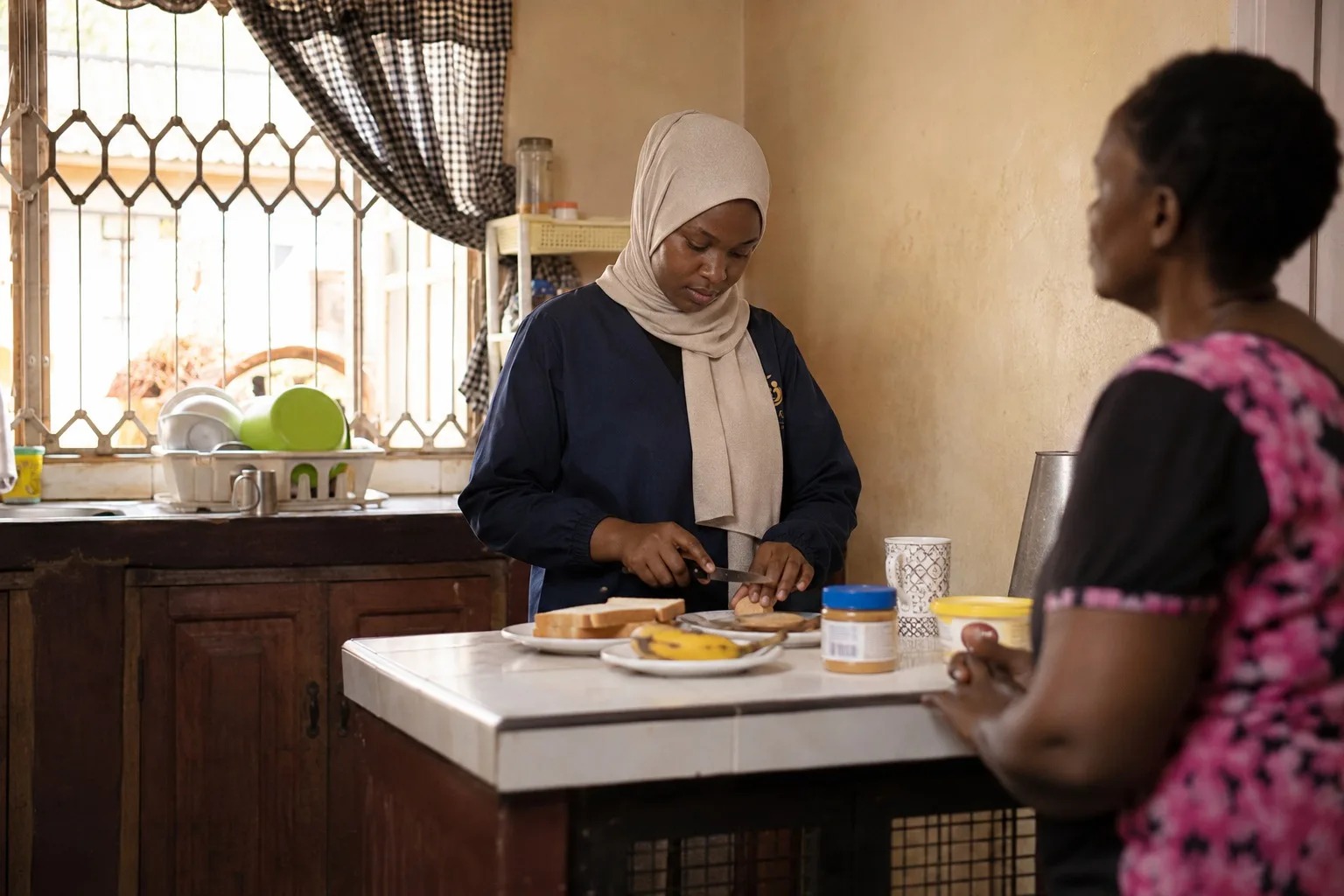
Home Care and Domestic Support in Uganda
For many Ugandan families, care does not happen in a hospital or clinic.
It happens at home.
It may involve helping an older parent manage daily routines, supporting a person living with a disability, helping a new mother after childbirth, caring for children, managing meals and household tasks, arranging appointments, providing companionship, or simply making everyday family life more manageable.
Sometimes the family needs a caregiver.
Sometimes it needs a maid or domestic worker.
Sometimes it needs a **babysitter or nanny.
Sometimes it needs **professional nursing or clinical care.
And sometimes the family needs help understanding which type of support is actually appropriate.
This distinction matters.
A maid is not automatically a caregiver. A caregiver is not automatically a nurse. A nurse is not simply a domestic worker. A babysitter does not automatically provide specialist newborn or medical care.
The right support begins by understanding the actual need.
That is where home care and domestic support can become much easier to navigate.
Aethla Care provides a Uganda-first care coordination point where families can explain their situation, understand possible support routes, and clarify whether Aethla operates, coordinates, partners in, or simply helps the family explore a particular service.
What Is Home Care in Uganda?
Home care generally refers to support provided around a person's life and care needs in their home or usual environment.
The exact type of support can vary considerably.
For one family, home care might mean practical assistance with daily routines.
For another, it could involve companionship for an older adult.
Another family may need support following hospital discharge.
A person living with a disability may need assistance that promotes independence while respecting the person's existing abilities and preferences.
A family caring for a relative may also need help coordinating appointments, transport, household responsibilities and communication.
Home care therefore should not be treated as one fixed package.
A useful home-care conversation asks:
- Who needs support? - What does the person need help with? - What can the person still do independently? - What does the family already manage? - What support is needed every day? - What support is needed occasionally? - Does any part of the situation require a qualified healthcare professional? - Where is the support needed? - Who needs to remain informed? - What responsibilities will belong to the household, caregiver, provider or coordinator?
These questions help prevent families from purchasing a service that does not actually match their situation.
What Is Domestic Support in Uganda?
Domestic support focuses primarily on practical household and day-to-day responsibilities.
This can include areas such as:
- Cleaning - Laundry - Household organization - Meal preparation - Shopping and errands - General household assistance - Supporting family routines - Basic companionship - Helping organize appointments or reminders - Other agreed household responsibilities
The exact responsibilities should be discussed clearly before employment, or service arrangements begin.
Families should approach domestic employment as a genuine working relationship where applicable. Clear expectations about duties, working arrangements, remuneration, time, responsibilities and communication can help reduce misunderstandings.
A good domestic-support arrangement should protect both the household receiving support and the person providing that support.
Maid, Domestic Worker, Caregiver or Nurse: What Is the Difference?
One of the most important questions families should answer is:
What type of person do we actually need?
The words *maid, house help, caregiver, carer, nurse, babysitter and nanny are sometimes used interchangeably in everyday conversation.
They should not automatically be treated as interchangeable professional roles.
Maid or Domestic Worker
A domestic worker generally focuses on household responsibilities.
Depending on the agreed role, this may include:
- Cleaning - Laundry - Cooking or meal preparation - Household organization - Shopping - General household assistance
A domestic worker may also be part of a household's wider support system.
However, domestic employment by itself does not mean that the worker is qualified to provide clinical care.
Caregiver
A caregiver may provide practical personal or supportive assistance to someone who needs help with daily life.
Depending on qualifications, experience and the agreed role, this may include:
- Assistance with daily routines - Companionship - Support with mobility - Help with personal routines - Support for an older person - Disability-related practical assistance - Family communication - Appointment support
The exact responsibilities must be established before the arrangement begins.
Nurse
A nurse is a qualified healthcare professional whose role involves professional clinical responsibilities within the scope of their training, registration and practice.
Clinical care can include activities that should not simply be assigned to a domestic worker or unqualified caregiver.
Families should never assume that someone can perform a medical procedure merely because they have previously helped an older relative or worked in a household.
When a situation requires clinical care, the appropriate qualified healthcare professional should be involved.
Babysitter or Nanny
A babysitter or nanny generally focuses on childcare.
Responsibilities may include:
- Child supervision - Feeding - Play and age-appropriate activities - School routines - Child-related household organization - Basic childcare support
However, childcare responsibilities should be distinguished from medical or specialized newborn care.
If a child has a health condition or specific clinical requirement, families should establish whether qualified professional support is necessary.
Home Care vs Domestic Help
A useful way to understand the difference is to ask:
Is the main need about the household, the person, or both?
Domestic Support Is Mainly About the Household
For example:
“We need help with cleaning, laundry, meals and household organisation.”
Caregiving Is Mainly About the Person’s Daily Support
For example:
“My elderly mother needs someone to help with routines, companionship and getting to appointments.”
Nursing Is Focused on Professional Clinical Care
For example:
“A qualified professional needs to provide clinical care at home.”
Family Support May Involve All Three
For example:
“Our father has returned home after hospital treatment. We need help organising the household, supporting his daily routine and coordinating follow-up appointments.”
This last situation is where families can become overwhelmed.
The solution may not be one worker doing everything.
It may require several clearly defined support roles working together.
What Types of Home Support Can Families in Uganda Need?
Home support can take many forms.
1. Household Assistance
Families may need practical help with:
- Cleaning - Laundry - Cooking - Shopping - Errands - Household organization - General domestic routines
This can be especially useful for households where work, childcare or caring responsibilities have become difficult to manage.
2. Elderly Home Support
Older adults may need assistance while continuing to live in familiar surroundings.
Support may involve:
- Companionship - Daily routines - Mobility assistance - Appointment coordination - Household support - Family communication - Practical assistance after hospital discharge
The objective should not automatically be to take over everything the person does.
Where possible, support should preserve independence, dignity and choice.
3. Disability-Related Home Support
A person living with a disability may require practical assistance while still wanting to maintain control over their daily life.
Support can involve:
- Personal routines - Mobility - Household tasks - Community participation - Transport planning - Communication support - Family coordination
Aethla's disability-support approach starts with the person, their routines, strengths, goals and communication preferences rather than assuming that every person with the same diagnosis needs the same service.
4. Companion Care
Companionship can be an important part of home support.
A companion may help with:
- Conversation - Social interaction - Shared activities - Walks where appropriate - Reading - Household routines - Accompanying someone to appointments or activities where agreed
Companionship can be particularly valuable for people who spend substantial periods of time alone.
However, companionship should not be represented as professional medical care unless the person providing it is appropriately qualified and the service actually includes clinical responsibilities.
5. Post-Hospital Home Support
Returning home after hospital treatment can create a new set of challenges.
Families may need to organize:
- Household help - Meals - Transport - Appointments - Family communication - Practical daily support - Follow-up arrangements
The medical plan should remain under the direction of the appropriate healthcare professionals.
Home support can help the household manage the practical side of recovery.
6. Support for Working Families
Parents and working professionals may need assistance with household responsibilities because work and family demands overlap.
Possible needs include:
- Domestic help - Childcare - Meal preparation - Errands - Household organization - Appointment coordination - Support for an elderly relative
Rather than searching separately for every possible service, families can first identify the complete situation and then determine which support roles are actually needed.
How Do I Find a Maid or Domestic Worker in Uganda?
Families searching online may use terms such as:
- Maid Uganda - Maids Kampala - Maid services Kampala - House help Uganda - Domestic worker Uganda - Domestic assistance Uganda - Household help Kampala
These terms may describe different arrangements.
Before engaging someone, clarify:
1. What Work Needs to Be Done?
Create a realistic list.
For example:
- Cleaning - Laundry - Cooking - Childcare - Shopping - Elderly support - Pet care - Gardening - Household organization
Do not simply advertise for “a maid” without understanding what the actual job requires.
2. Is Childcare Involved?
If children are involved, specify their ages and the expected responsibilities.
Childcare can require a very different skill set from general domestic work.
3. Is Elderly or Disability Support Involved?
If yes, describe the actual support required.
Someone who is excellent at household cleaning may not be suitable for supporting a person with mobility limitations.
4. Is Personal Care Involved?
If the person needs assistance with personal routines, mobility or other sensitive needs, establish exactly what is required and whether specific training or professional qualifications are necessary.
5. Is Clinical Care Involved?
If yes, the family should not simply assign those responsibilities to a domestic worker.
A qualified healthcare professional may be required.
What Should Families Check Before Hiring a Domestic Worker?
A careful process can reduce avoidable problems.
Families should consider:
Identity and References
Where appropriate, verify identity and request relevant references.
Previous Experience
Ask about previous household responsibilities and experience relevant to the proposed role.
Role Suitability
Someone may be an excellent cleaner but unsuitable for elderly care.
Someone experienced in childcare may not be qualified for disability support.
Someone with nursing experience may not be seeking domestic employment.
Match the person to the actual role.
Expectations
Discuss:
- Duties - Working hours - Time off - Pay - Household rules - Privacy - Accommodation if applicable - Communication - Boundaries - Responsibilities
Safeguarding
Families should consider the safety of:
- Children - Older adults - People with disabilities - Domestic workers - Other household members
Safeguarding should work in both directions.
A good home-support arrangement should protect the person receiving support and the person providing it.
Can a Maid Provide Care for an Elderly Person?
Not automatically.
A domestic worker may be able to assist an older person with household tasks, companionship or agreed practical activities.
However, that does not automatically make the person a trained caregiver or nurse.
For example, a domestic worker may reasonably be responsible for:
- Cleaning - Cooking - Laundry - Household errands
A separate caregiver might support:
- Daily routines - Mobility - Companionship - Personal support
A qualified healthcare professional may be required for:
- Clinical assessment - Medical procedures - Clinical monitoring - Certain medication-related responsibilities - Nursing care
The exact requirement depends on the person's situation and the professional scope of the person providing support.
Can a Caregiver Also Do Household Chores?
Sometimes, but this should be clearly agreed.
For example, a caregiver might prepare a meal for the person they are supporting or help maintain the person's immediate environment.
That is different from making extensive household cleaning the main responsibility of a caregiving role.
A written or clearly agreed role can help prevent:
“I thought the caregiver was supposed to clean the whole house.”
versus:
“I thought the caregiver was only responsible for supporting the older person.”
Clear expectations protect everyone.
Home Care for Older Parents in Uganda
One of the most common reasons families explore home support is concern for an ageing parent.
The family may notice:
- Increasing difficulty managing household tasks - Missed appointments - Reduced mobility - Social isolation - Difficulty shopping or preparing meals - Increased dependence on relatives - Challenges after hospital treatment - A family caregiver becoming exhausted
Home care does not necessarily mean moving the older person out of their home.
For some families, appropriate support can allow an older person to remain connected to familiar routines and surroundings.
The right approach depends on the person's needs, preferences, safety and available support network.
Home Support for People Living with Disabilities
Disability support should begin with the person rather than a label.
Two people with the same disability may have completely different:
- Abilities - Communication preferences - Household arrangements - Mobility requirements - Support networks - Goals - Independence levels
Home support may therefore involve helping a person do something independently rather than doing everything for them.
A good question is:
“What does this person want to continue doing themselves, and where do they want support?”
That approach can lead to more respectful and practical support planning.
Home Support After Hospital Discharge
Families often discover that leaving hospital does not mean the practical challenges have ended.
The household may suddenly need to coordinate:
- Transport home - Meals - Household tasks - Follow-up appointments - Family responsibilities - Mobility - Communication between relatives - Professional follow-up
This is an important area where home care, healthcare navigation and mobility support can overlap.
Aethla can help families clarify the practical route and determine which parts can be coordinated and which require an independent professional or provider.
Home Support for New Parents
The arrival of a baby can transform household routines.
Parents may need help with:
- Household chores - Meals - Shopping - Childcare - Sibling routines - Appointments - Transport - Family organization
The practical burden can be particularly significant when parents are also returning to work or managing other children.
Domestic support can help with the household.
Childcare can help with child-related routines.
Qualified healthcare professionals should handle clinical maternity, postnatal or newborn concerns when necessary.
These roles should not be blurred simply because they occur in the same home.
Home Care and Childcare in Uganda
Childcare is another area where families sometimes combine multiple responsibilities under one job title.
A family may say:
“We need a maid.”
But what they actually need may be:
- A nanny - A babysitter - A domestic worker - A caregiver - A combination of household and childcare support
Before hiring, define:
- Children's ages - Working hours - School runs - Meals - Homework - Play - Bathing - Night support - Household responsibilities - Any special needs
If a child has medical or developmental requirements, those should be discussed separately.
Home Care for Families Living Abroad
A family member does not have to live in Uganda to need help coordinating support.
Ugandans living in:
- Australia - United Kingdom - United States - Canada - United Arab Emirates - South Africa - Europe - Other countries
may still be responsible for helping parents or relatives in Uganda.
The challenge is often not simply finding someone.
It is knowing:
Who can do what, where, when and how will the family know what happened?
Diaspora families may need help coordinating:
- Home support - Elderly care - Companionship - Specialist appointments - Hospital support - Mobility - Family communication - Practical household assistance
Aethla's diaspora-care pathway is designed around this coordination problem rather than requiring the family member abroad to manage every local detail personally.
How Much Does Home Care Cost in Uganda?
There is no single reliable price for “home care in Uganda.”
The cost of support can vary depending on factors such as:
- Type of support - Number of hours - Frequency - Location - Live-in or live-out arrangements - Experience - Qualifications - Number of people requiring support - Complexity of the care situation - Whether professional healthcare is required - Transport requirements - Whether services are delivered directly or coordinated through another provider
For this reason, families should be cautious about websites claiming that every maid, caregiver or home-care arrangement has one standard national price.
A more useful question is:
“What support do we actually need, and what type of professional or worker is appropriate for it?”
Once the role is clear, the family can obtain the relevant quotation or employment terms.
Home Care in Kampala, Wakiso, Entebbe and Mukono
Home-support needs exist across Uganda, but availability can differ substantially by location and service type.
Aethla Care's current early coordination footprint includes:
- Kampala - Wakiso - Entebbe - Mukono
Availability depends on the particular support requested and is confirmed before a family proceeds.
Families outside these locations can still provide their location and care need so that the appropriate route can be clarified.
This distinction is important for local SEO as well as for families.
A page saying “home care Uganda” should not imply that every provider operates in every district.
Local service availability should always be confirmed.
How Aethla Care Can Help Families Navigate Home Support
Aethla Care is positioned as an **integrated care and family-support platform**, rather than simply a maid agency, nursing company, clinic or travel operator.
Its home and family support pathway focuses on understanding the household situation and identifying the practical support route.
A family can start by explaining:
- Who needs support - Where they are located - What is currently difficult - What help is needed - Whether there is an elderly person, child or person with a disability involved - Whether there has been a recent hospital stay - Whether professional healthcare is required - How the family would like to communicate
The next step is to clarify the route.
Depending on the request, Aethla may:
- Operate a service directly - Coordinate support - Work with a partner - Help the family understand an external option - Explain that a particular service or location needs further confirmation
This distinction is central to responsible care coordination.
Families should know who is actually delivering the service.
The Aethla Care Home-Support Process
Step 1: Tell Us What Is Happening
Explain the situation in everyday language.
You do not need to know the correct service name before starting.
For example:
“My mother lives alone in Kampala and needs help with meals, shopping and appointments.”
Or:
“We need someone to help our family with household tasks and childcare.”
Or:
“My father has come home from hospital, and our family needs practical support.”
Step 2: Clarify the Actual Need
The important question is not simply:
“Do you need a maid?”
It is:
“What does the household actually need help with?”
That distinction can reveal whether the family needs domestic support, caregiving, childcare, mobility assistance, healthcare navigation, nursing or several services working together.
Step 3: Clarify Aethla's Role
Before proceeding, families should understand whether Aethla is:
- Delivering the service - Coordinating the service - Working with a partner - Providing information - Helping the family identify the next route
Step 4: Confirm Availability
Not every service is available in every location or at every time.
Availability, provider suitability and specific arrangements should be confirmed before a family commits.
This helps ensure that expectations are clear before support begins.
Step 5: Agree the Next Practical Step
The objective is not to overwhelm the family with options.
It is to make the next step clear.
A good support arrangement should help families understand:
- What happens next - Who is responsible - What support has been agreed - Who should receive updates - How concerns should be communicated
Questions to Ask Before Hiring Home Support in Uganda
Before agreeing to an arrangement, consider asking:
1. What exactly will the worker be responsible for?
2. Is this domestic work, caregiving, childcare or clinical support?
3. What experience does the person have?
4. Are references available?
5. Does the person have relevant qualifications?
6. What hours are expected?
7. What happens when the worker is unavailable?
8. Who supervises the arrangement?
9. What happens in an emergency?
10. What information should remain private?
11. Who communicates with family members?
12. Are transport responsibilities included?
13. Are overnight responsibilities expected?
14. Are there children or vulnerable adults in the household?
15. Does any part of the role require a qualified healthcare professional?
16. What are the agreed employment or service terms?
17. How will concerns be raised?
18. What happens if the arrangement is not working?
These questions can prevent significant misunderstandings later.
Home Care and Dignity
Good home support should not simply make life easier for the household.
It should also respect the person receiving support.
This means considering:
- Privacy - Choice - Independence - Communication - Cultural preferences - Personal routines - Family relationships - Personal belongings - Confidentiality - Dignity
For an older person, this may mean asking before changing their routine.
For a person with a disability, it may mean supporting independence instead of taking over.
For a new parent, it may mean providing practical help without unnecessarily interfering with family decisions.
Care is personal.
The support arrangement should recognize that.
Home Care Safety: When Professional Help Is Needed
Some situations should not be managed simply by hiring a household worker.
Professional healthcare support may be necessary where there are:
- Serious medical concerns - Sudden deterioration - Significant injury - Complex clinical needs - Medication questions requiring professional guidance - Wound-care requirements - Post-operative concerns - Emergency symptoms - Other situations requiring medical assessment
A domestic worker or general caregiver should not be expected to make medical diagnoses.
Aethla's role is to help families understand and coordinate practical routes, while clinical decisions remain with appropriate qualified healthcare professionals.
Home Care for Diaspora Families: What to Prepare
If you are arranging support for a parent or relative from outside Uganda, prepare:
The Person's Location
Include:
- District - Town - Neighborhood - Home location where appropriate
The Type of Support
Explain the actual need rather than simply saying “care.”
For example:
- Household assistance - Elderly support - Childcare - Companionship - Mobility assistance - Appointment support
Existing Providers
If the person already has:
- A doctor - Nurse - Hospital - Caregiver - Domestic worker - Family member helping
include this information.
Family Contacts
Identify who should be contacted locally and who should receive updates abroad.
Important Preferences
Include relevant information about:
- Routine - Language - Mobility - Communication - Cultural preferences - Family expectations
The more clearly the situation is described, the easier it is to identify an appropriate route.
Home Care Is About More Than Finding a Worker
One of the biggest mistakes families can make is assuming that every care problem can be solved by finding one person.
Sometimes it can.
Sometimes it cannot.
A household may need:
Domestic support + caregiver + nurse + transport + specialist appointment coordination.
Another family may need only:
Two days of household assistance each week.
Another may need:
Childcare + domestic support.
Another may need:
Companionship + appointment transport.
The right solution depends on the actual situation.
That is why care coordination matters.
Frequently Asked Questions About Home Care and Domestic Support in Uganda
What is home care in Uganda?
Home care is practical or professional support provided around a person's needs in their home or usual environment. It can include household support, companionship, caregiving, disability support, elderly support and, where appropriately provided, professional healthcare.
What is domestic support?
Domestic support refers primarily to assistance with household responsibilities such as cleaning, laundry, meals, errands and household organization.
What is the difference between a maid and a caregiver?
A maid or domestic worker generally focuses on household responsibilities, while a caregiver focuses more on supporting a person's daily care and wellbeing. The exact responsibilities should be agreed clearly.
Can a maid care for an elderly person?
A domestic worker may provide agreed practical assistance or household support, but being a maid does not automatically mean the person is trained or qualified as a caregiver or nurse.
Can a caregiver also clean the house?
This depends on the agreed role. Some caregiving arrangements may include limited household tasks, particularly those directly related to the person being supported. The responsibilities should be agreed beforehand.
Is home nursing the same as home care?
No. Home nursing involves professional clinical care by appropriately qualified healthcare professionals. Home care can refer more broadly to practical, personal, household or supportive assistance.
How much does home care cost in Uganda?
There is no single price for all home-care services. Costs depend on the type of support, hours, location, qualifications, complexity and other factors. Families should obtain terms or quotations based on their specific needs.
How do I find a maid in Uganda?
Start by defining the actual household responsibilities, working arrangement and required experience. Then use an appropriate recruitment, employment or coordination route and verify the person's suitability before engagement.
How do I find a caregiver for an elderly parent in Uganda?
Begin by identifying what your parent actually needs help with, such as companionship, mobility, daily routines or appointment support. If clinical care is required, identify an appropriately qualified healthcare professional.
Can I arrange home care in Uganda from abroad?
Yes. Families living outside Uganda can begin by explaining the location, person's needs, existing support and preferred communication arrangements. The appropriate local route and availability should then be confirmed.
Can Aethla Care help me find a maid?
Aethla Care can help families clarify domestic-support and home-support needs and determine what route can be coordinated. The exact role, provider and availability should always be confirmed before proceeding.
Can Aethla Care arrange a caregiver?
Aethla can help families explore and coordinate relevant care routes where an appropriate route is available. The exact service, provider role and availability must be confirmed for each request.
Can a domestic worker give medication?
Families should not assume that a domestic worker is qualified to manage medication simply because they work in the household. Medication-related responsibilities that require professional judgement should be handled through an appropriate qualified healthcare route.
Can a caregiver provide nursing care?
Only where the person is appropriately qualified and the service is being provided within their professional scope. “Caregiver” and “nurse” should not automatically be treated as the same role.
What should I look for in a home caregiver?
Consider relevant experience, suitability for the person's needs, references, role clarity, communication, reliability, safeguarding and any qualifications required for the specific support.
Does Aethla Care provide home care everywhere in Uganda?
Aethla is developing its Uganda-first service footprint carefully. Current early coordination focus includes Kampala, Wakiso, Entebbe and Mukono, with availability dependent on the type of support requested. Families outside these areas can ask about their specific location.
Aethla Care: One Starting Point for Home and Family Support
Families should not have to become experts in care terminology before asking for help.
You may know:
“My mother needs help.”
“We need a maid.”
“Dad cannot manage the house alone anymore.”
“We need someone to help after hospital.”
“We need childcare and household support.”
“Our family lives abroad and we need someone in Uganda to help coordinate things.”
That is enough to begin the conversation.
Aethla Care's approach is:
Tell us what you need → clarify the care route → coordinate the appropriate support → keep the family informed.
The objective is not to force every situation into the same service.
It is to understand the person, the household and the practical problem before identifying the next step.
Internal Linking Strategy for Aethla Care
This pillar should become one of the site's central internal-link hubs.
Link naturally to:
Elderly Care
Anchor examples:
- elderly care in Uganda - elderly home support - caring for older adults at home - support for an elderly parent
Disability Support
Anchor examples:
- disability support in Uganda - home support for people with disabilities - disability care and independence
Childcare & Newborn Support
Anchor examples:
- childcare in Uganda - newborn support - childcare and family support
Maternity & Family Support
Anchor examples:
- maternity and family support - support after childbirth - practical support for new parents
Travel & Mobility Support
Anchor examples:
- mobility support in Uganda - appointment transport - assisted travel
Healthcare Navigation
Anchor examples:
- healthcare navigation in Uganda - specialist appointment coordination - navigating healthcare services
Diaspora Care
Anchor examples:
- diaspora care in Uganda - arranging care for parents in Uganda from abroad - supporting family in Uganda from overseas
Get Care
Anchor examples:
- get care in Uganda - speak to a care advisor - start a care request
- Home care Kampala - Home care Uganda - Domestic support Kampala - Maid services Kampala - Caregivers Kampala - Elderly home care Kampala - Home support Wakiso - Home care Entebbe - Home support Mukono - Caregiver Uganda - Domestic assistance Uganda
- Home care - Domestic support - Elderly support - Disability support - Childcare - Maternity and family support - Specialist coordination - Healthcare navigation - Mobility support
Aethla Care is a Uganda-first integrated care and family-support platform connecting families with home care, domestic support, elderly care, childcare, specialist coordination and mobility support.
Home Care and Domestic Support in Uganda
Home care is not simply about finding someone to work in a household.
It is about understanding a person's life, family situation and practical needs.
A family may begin with a simple question:
“Who can help us at home?”
But the answer depends on what the household actually needs.
The family may need:
- Domestic support - Elderly care - Disability support - Childcare - Newborn assistance - Companionship - Mobility support - Healthcare navigation - Professional healthcare - A combination of several services
The most important first step is understanding the situation.
Aethla Care helps families begin that conversation by clarifying:
Who needs support → What help is required → Which route may be appropriate → Who should be involved → What happens next
This approach helps families avoid confusion between different roles and find support that matches their actual needs.
Need Home Care or Domestic Support in Uganda?
If you or your family needs help understanding the right support option, start by explaining your situation.
Useful information includes:
- Who needs support - Their location - The type of help required - Whether children, elderly relatives or people with disabilities are involved - Whether there has been a recent hospital stay - Whether professional healthcare is needed - Whether the family is coordinating from abroad - The preferred way to communicate
Aethla Care can then help clarify the practical route and explain how it can be involved.
Aethla Care Uganda
Phone: +256 795896044 WhatsApp/Text: +256 754319227 Email: support@aethlacare.org Office: 4th Floor, AHA Towers, 7 Lourdel Rd, Kampala, Uganda
Start with the situation. Understand the need. Coordinate the right support.
Elderly Care in Uganda
- elderly care in Uganda - support for older adults - elderly home support
Disability Support in Uganda
- disability support in Uganda - home support for people with disabilities
Childcare and Newborn Support
- childcare support - newborn support in Uganda
Maternity and Family Support Anchor text: - maternity support in Uganda - support for new parents
Healthcare Navigation in Uganda
- healthcare navigation in Uganda - specialist appointment coordination
Travel and Mobility Support
- mobility support in Uganda - appointment transport support
Diaspora Care
- supporting relatives in Uganda from abroad - diaspora family care
Get Care - request care support - start a care request
- Home Care Uganda - Domestic Support Uganda - Maid Services Uganda - Caregiver Support - Elderly Home Care - Disability Support - Childcare Support - Family Assistance - Household Support - Diaspora Care Uganda