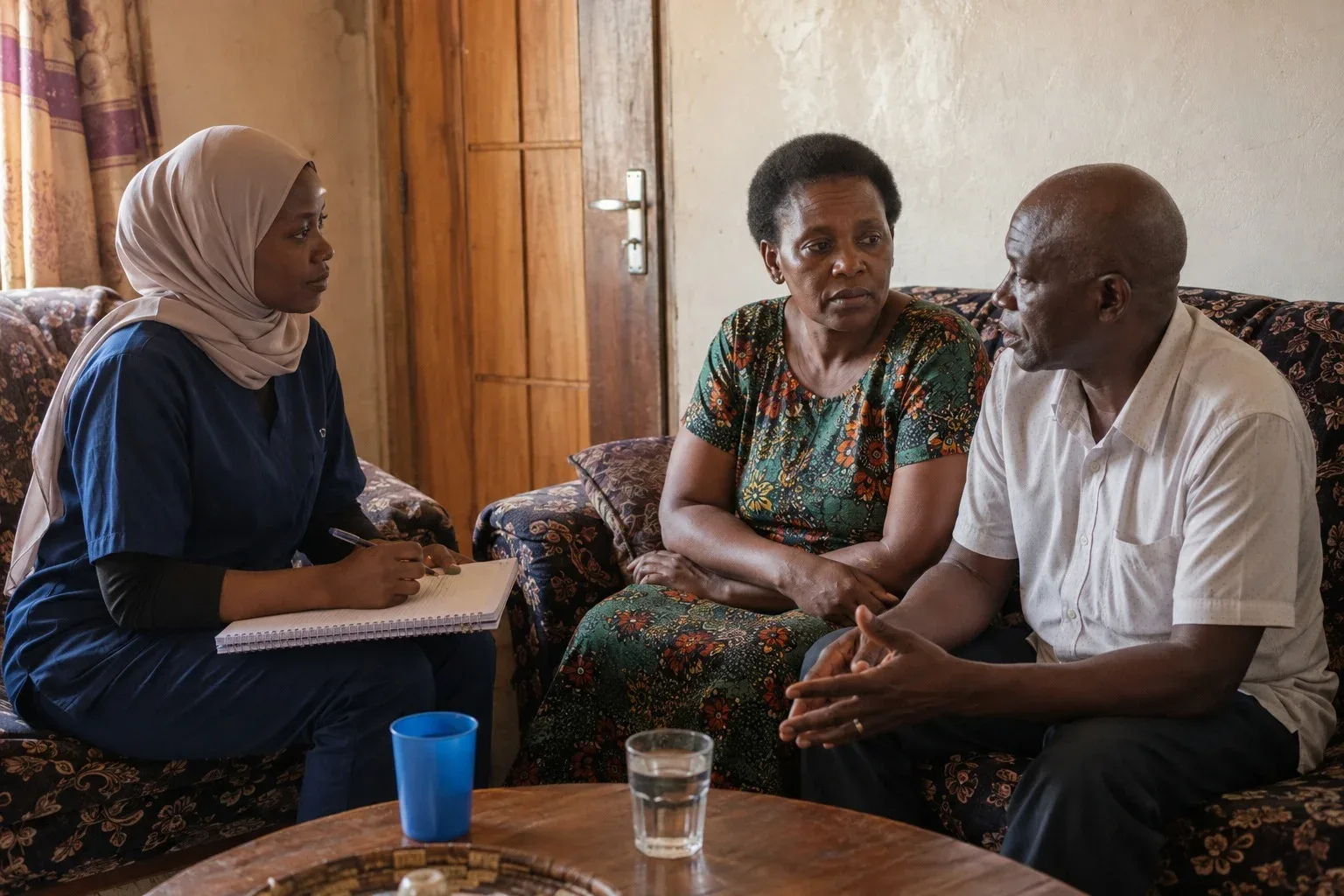
# Family Care Coordination in Uganda: A Complete Guide to Organising Elderly Care, Childcare, Disability Support, Home Help and Healthcare
**Primary Keyword:** family care coordination Uganda
**Secondary Keywords:** family care services Uganda, care coordination Uganda, family support Uganda, elderly care Uganda, home care Uganda, disability support Uganda, childcare Uganda, caregiver services Uganda, healthcare navigation Uganda, specialist appointments Uganda, care services Kampala, family care provider Uganda, care coordinator Uganda, home support Uganda
**Search Intent:** Informational + commercial investigation + service discovery
---
## Quick Answer: What Is Family Care Coordination in Uganda?
Family care coordination is the process of helping a person or family organise different types of care and practical support around their actual needs.
Instead of arranging elderly care, childcare, disability support, household assistance, healthcare appointments, transport and specialist services separately, a family can begin with one clear description of what is needed and then determine which services, professionals or partners are appropriate.
For example, a family may need:
- A caregiver for an older parent - Help organising specialist appointments - Support after hospital discharge - A babysitter or childcare support - A maid or household assistance - Disability and mobility support - Transport or an accompanying person for appointments - Home support for someone recovering from illness - Assistance for a family member living alone - Coordination for a Ugandan family member while relatives live abroad - Several of these services at the same time
Good care coordination starts with the **person and the family situation**, not with a predetermined service.
The goal is to make care easier to understand, organise and communicate while keeping clinical decisions with qualified healthcare professionals and ensuring that each service is provided by the appropriate person or organisation.
---
# Why Family Care Coordination Matters in Uganda
Families often do not have one single care problem.
A parent may be ageing while also managing appointments and reduced mobility.
A child may need childcare while both parents are working.
A person with a disability may require assistance at home, accessible transportation and rehabilitation appointments.
A relative returning home from hospital may need temporary practical support.
A Ugandan living abroad may need help coordinating support for parents or relatives at home.
These situations can involve several different organisations and professionals.
The difficulty is not always finding a single service.
Sometimes the difficulty is **putting the services together**.
Uganda's health system is also continuing to strengthen healthcare access, service quality, workforce capacity and health-system coordination. The Ministry of Health's Health Service Delivery Standards 2025–2030 set minimum standards intended to support quality, accessible and accountable healthcare services, while the Uganda National Health Compact 2025–2030 focuses on strengthening health services and progressing toward Universal Health Coverage.
Family care coordination sits around this wider system by helping families understand what practical support they need, which route is appropriate and what should happen next.
---
# What Does a Family Care Coordinator Do?
A care coordinator can help a family move from:
**“We need help, but we don't know where to start.”**
to:
**“We understand what support is needed, who should provide it and what the next step is.”**
Depending on the situation, coordination may include:
1. Understanding the family's care needs 2. Identifying priorities 3. Clarifying whether the need is medical, practical, domestic, childcare, mobility or social support 4. Identifying the appropriate service route 5. Coordinating with relevant professionals or service providers 6. Helping organise appointments 7. Coordinating transport or mobility support where appropriate 8. Helping families communicate information between relevant parties 9. Keeping family members informed 10. Reviewing whether the arrangement continues to meet the person's needs
The coordinator does **not** replace a doctor, nurse, therapist, hospital, specialist or other regulated professional.
Instead, coordination helps the different parts of a person's support system work together more clearly.
---
# Family Care Is More Than Healthcare
One of the most important distinctions is that **care and healthcare are not identical**.
Healthcare may involve:
- Doctors - Nurses - Specialists - Hospitals - Clinics - Physiotherapists - Occupational therapists - Pharmacists - Diagnostic services - Rehabilitation professionals
Family support may involve:
- Caregivers - Companions - Babysitters - Maids - Household assistance - Errand support - Appointment coordination - Transport assistance - Family communication - Practical assistance at home
A family may need both.
For example, an older adult might have a medical condition managed by a doctor but also require assistance with daily routines, appointments, transportation and household activities.
The medical treatment remains the responsibility of qualified healthcare professionals.
The practical support can be organised around it.
---
# The Main Types of Family Care Coordination in Uganda
## 1. Elderly Care Coordination
Older adults may need different types of support as circumstances change.
This can include:
- Companionship - Help with daily routines - Personal support - Household assistance - Appointment coordination - Mobility assistance - Transport arrangements - Post-hospital support - Family communication - Support for relatives who live elsewhere
A good elderly-care arrangement should begin by understanding the individual's preferences, abilities, routines and priorities.
WHO's integrated-care approach for older people emphasizes person-centred care and collaborative care planning involving the older person, family and caregivers where appropriate.
The objective is not simply to provide “someone to look after an elderly person.”
It is to determine what support actually helps that person live safely, comfortably and with as much independence as possible.
---
# 2. Disability Care Coordination
Disability support can involve multiple areas at once.
Depending on the person's circumstances, families may need to coordinate:
- Home support - Caregivers - Mobility assistance - Accessible transport - Rehabilitation - Assistive technology - Specialist appointments - Family support - Child disability services - Education-related support - Post-hospital assistance
Uganda's Ministry of Gender, Labour and Social Development lists the National Policy on Persons with Disabilities, 2023 and the Revised National Policy on Persons with Disabilities among its national policy documents.
The important principle is that disability support should not automatically be reduced to medical treatment.
A person's environment, mobility, communication, family circumstances and ability to participate in everyday life can all affect the support required.
---
# 3. Childcare and Family Support
Parents may require childcare support for many different reasons.
Examples include:
- Working parents - Parents attending appointments - Families needing temporary childcare - New parents needing practical assistance - Families managing several children - Parents who need help with routines - Families supporting a child while another family member is unwell
Childcare is different from clinical paediatric care.
A babysitter or childcare worker should not be presented as a substitute for a paediatrician, nurse or other healthcare professional.
Uganda's National Child Policy 2020 is listed among the country's current social-sector policy documents, while early childhood development policy and programming emphasize the importance of children's health, safety, responsive caregiving and development.
Good family coordination helps parents understand which need is childcare, which is healthcare and which may require specialist assessment.
---
# 4. Home Care and Household Support
A family may not need nursing care.
It may simply need practical assistance.
Home and family support can include:
- Household routines - Meal-related practical help - Errands - Shopping - Appointment reminders - Household organisation - Companionship - Support with everyday responsibilities - Assistance for a family member who needs practical help
This distinction is important.
A household assistant is not automatically a nurse.
A caregiver is not automatically a doctor.
A coordinator should help families identify the correct level of support rather than assigning every problem to the same category.
---
# 5. Healthcare Navigation and Specialist Appointments
Healthcare systems can be difficult to navigate, particularly when a family member needs several appointments or specialist services.
Healthcare navigation may involve helping a family:
- Identify the type of specialist required - Organise an appointment request - Understand what information may be needed - Coordinate appointment logistics - Arrange transport - Organise an accompanying person where appropriate - Keep relatives informed - Coordinate practical follow-up
For example, a family might know that an older parent needs medical attention but not know whether the next step should involve a general doctor, cardiologist, neurologist, physiotherapist or another professional.
A coordinator can help clarify the administrative and logistical route.
The coordinator should not diagnose the patient or determine treatment.
Clinical decisions remain with qualified healthcare professionals.
---
# 6. Travel and Mobility Support
Mobility can become a major part of family care.
A person may need assistance travelling to:
- Medical appointments - Rehabilitation - Hospital follow-ups - Essential activities - Family events - Other important destinations
Mobility support can involve:
- Transport coordination - An accompanying person - Journey planning - Timing coordination - Communication with family - Accessibility considerations
For an older adult or person with a disability, transport is not merely a convenience.
It can determine whether the person can reach healthcare, participate in the community or maintain independence.
The actual transport service should be provided by an appropriate transport provider or partner, depending on the journey and requirements.
Emergency medical transport is a separate matter and should use the appropriate emergency service.
---
# 7. Post-Hospital Family Support
Discharge from hospital does not necessarily mean that a family immediately returns to its normal routine.
Someone may return home needing:
- Practical assistance - Transportation - Household support - Appointment coordination - Caregiver assistance - Mobility support - Family monitoring - Follow-up appointment organisation
A useful family care plan should therefore ask:
**What happens after the person leaves the hospital?**
This does not mean that a non-clinical care provider should give medical instructions.
Instead, families can identify which parts of the discharge plan require qualified clinical follow-up and which parts involve practical support at home.
---
# 8. Care Coordination for Families Living Abroad
Family care coordination is particularly important for Ugandans living outside the country.
A family member in the United Kingdom, United States, Canada, Australia, UAE, South Africa or elsewhere may need to coordinate support for a parent or relative in Uganda.
The challenge is often not simply paying for a service.
It is knowing:
- Who will provide the support? - What exactly will they do? - When will support begin? - Who will communicate with the family? - What happens if circumstances change? - How will appointments be coordinated? - Who handles transport? - Who should the family contact if there is a problem?
A coordinated approach can give relatives abroad a clearer point of communication.
Aethla Care's diaspora-care approach is designed around this type of practical coordination rather than replacing the family's relationship with healthcare professionals.
---
# When Does a Family Need Care Coordination?
A family may benefit from coordination when:
### Several services are needed at once
For example:
> Elderly care + specialist appointment + transport + household assistance.
### Family members live in different locations
For example:
> One sibling lives in Kampala, another lives in Entebbe and another lives abroad.
### The person receiving care has changing needs
For example:
> Someone returns home after hospitalisation and needs temporary support while recovering.
### The family is unsure which service is appropriate
For example:
> “Do we need a caregiver, nurse, physiotherapist or household assistant?”
### A family is struggling to manage logistics
For example:
> “We know what needs to happen, but nobody has time to organise everything.”
These are coordination problems as much as individual service problems.
---
# How to Build a Family Care Plan in Uganda
A practical care plan can begin with seven questions.
## 1. Who needs support?
Record:
- Age - Living situation - Main concerns - Independence level - Important routines - Communication needs - Family contacts
Do not collect unnecessary personal information.
---
## 2. What does the person actually need?
Separate needs into categories.
| Area | Example | |---|---| | Healthcare | Doctor or specialist appointment | | Personal care | Assistance with daily routines | | Home | Household support | | Childcare | Babysitting or childcare | | Mobility | Transport or accompaniment | | Disability | Accessibility, rehabilitation or assistive support | | Family | Communication and coordination | | Administration | Appointment organisation |
This prevents one service from being expected to solve every problem.
---
# 3. What Is Urgent?
Families should distinguish between:
**Emergency**
Requires appropriate emergency medical assistance.
**Urgent healthcare**
Requires prompt assessment by a qualified healthcare professional.
**Routine healthcare**
Can be scheduled.
**Practical support**
Can be coordinated around the person's needs.
**Longer-term care**
Requires a sustainable plan that can be reviewed over time.
A care coordinator should never delay emergency care while attempting to arrange ordinary services.
---
# 4. Who Should Provide Each Part?
A simple responsibility map can prevent confusion.
| Need | Appropriate route | |---|---| | Diagnosis | Qualified healthcare professional | | Medical treatment | Licensed healthcare provider | | Specialist care | Relevant specialist/provider | | Rehabilitation | Qualified rehabilitation professional | | Personal care | Appropriate caregiver/support worker | | Childcare | Appropriate childcare provider | | Household support | Domestic/home-support provider | | Transport | Appropriate transport provider | | Care coordination | Care coordinator/platform | | Family decisions | Family/person receiving care |
This separation creates clearer expectations and better safeguarding.
---
# 5. How Will the Family Communicate?
A family should establish:
- Primary contact - Backup contact - Emergency contact - Preferred communication method - Appointment communication process - How changes will be reported - Who makes family decisions
For diaspora families, this can be particularly important.
A simple communication structure can prevent five relatives from receiving different versions of the same information.
---
# 6. How Often Should the Arrangement Be Reviewed?
Care needs change.
A person who needs minimal assistance today may need more support later.
A child may move into a different childcare arrangement.
An older adult may return home after hospitalisation.
A person with a disability may begin rehabilitation.
A family member may return to Uganda.
The care plan should therefore be reviewed when circumstances change rather than treated as permanent.
WHO guidance on integrated care emphasizes follow-up and monitoring as part of person-centred care planning.
---
# Choosing a Family Care Provider in Uganda
Before engaging a provider, families should ask practical questions.
### Service questions
- What exactly do you provide? - What do you not provide? - Is the service delivered directly or through a partner? - Where do you currently operate? - How is the person's need assessed? - Who coordinates the service?
### Caregiver questions
- How are caregivers selected? - What experience is required? - What references or verification are obtained? - What happens if the assigned caregiver is unavailable?
### Healthcare questions
- Are clinical services provided by licensed professionals? - Does the organisation diagnose or prescribe? - How are specialist appointments coordinated? - What happens when medical concerns arise?
### Safety questions
- How are safeguarding concerns handled? - Who should the family contact? - How are incidents reported? - What information is shared with family members?
### Continuity questions
- Who is the family's main point of contact? - Can support be adjusted when needs change? - How are replacements handled? - How does communication work when relatives live abroad?
A trustworthy provider should be clear about its boundaries rather than promising everything.
---
# Care Coordinator vs Caregiver vs Nurse: What Is the Difference?
These roles should not be confused.
| Role | Main function | |---|---| | Care coordinator | Organises and connects different parts of support | | Caregiver | Provides agreed practical/personal care support | | Nurse | Provides professional nursing care within their qualifications | | Doctor | Diagnoses and manages medical conditions | | Specialist | Provides specialist clinical assessment and treatment | | Physiotherapist | Provides professional rehabilitation/physical therapy | | Babysitter | Provides childcare within the agreed role | | Maid/domestic worker | Provides household/domestic assistance | | Transport provider | Provides transportation | | Family member | Makes or participates in personal/family decisions |
One person may sometimes have multiple skills, but families should not assume that one role automatically includes another.
---
# How Aethla Care Approaches Family Care Coordination in Uganda
Aethla Care is designed as an integrated care and family-support platform.
The starting point is not:
**“Which service do you want to buy?”**
It is:
**“What does your family need help with?”**
A typical Aethla Care journey is:
### Step 1 — Tell us what you need
The family explains the situation.
### Step 2 — Clarify the care route
The need is separated into practical, healthcare, childcare, household, mobility or other relevant areas.
### Step 3 — Coordinate the appropriate support
Aethla determines what can be coordinated directly, what requires a partner or independent provider, and what should remain with a healthcare professional or another organisation.
### Step 4 — Confirm the next practical step
The family receives a clearer route forward.
### Step 5 — Keep communication organised
Where appropriate, family members can remain informed about the coordination process.
Aethla Care is **not a hospital or clinic**, and healthcare navigation is not medical diagnosis or medical advice.
Clinical decisions remain with qualified healthcare professionals and the relevant healthcare facility.
---
# One Family, Multiple Needs: A Practical Example
Consider a family whose elderly mother lives in Kampala.
Her daughter lives abroad.
The mother needs:
- A specialist appointment - Transport to the appointment - Someone to accompany her - Help with household routines - Occasional companionship - Family communication
Trying to arrange each service independently can create multiple phone calls, contacts and schedules.
A coordinated approach can begin with one family-care assessment.
The needs can then be separated:
**Healthcare:** specialist appointment.
**Mobility:** appropriate transport.
**Accompaniment:** support during the journey and appointment where available.
**Home support:** household/practical assistance.
**Family communication:** agreed reporting and communication route.
The doctor remains responsible for clinical care.
The transport provider remains responsible for transport.
The caregiver remains responsible for the agreed support role.
The family remains involved in decisions.
The coordinator connects the practical pieces.
That is the central idea behind family care coordination.
---
# Family Care Coordination for Working Parents
Family coordination is not only for elderly care.
Working parents may need support with:
- Childcare - Household routines - School-related logistics - Appointments - Elderly parents - Disability support - Family transport - Temporary assistance during busy periods
A family may simultaneously have a young child and an ageing parent.
That creates a **multi-generational care situation**.
Instead of thinking about elderly care and childcare as completely separate problems, families can look at the entire household's support requirements.
---
# Family Care Coordination for People With Disabilities
A person with a disability may require a combination of:
- Personal support - Accessible transport - Rehabilitation - Specialist healthcare - Home modifications - Assistive technology - Family assistance - Communication support
The appropriate combination depends on the individual.
The purpose of coordination is to reduce unnecessary fragmentation while maintaining professional boundaries.
Uganda's health-sector work on rehabilitation and assistive technology is part of a broader effort to improve access to these services as components of healthcare.
---
# What Good Family Care Coordination Should Look Like
Good coordination should be:
### Person-centred
The person receiving care should not disappear behind the family's logistics.
### Clear
Everyone should understand who is responsible for what.
### Safe
Clinical, safeguarding and emergency issues should be handled through the appropriate professional routes.
### Flexible
Care arrangements should be able to change when needs change.
### Respectful
People should be treated with dignity and their preferences considered.
### Communicative
Families should know how information will be shared.
### Practical
The plan should work in real life, not just look good on paper.
### Transparent
Providers should clearly distinguish their own services from partner or independent services.
---
# Family Care Coordination in Kampala, Wakiso, Entebbe and Mukono
Aethla Care currently highlights **Kampala, Wakiso, Entebbe and Mukono** as its early service areas.
Actual availability depends on the type of support required.
Families outside these areas can still provide their location and care need so Aethla can determine whether a suitable route exists.
This is important because care availability can differ significantly by service type.
A responsible care platform should not imply nationwide operational coverage for every service unless that coverage has actually been established.
---
# A Family Care Coordination Checklist
Before arranging support, ask:
### About the person
- What support does the person need? - What can they do independently? - What are their preferences? - What are their important routines? - What are their communication needs?
### About healthcare
- Is there a medical issue? - Does a healthcare professional need to be involved? - Is a specialist appointment needed? - Are there existing instructions or follow-up appointments?
### About home
- Does the family need household assistance? - Is a caregiver required? - Is companionship useful? - Are mobility or accessibility issues present?
### About childcare
- Does the family need a babysitter? - Is childcare temporary or ongoing? - Are there specific routines or safety requirements?
### About mobility
- Does the person need transport? - Do they need someone to accompany them? - Is accessibility a consideration?
### About family communication
- Who is the primary family contact? - Are relatives abroad involved? - How should updates be shared?
### About safety
- What situations require immediate medical attention? - Who should be contacted in an emergency? - What are the provider's safeguarding procedures?
---
# Frequently Asked Questions
## What is family care coordination in Uganda?
Family care coordination is the process of organising multiple forms of care and practical support around a person's needs. It can include elderly care, disability support, childcare, home assistance, specialist appointments, mobility and family communication.
## Is a care coordinator the same as a nurse?
No. A care coordinator organises and connects services. A nurse provides professional nursing care within their qualifications.
## Can family care coordination include elderly care?
Yes. Elderly care coordination can include caregivers, household support, appointments, mobility, companionship and family communication, depending on the person's needs.
## Can care coordination help people with disabilities?
Yes. Depending on the situation, coordination may involve caregivers, rehabilitation, specialist appointments, mobility support, accessible transport and family assistance.
## Can Aethla Care arrange specialist appointments?
Families can request specialist appointment support through Aethla Care. The appointment route is coordinated with the relevant provider or partner rather than presented as live availability unless connected to an appropriate scheduling system.
## Does Aethla Care provide medical treatment?
Aethla Care is not a hospital or clinic. Clinical assessment, diagnosis and treatment remain the responsibility of qualified healthcare professionals and healthcare facilities.
## Can people living abroad arrange care for relatives in Uganda?
Yes. Families living abroad can use a care-coordination approach to organise practical support for relatives in Uganda, subject to the services and locations available.
## Does family care coordination include childcare?
It can. Childcare requirements should be clearly separated from medical or specialist healthcare needs, with appropriate childcare or healthcare professionals involved depending on the situation.
## Can family care coordination include a maid?
Yes, where domestic or household support is appropriate. A domestic worker should not automatically be expected to perform nursing or clinical duties.
## Can Aethla Care help with transportation?
Aethla Care can explore and coordinate appropriate travel or mobility support depending on the person's needs and the available provider route. Emergency medical transportation is a separate matter.
## Does care coordination replace the family?
No. Family members remain involved in important personal and care decisions. Coordination is intended to make arrangements clearer and more manageable.
## How do I start arranging care in Uganda?
Start by explaining who needs help, where they are located, what support they need and whether there are existing healthcare or family requirements. The next step is to determine the appropriate care route.
---
# How to Start Family Care Coordination With Aethla Care
Families do not need to know the perfect service name before making an enquiry.
Start with the situation.
For example:
> “My mother lives in Kampala and needs help with appointments and daily routines.”
Or:
> “We live abroad and need help coordinating support for our parents in Uganda.”
Or:
> “We have a child and an elderly parent and need help organising childcare and home support.”
Or:
> “My brother has a disability and needs help with mobility, appointments and support at home.”
The more clearly the family explains the situation, the easier it becomes to identify the appropriate route.
Aethla Care's role is to help turn a complicated care situation into a clearer set of practical next steps.
---
# Conclusion: One Family, One Coordinated Care Journey
Families in Uganda increasingly face situations where care is not one-dimensional.
An older parent may need healthcare, companionship, household support and transportation.
A child may need childcare while parents manage work and family responsibilities.
A person with a disability may need rehabilitation, mobility assistance, healthcare navigation and home support.
A family living abroad may need a reliable way to coordinate support for relatives in Uganda.
These situations are easier to manage when the different parts of care are understood and coordinated rather than treated as isolated problems.
Family care coordination does not mean replacing doctors, nurses, specialists, caregivers, childcare providers or transport companies.
It means helping families understand **which support is needed, who should provide it, how the pieces fit together and what should happen next**.
That is the role of an integrated family-care platform.
For families looking for elderly care, home support, childcare, disability assistance, specialist appointments, mobility support or care coordination in Uganda, Aethla Care provides a starting point for understanding the available route and organising the next practical step.
---
## Related Aethla Care Services and Resources
This pillar should naturally connect to the following Aethla Care pages and supporting articles:
- Elderly Care in Uganda - Disability Support Services in Uganda - Caregiver Services in Uganda - Home & Family Support - Childcare & Newborn Support - Maternity & Family Support - Specialist Appointments & Healthcare Navigation - Travel & Mobility Support - Diaspora Care in Uganda - Corporate Care in Uganda - Get Care - Areas We Serve - Contact Aethla Care
These internal links should be placed contextually within the relevant sections rather than as a large collection of links at the bottom of every page.
---
## Factual References and Further Reading
**Uganda Ministry of Health** — Health Service Delivery Standards 2025–2030.
**Uganda Ministry of Health** — Uganda National Health Compact 2025–2030.
**Uganda Ministry of Gender, Labour and Social Development** — National Policy on Persons with Disabilities, 2023 / Revised National Policy on Persons with Disabilities, 2023.
**Uganda Ministry of Gender, Labour and Social Development** — National Child Policy 2020.
**World Health Organization** — Integrated Care for Older People (ICOPE).
**World Health Organization** — Person-centred integrated care and personalised care planning.
---
## Important Information Note
This article provides general information about family care coordination and practical support. It is not a substitute for medical diagnosis, emergency care, professional healthcare advice, legal advice or individual clinical assessment.
Specific services, providers, locations and availability should be confirmed before arrangements are made. Clinical decisions should remain with appropriately qualified healthcare professionals.
**Last reviewed: September 2026**