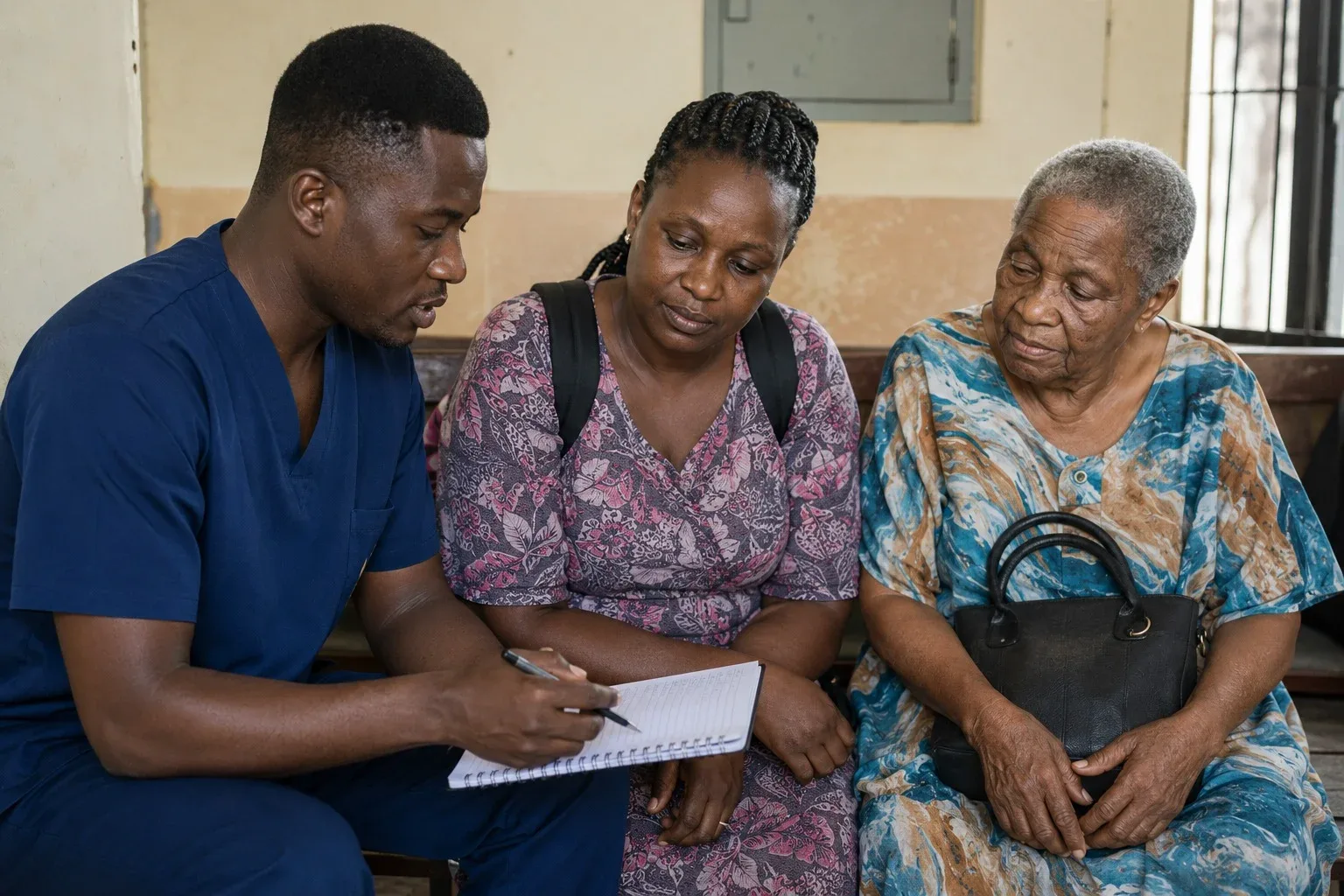
# Family Care Coordination in Uganda: A Complete Guide to Organising Elderly Care, Childcare, Disability Support, Home Care and Healthcare
**Primary Keyword:** family care coordination Uganda
**Secondary Keywords:** family care Uganda, care coordination Uganda, care services Uganda, family support services Uganda, home care Uganda, elderly care Uganda, childcare Uganda, disability support Uganda, caregiver services Uganda, healthcare navigation Uganda, specialist appointments Uganda, care management Uganda, family caregiver support Uganda, care provider Uganda, integrated care Uganda, elderly support Kampala, family assistance Uganda
**Search Intent:** Informational + service discovery + commercial investigation
---
# Quick Answer: What Is Family Care Coordination in Uganda?
**Family care coordination in Uganda is the process of helping a family organise different care, support, healthcare-navigation and practical services around the needs of one person or household.**
Instead of making a family find and coordinate every service separately, care coordination creates a clearer pathway between the family's needs and the appropriate support.
Depending on the situation, this may involve:
- Elderly care - Home care - Companionship - Childcare and babysitting - Newborn and family support - Disability-related support - Healthcare navigation - Specialist appointment coordination - Hospital and post-hospital support - Transport and mobility assistance - Domestic help - Family communication - Diaspora family coordination - Corporate family-care support
The important point is that **care coordination is not the same thing as providing every service directly**.
A responsible care coordinator should explain whether a service is:
1. Provided directly. 2. Coordinated through a partner. 3. Referred to another appropriate provider. 4. Or simply an information and navigation service.
This distinction matters because healthcare, childcare, disability support, transport and domestic services have different requirements.
For families, the practical benefit is simple:
> **Instead of asking, "Who do I call for all these different problems?" the family can begin by explaining the situation and identifying the appropriate care pathway.**
---
# Why Families in Uganda May Need Care Coordination
Care rarely fits into one category.
Consider an older parent living in Kampala.
The family may initially think:
> "We need an elderly caregiver."
But after discussing the situation, they may discover that the parent also needs:
- Help attending appointments - Transport - Companionship - Assistance with household routines - Family communication - Medication-related reminders - Post-hospital support - Specialist appointment coordination
The actual requirement is therefore broader than simply finding a caregiver.
Another family may have a child who needs childcare while the parents work.
They may need:
- A babysitter - Household assistance - School-related routines - Newborn support - Transport arrangements - Backup childcare
A third family may be supporting a relative living with disability and may need:
- Accessible transport - Rehabilitation navigation - Specialist appointments - Home assistance - Mobility support - Family coordination
This is why a **needs-first approach** can be more useful than starting with a single service label.
---
# What Does a Family Care Coordinator Do?
A family care coordinator helps turn a complicated situation into a manageable sequence of practical steps.
A typical process may look like this:
### Step 1: Understand the situation
The family explains:
- Who needs support - Where they live - What has happened - What support is required - Whether there is an urgent issue - What the family is currently managing
### Step 2: Clarify the actual need
The coordinator helps distinguish between:
- Medical care - Home support - Personal assistance - Childcare - Transport - Domestic assistance - Appointment coordination - Family communication
### Step 3: Identify the appropriate route
The coordinator determines what type of provider or service may be appropriate.
### Step 4: Confirm availability
A service should not be presented as confirmed until the relevant provider or route has actually been confirmed.
### Step 5: Coordinate the next step
This might involve an appointment request, caregiver route, transport arrangement, home-support referral or another appropriate service.
### Step 6: Keep the family informed
Where agreed, family members can receive updates about the practical process.
This can be particularly valuable when relatives live in different cities or countries.
---
# Family Care Coordination Is Not Medical Diagnosis
This distinction is essential.
A care coordinator can help a family navigate healthcare.
That does **not** mean the coordinator diagnoses disease or decides which treatment a patient needs.
For example, a family might say:
> "My father is becoming increasingly confused. Which doctor should we see?"
A coordinator may help the family understand the practical process for seeking qualified healthcare.
The coordinator should not diagnose dementia, stroke, infection or another medical condition.
Similarly, a care coordinator may help organise a specialist appointment.
The specialist remains responsible for clinical assessment, diagnosis and treatment.
---
# Why Integrated Care Matters
The concept of integrated care is increasingly important internationally.
WHO's Integrated Care for Older People approach promotes person-centred and coordinated care and encourages consideration of both health and social-care needs. Its second-edition handbook describes pathways that include assessment, identification of social support needs, personalised care planning, implementation and monitoring.
WHO also describes the need for a continuum of care that connects homes, primary care, hospitals, long-term care and communities, with community involvement supporting ageing in place.
For families, this reflects an important reality:
**People do not experience care as separate websites or departments.**
A family experiences one person with a collection of needs.
That person might need:
- Healthcare - Mobility - Social support - Household assistance - Family involvement - Transport - Follow-up
Good coordination helps connect those pieces.
---
# Uganda's Changing Healthcare Context
Uganda's Ministry of Health Strategic Plan II for 2025/26–2029/30 identifies improving healthcare services, strengthening health systems, preventing disease and enhancing health-service delivery as strategic priorities. The plan aims toward accessible, equitable and quality healthcare.
Uganda's National Health Compact 2025–2030 similarly focuses on strengthening the health system through healthcare services, health financing, workforce development and disease prevention.
The Ministry's National Essential Health Care Package, published in 2024, provides a framework for directing health-service planning and investment. It includes areas relevant to older people, including mobility management and home adaptations.
This does not mean every family automatically receives every service.
It means that families increasingly need practical ways to understand where different types of support fit within the wider health and social-care environment.
---
# The Main Types of Family Care Coordination in Uganda
## 1. Elderly Care Coordination
Families caring for older adults may need support that changes over time.
A parent who currently needs only companionship may later require:
- Personal assistance - Mobility support - Appointment coordination - Transport - Post-hospital care - More regular home support
Care coordination can help families review the situation rather than assuming one fixed service will always be appropriate.
### Questions to consider
- Can the person safely manage daily routines? - Do they have reliable family support? - Do they need help attending appointments? - Is transport a problem? - Do they need companionship? - Has their support requirement recently changed?
WHO's person-centred care approach specifically emphasises understanding the older person's individual needs and involving the person, family and caregivers in personalised planning.
---
# 2. Home Care Coordination
Home care can include different forms of assistance.
Depending on the provider and family requirement, this may involve:
- Personal assistance - Companionship - Household routines - Meal-related practical help - Errands - Appointment assistance - Family communication - Post-hospital support
Families should ask exactly what a provider means by "home care."
The term can describe very different services.
One provider may offer personal care.
Another may focus on domestic assistance.
Another may provide nursing.
Another may simply provide companionship.
These are not interchangeable.
---
# 3. Childcare Coordination
Parents may need help identifying appropriate childcare arrangements.
Possible needs include:
- Babysitters - Nannies - Newborn support - Daytime childcare - After-school assistance - Backup childcare - Family-support services
When choosing childcare, parents should consider:
- The child's age - Hours required - Location - Supervision - Experience - References - Safeguarding - Emergency arrangements - Responsibilities of the caregiver
A referral should not automatically be interpreted as a guarantee of suitability.
Parents remain responsible for making the final decision about childcare arrangements.
---
# 4. Newborn and Family Support
The arrival of a baby can change the family's practical needs quickly.
Parents may need support with:
- Household routines - Newborn care - Babysitting - Meals - Errands - Appointments - Older siblings - Family logistics
The support required may also change as the child grows.
This is another reason care coordination should begin with the family situation rather than a predetermined package.
---
# 5. Disability Support Coordination
Disability support can involve multiple systems.
A family may need to coordinate:
- Healthcare - Rehabilitation - Assistive technology - Mobility - Transport - Home support - Education-related needs - Family assistance
Uganda's Ministry of Health has identified rehabilitation and assistive technology as an area requiring strengthened access, with its 2025–2030 strategic plan focused on improving equitable access nationwide.
For families, the practical challenge can be understanding what type of service is needed and where to start.
A coordinator can help identify a pathway without replacing qualified clinical or rehabilitation professionals.
---
# 6. Healthcare Navigation
Healthcare navigation is particularly useful when a family does not know the next practical step.
A family may ask:
> "Which facility should we contact?"
Or:
> "How do we arrange a specialist appointment?"
Or:
> "What should we prepare before the appointment?"
Navigation can help organise information around:
- Facility selection - Referral requirements - Specialist appointment requests - Documents - Transport - Family communication - Follow-up logistics
The clinical decision remains with the qualified healthcare professional.
---
# 7. Specialist Appointment Coordination
Specialist care can involve additional logistical steps.
A family may need to identify an appropriate specialty such as:
- Cardiology - Paediatrics - Geriatrics - Physiotherapy or rehabilitation - Orthopaedics - Ophthalmology - ENT - Other specialties
The coordinator's role is not to decide that someone "needs cardiology" as a diagnosis.
Rather, the family may already have a referral or healthcare recommendation and need help with the practical appointment process.
Where Aethla supports specialist appointment requests, availability must be confirmed with the relevant provider.
---
# 8. Transport and Mobility Coordination
Transport can become a care issue when someone:
- Is elderly - Has limited mobility - Uses a wheelchair - Has recently been discharged - Needs to attend hospital - Needs an accompanying person - Cannot easily use ordinary transport
A family should clarify:
- Vehicle requirements - Accessibility - Whether an accompanying person is needed - Pick-up and drop-off arrangements - Appointment timing - Waiting requirements - Emergency versus non-emergency status
Care coordination can help families organise the practical route.
It should not be confused with emergency ambulance services.
---
# 9. Post-Hospital Care Coordination
Hospital discharge does not necessarily mean that every practical problem ends.
A person returning home may need:
- Family support - Home assistance - Follow-up appointments - Transport - Household help - Caregiver coordination - Information sharing
Before discharge, families should understand the instructions given by the treating clinical team.
A coordinator can help with practical arrangements around those instructions.
The coordinator should not change clinical discharge instructions or prescribe treatment.
---
# 10. Domestic Help and Family Assistance
Sometimes the family's primary problem is not medical.
It may simply be:
> "We need help keeping the household functioning while we care for someone."
Potential support may include:
- Cleaning - Laundry - Meal-related assistance - Errands - Household routines - Shopping - General practical assistance
Families should establish the exact duties before hiring someone.
"Domestic help" should not automatically be interpreted as nursing, personal care or childcare.
Clear role definitions protect both families and workers.
---
# When Should a Family Consider Care Coordination?
Care coordination can be particularly useful when:
### Several services are involved
For example:
**Doctor + transport + caregiver + home support.**
### Family members live in different places
For example:
**Parent in Kampala + children in Australia, UK, USA or Canada.**
### A family member has recently left hospital
The household may suddenly need additional practical support.
### A person's needs are changing
A family may not know whether existing arrangements are still sufficient.
### The family is overwhelmed by administration
Even when the required services exist, coordinating them can take time.
### A family needs a starting point
Sometimes the biggest problem is simply not knowing where to begin.
---
# A Simple Family Care Coordination Process
A useful care-coordination process can be divided into six stages.
## Stage 1: Tell Us What Is Happening
Start with the situation rather than a service name.
Instead of:
> "I need a caregiver."
Try:
> "My 78-year-old mother lives alone, has difficulty travelling to appointments and needs someone to help with household routines."
That gives the coordinator more useful information.
---
## Stage 2: Identify the Priorities
Separate the urgent issue from the important but non-urgent issues.
For example:
**Immediate:** transport to an appointment.
**Short term:** home assistance.
**Long term:** ongoing elderly-care arrangement.
---
## Stage 3: Determine Who Provides What
This is where role clarity matters.
For example:
| Need | Possible route | |---|---| | Diagnosis | Qualified clinician | | Specialist appointment | Healthcare facility/provider | | Transport | Transport/mobility provider | | Household assistance | Domestic-support provider | | Companionship | Caregiver/support provider | | Care coordination | Care coordinator | | Emergency | Appropriate emergency service |
One organisation may coordinate several of these.
That does not mean it clinically provides all of them.
---
# Stage 4: Confirm Availability
Never assume that a service is available simply because it appears on a website.
Confirm:
- Location - Date - Time - Provider - Service type - Cost - Responsibilities - Cancellation terms
This is particularly important for healthcare appointments and transport.
---
# Stage 5: Put the Plan Into Practice
Once confirmed, the family can implement the agreed support.
The plan might involve:
- A caregiver visiting - A transport journey - An appointment - Household assistance - Family updates
---
# Stage 6: Review the Arrangement
Care needs can change.
Families should periodically ask:
- Is the arrangement still working? - Has the person's mobility changed? - Are appointments increasing? - Does the caregiver role need adjustment? - Does the family need additional support? - Is the current provider still appropriate?
Care coordination should therefore be viewed as an ongoing process rather than a one-time transaction.
---
# Family Care Coordination for Ugandans Living Abroad
One of the strongest use cases is remote family care.
A son or daughter may live in:
- Australia - United Kingdom - United States - Canada - United Arab Emirates - South Africa - Another country
while their parents remain in Uganda.
Distance can make ordinary family responsibilities harder to manage.
The family member abroad may need help coordinating:
- Home visits - Elderly support - Appointments - Transport - Post-hospital assistance - Household support - Family communication
The goal is not to remove the overseas family member from the care process.
It is to make participation possible despite distance.
This is especially relevant where the family wants a practical local coordination point.
---
# Family Care Coordination in Kampala and Beyond
Aethla Care's current early footprint includes:
- Kampala - Wakiso - Entebbe - Mukono
However, Uganda-wide care coordination requires careful handling of geography.
A service available in Kampala may not automatically be available in another district.
Therefore, families outside the current early footprint should provide:
- Location - Type of support required - Timing - Whether the need is ongoing or one-off
Aethla can then assess whether an appropriate service or partner route exists.
This is better than publishing hundreds of location pages claiming universal coverage that has not actually been established.
---
# How to Choose a Family Care Provider in Uganda
Before selecting a provider, ask:
## 1. What exactly do you provide?
Ask for a specific description.
## 2. Do you provide the service directly?
Or is it coordinated through another provider?
## 3. Who actually delivers the care?
Understand the role and qualifications where relevant.
## 4. What areas do you cover?
Geographic availability matters.
## 5. How are providers selected?
Ask about screening, verification and references.
## 6. What happens if the assigned person cannot attend?
There should be a clear contingency process.
## 7. How are family updates handled?
Especially important for diaspora families.
## 8. How are medical issues handled?
The provider should have clear clinical boundaries.
## 9. What happens in an emergency?
Families should know the appropriate emergency pathway.
## 10. How are fees explained?
Ask what is included and what may be charged separately.
---
# Warning Signs Families Should Watch For
Be cautious when a provider:
- Promises every service without explaining who delivers it - Claims universal Uganda coverage without qualification - Guarantees medical outcomes - Presents appointment requests as guaranteed bookings - Cannot explain provider responsibilities - Gives vague answers about fees - Cannot explain how complaints are handled - Makes unsupported claims about qualifications - Treats a coordinator as a substitute for a clinician - Uses unclear or misleading service descriptions
Trust is built through specificity.
---
# Family Care Coordination vs Hiring One Caregiver
These are different approaches.
### Hiring one caregiver
The family finds one person to provide a defined set of support.
This can work well when the family has a relatively stable requirement.
### Care coordination
The family has several needs involving different providers or services.
For example:
**Elderly parent → caregiver + specialist + transport + household support.**
In that situation, coordination may be more useful than expecting one caregiver to perform unrelated roles.
---
# The Aethla Care Approach
Aethla Care is designed around a simple principle:
> **Understand the family situation first, then identify the appropriate care route.**
The workflow is:
**Tell us what you need → clarify the care route → coordinate support → keep the family informed.**
This means Aethla does not need to treat every request as the same.
An elderly-care request can follow one pathway.
A childcare request can follow another.
A specialist appointment can follow another.
A mobility request can follow another.
A diaspora family may need several of these coordinated together.
---
# What Aethla Care Is — and Is Not
Aethla Care is an integrated care and family-support platform.
It is **not simply a hospital**.
It is **not a universal emergency service**.
It is **not a replacement for qualified healthcare professionals**.
It is **not automatically the direct employer of every person involved in a coordinated service**.
Its role can vary according to the request.
Aethla may:
- Provide support directly - Coordinate a service - Work with a partner - Help a family navigate a pathway - Provide information
The exact role should be confirmed for each request.
---
# Aethla Care Services That Can Connect Into Family Care Coordination
Depending on the request and confirmed availability, family coordination may connect with:
### Elderly Care
Support for older adults and families managing ageing-related practical needs.
### Home & Family Support
Household routines, errands, appointments and practical family assistance.
### Healthcare Navigation
Helping families understand practical healthcare pathways.
### Specialist Appointment Coordination
Supporting appointment requests with appropriate healthcare providers.
### Travel & Mobility Support
Helping explore transport and accompanying-person requirements.
### Childcare
Babysitting and family-support routes depending on availability and suitability.
### Diaspora Care
Supporting Ugandans abroad who are coordinating care for relatives in Uganda.
### Corporate Care
Helping employers provide family-care coordination as an employee-support benefit.
---
# Building a Family Care Plan
Families can create a simple written care plan.
## Person
Who needs support?
## Location
Where do they live?
## Current situation
What is happening now?
## Immediate priorities
What needs to happen first?
## Existing providers
Who is already involved?
## Family contacts
Who should receive updates?
## Healthcare contacts
Which clinicians or facilities are already involved?
## Practical support
What household, mobility or caregiver support is required?
## Review date
When should the arrangement be reviewed?
This simple structure can prevent important information from being scattered across WhatsApp messages, phone calls and different family members.
---
# Example: Coordinating Care for an Older Parent
Imagine a family in Australia whose mother lives in Kampala.
The mother has recently become less mobile.
The family wants to help but cannot be physically present every day.
Their needs may include:
1. Understanding the current support requirement. 2. Organising a healthcare appointment. 3. Exploring transport. 4. Arranging home assistance. 5. Identifying appropriate companionship. 6. Keeping family members informed.
Instead of treating these as six unrelated problems, the family can approach them as **one coordinated care situation**.
That is the central idea behind family care coordination.
---
# Example: A Working Family With Young Children
A couple in Kampala may both work full-time.
They have a newborn and an older child.
Their needs may include:
- Babysitting - Household help - Appointment logistics - Family assistance - Backup childcare
Again, the issue is not simply:
> "Find me a babysitter."
The broader requirement may be:
> **"Help us organise reliable family support around our working schedule."**
A coordinator can help identify which parts of that request require different providers.
---
# Example: Disability and Mobility Support
A family member may have difficulty moving around independently.
The family may need:
- A suitable transport option - Appointment coordination - Rehabilitation navigation - Home assistance - Family communication
A coordinated approach can help prevent each issue from being solved in isolation.
The clinical and rehabilitation decisions remain with qualified professionals.
---
# Why Clear Information Matters for Families and AI Search
People increasingly search for care using conversational questions.
They may ask:
- "How do I arrange elderly care in Uganda?" - "Who can help care for my parents in Kampala?" - "How can I organise care for my mother from Australia?" - "Where can I find childcare in Uganda?" - "How do I arrange transport for an elderly person?" - "How can I book a specialist appointment in Uganda?" - "What support is available after hospital discharge?"
A useful care website should answer these questions directly.
That means pages should contain:
- Clear definitions - Direct answers - Local context - Service boundaries - Frequently asked questions - Authoritative references - Clear contact routes - Updated information
Google's current search guidance continues to emphasise useful, reliable, people-first content and clear search fundamentals. Structured data can also help Google understand page content when it accurately reflects what is visible on the page.
The same principles make content easier for conversational search systems to understand: clear questions, direct answers, useful context and trustworthy source information.
The objective should therefore be **usefulness first**, rather than trying to insert the names of individual AI systems into every paragraph.
---
# Recommended Internal Links From This Pillar
This article should function as an important hub within Aethla Care's content architecture.
Naturally link from this page to:
- Elderly Care in Uganda - Home & Family Support in Uganda - Disability Care in Uganda - Childcare & Newborn Support in Uganda - Specialist Appointments & Healthcare Navigation - Travel & Mobility Support - Maternity & Family Support - Diaspora Care in Uganda - Corporate Care in Uganda - Get Care - Areas We Serve
Then link supporting articles back to this pillar.
This creates a clear topical relationship:
**Family Care Coordination**
→ Elderly Care → Home Care → Childcare → Disability Support → Healthcare Navigation → Specialist Appointments → Mobility → Diaspora Care → Corporate Care
That structure is more useful than publishing dozens of disconnected articles targeting nearly identical keywords.
---
# Family Care Coordination Checklist
Before arranging support, families should clarify:
### Person
- [ ] Who needs support? - [ ] What is their age? - [ ] What is their living situation?
### Need
- [ ] What support is required? - [ ] Is it medical, practical or both? - [ ] Is the need temporary or ongoing?
### Location
- [ ] Where does the person live? - [ ] Where does support need to happen?
### Timing
- [ ] When is support needed? - [ ] Is there a specific appointment? - [ ] Is the need recurring?
### Family
- [ ] Who is responsible for decisions? - [ ] Who needs updates? - [ ] Who lives nearby?
### Existing care
- [ ] Is a doctor already involved? - [ ] Is there an existing caregiver? - [ ] Is there an existing transport provider?
### Safety
- [ ] Is this an emergency? - [ ] Does the person require clinical attention? - [ ] Is the home environment suitable?
### Provider
- [ ] What exactly does the provider do? - [ ] Who delivers the service? - [ ] How is availability confirmed? - [ ] What happens if the service cannot be delivered?
---
# Frequently Asked Questions
## What is family care coordination in Uganda?
Family care coordination is the process of helping families organise multiple care, healthcare-navigation and practical support needs around a person or household.
## What services can family care coordination include?
Depending on the provider, it can include elderly care, home support, childcare, disability-related support, specialist appointment coordination, healthcare navigation, transport, mobility support, post-hospital assistance and family communication.
## Is care coordination the same as nursing?
No. Care coordination and nursing are different roles. A coordinator may organise or navigate services, while nursing is a clinical profession performed by appropriately qualified professionals.
## Can a care coordinator diagnose a patient?
No. Diagnosis and clinical treatment decisions belong to appropriately qualified healthcare professionals.
## Can family care coordination help elderly parents?
Yes. It can potentially connect elderly-care support with appointments, transport, home assistance, companionship and family communication.
## Can family care coordination help parents living abroad?
Yes. It can be particularly useful for Ugandans living overseas who need to coordinate practical support for parents or relatives in Uganda.
## Can family care coordination include childcare?
Depending on the provider, it may include childcare information, referrals, babysitting or other family-support routes.
## Can disability support be coordinated?
Yes. Depending on the situation, coordination can involve mobility, transport, rehabilitation navigation, assistive technology and home-support pathways.
## Can care coordination arrange specialist appointments?
It can support appointment requests where an appropriate healthcare provider route exists. Availability should always be confirmed with the relevant provider.
## Does Aethla Care provide every service directly?
Not necessarily. Aethla's role depends on the individual request. Aethla may provide, coordinate, partner for or navigate a service.
## Does Aethla Care operate throughout Uganda?
Aethla's current early footprint includes Kampala, Wakiso, Entebbe and Mukono. Requests from other areas can be assessed according to the location, support requirement and available route.
## Can care coordination help after hospital discharge?
It can potentially help organise practical support such as home assistance, transport, appointments and family coordination, while clinical instructions remain with the treating healthcare team.
## How does family care coordination work?
A typical process is:
**Tell us what you need → clarify the situation → identify the appropriate route → confirm availability → coordinate support → review the arrangement.**
## How do I start arranging care in Uganda?
Start by identifying who needs help, where they live, what support is required, when it is needed and whether any healthcare professionals are already involved.
---
# Final Thoughts: Care Should Be Coordinated Around the Person
Families rarely experience care as one neat category.
A parent may need healthcare, transport and home assistance.
A child may need childcare while parents work.
A person living with disability may need mobility, rehabilitation and family support.
A person leaving hospital may need practical assistance at home.
A family living overseas may need someone in Uganda to help coordinate several of these needs.
That is why **family care coordination in Uganda** is an important concept.
The starting point should not always be:
> "Which service do I buy?"
It can be:
> **"What does this person and family actually need, and who should be involved?"**
From there, the care pathway becomes clearer.
Aethla Care's model is built around this principle.
**Tell us what you need → clarify the care route → coordinate support → keep the family informed.**
Depending on the situation, that may lead to elderly care, home and family support, childcare, disability support, healthcare navigation, specialist appointments, mobility assistance, diaspora coordination or another appropriate route.
The important thing is that the service should be clearly defined, responsibly coordinated and matched to the family's actual circumstances.
For families looking for care support in Uganda, particularly where several practical needs overlap, care coordination can provide a useful starting point.
**Aethla Care Uganda can help families explore the appropriate care route based on the person's needs, location and available services.**
---
# Factual References
### Uganda Ministry of Health — Strategic Plan II 2025/26–2029/30
Uganda's Ministry of Health Strategic Plan II sets out strategies for improving healthcare services, strengthening health systems, promoting disease prevention and enhancing healthcare delivery, with a stated aim of accessible, equitable and quality healthcare.
### Uganda Ministry of Health — Uganda National Health Compact 2025–2030
The National Health Compact describes strategies for strengthening Uganda's health system, including healthcare services, health financing, workforce development and disease prevention.
### Uganda Ministry of Health — National Essential Health Care Package
The 2024 National Essential Health Care Package provides a framework for planning and investment in health service delivery. Its service package includes provisions relevant to older people, including mobility management and home adaptations.
### World Health Organization — Integrated Care for Older People
WHO's ICOPE approach promotes person-centred, coordinated care for older people and recognises health, social-support and caregiver needs as part of a broader care pathway.
### World Health Organization — Person-Centred Integrated Care
WHO describes integrated care as a continuum connecting homes, primary care, hospitals, long-term care and communities, with an emphasis on person-centred and coordinated services.
### World Health Organization — Personalised Care Planning
WHO's ICOPE materials emphasise collaborative care planning involving the older person, family and caregivers, with follow-up and monitoring.
### Google Search Central
Google's search documentation emphasises helpful, reliable, people-first content and recommends using structured data accurately to help Google understand page content. These principles are particularly relevant to health and care websites where trust, clarity and source quality matter.
---
## Important Information
This article provides general information about family care coordination in Uganda. It is not medical, nursing, legal, childcare, disability, employment or emergency-care advice.
Clinical assessment, diagnosis and treatment should be provided by appropriately qualified healthcare professionals.
Families should verify the qualifications, suitability, availability and responsibilities of any individual or organisation they engage.
Aethla Care's actual services, geographic coverage, provider relationships, appointment availability and pricing should be confirmed for each individual request.
**Last reviewed: September 2026**