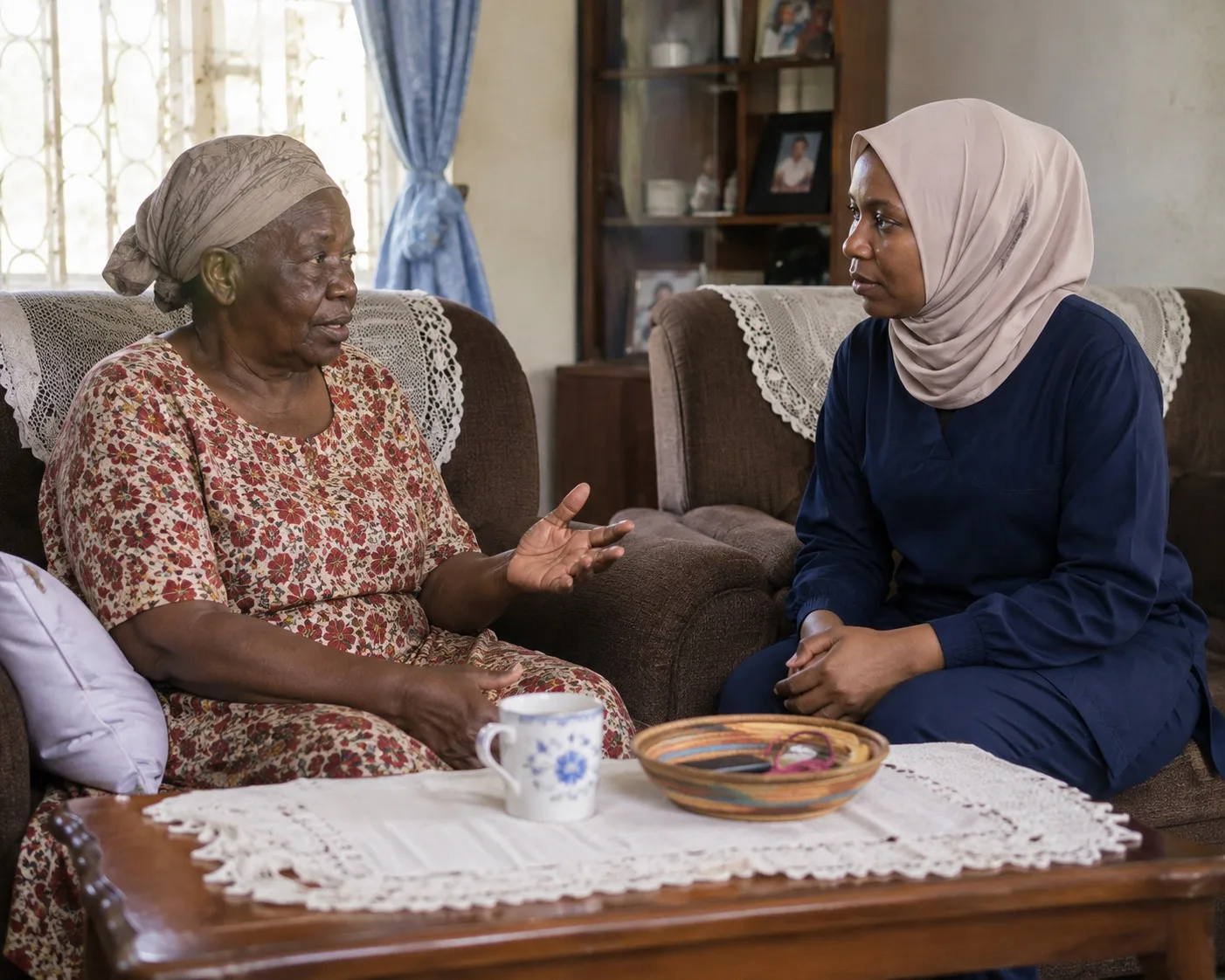
Elderly Care in Uganda: A Complete Guide to Caring for Older Adults at Home
Finding the right support for an ageing parent, grandparent or older relative can become increasingly important as everyday activities, mobility, healthcare appointments and household responsibilities become more difficult.
For many Ugandan families, the question is not simply:
"Does my parent need a caregiver?"
It is:
"What type of support does my parent actually need, and how can we arrange it?"
Elderly care in Uganda can include companionship, practical assistance, support with everyday activities, mobility assistance, appointment coordination, family support and, where clinically appropriate, professional healthcare services.
The right arrangement depends on the individual.
An older person who is largely independent may need occasional practical assistance. Another person may require more regular support following illness, hospitalization, reduced mobility or disability.
Aethla Care approaches elderly care as part of a broader care-coordination model. Its current elderly-care pathway focuses on understanding an older person's routines, needs, family situation and support requirements before determining the appropriate route. Aethla identifies its early operating footprint as including Kampala, Wakiso, Entebbe and Mukono, with availability confirmed according to the specific request and location.
This guide explains what elderly care means in Uganda, when an older person may benefit from additional support, what caregivers can and cannot do, how families can arrange care, and how people living overseas can coordinate support for parents and relatives in Uganda.
What Is Elderly Care?
Elderly care refers to support provided to older adults to help them manage their daily lives, maintain their wellbeing and remain as independent as reasonably possible.
The type of support varies considerably.
It can include:
- Companionship - Assistance with daily activities - Mobility support - Meal assistance - Household support - Appointment coordination - Transport assistance - Medication reminders - Family communication - Post-hospital support - Personal care - Nursing or other professional healthcare services where appropriately qualified professionals are required
These services should not be treated as interchangeable.
A caregiver does not necessarily provide nursing care.
A nurse does not necessarily provide domestic services.
A driver does not automatically provide personal care.
This distinction matters because families need to understand exactly what type of support an older person is receiving.
Aethla Care's model is designed around clarifying this distinction and identifying whether a particular service is operated by Aethla, coordinated by Aethla, delivered through a partner or provided as information.
Why Is Elderly Care Important in Uganda?
Uganda's population is changing, and understanding the needs of older adults is increasingly important for families, communities and the healthcare system.
The 2024 Uganda National Population and Housing Census provides the country's most recent comprehensive population data. Uganda had a population of 45,905,417 people across 10,698,913 households according to the census.
Ageing does not automatically mean that a person requires care.
Many older Ugandans remain active, independent and involved in their families and communities.
However, the likelihood of needing some form of assistance can increase when an older person experiences:
- Reduced mobility - Disability - Chronic health conditions - Vision or hearing difficulties - Difficulty with daily activities - Social isolation - Recovery after illness - Hospitalisation - Difficulty travelling to appointments
Uganda's latest disability evidence is particularly relevant.
The Uganda Bureau of Statistics' 2024 Disability Monograph reports that disability prevalence among people aged 60 years and above was 46.8%, with functional difficulties including challenges involving walking or climbing steps, seeing, hearing, self-care, remembering or concentrating and communication.
This does not mean that 46.8% of older people require elderly care.
It does demonstrate why older people's needs can be diverse and why care should be assessed individually.
When Should a Family Consider Elderly Care?
There is no universal age at which someone suddenly "needs elderly care."
A better approach is to look at changes in everyday life.
Families may want to consider additional support when an older relative begins experiencing difficulties with:
Mobility
The person may have increased difficulty walking, climbing stairs or moving safely around the home.
Household tasks
Cleaning, laundry, shopping or cooking may become increasingly difficult.
Appointments
The person may have difficulty remembering, arranging or travelling to healthcare appointments.
Meals
Preparing regular meals may become challenging.
Personal routines
Activities such as dressing or bathing may require assistance.
Social connection
An older person may become increasingly isolated.
Medication routines
Some people may need reminders to follow an established medication schedule.
Medication management itself should be handled appropriately and according to professional instructions.
Family caregiving
Sometimes the person is coping reasonably well, but the family member providing most of the support is becoming overwhelmed.
This is also a legitimate reason to explore additional support.
What Does an Elderly Caregiver Do?
An elderly caregiver's responsibilities depend on the agreed care plan.
Possible areas of support include:
- Companionship - Assistance with everyday routines - Meal preparation or assistance - Mobility support - Shopping and errands - Household assistance - Accompanying a client to appointments - Supporting social activities - Helping maintain daily routines - Communicating relevant concerns to family members - Medication reminders where appropriate
The exact responsibilities should be agreed before care begins.
Families should never assume that a caregiver is qualified to perform clinical procedures simply because the person works in a care environment.
If an older adult requires medical treatment, nursing procedures or clinical assessment, appropriately qualified healthcare professionals should be involved.
Elderly Care vs Home Nursing
These terms are often confused.
Elderly care
Elderly care generally focuses on supporting an older person's everyday life.
It may include:
- Companionship - Daily living assistance - Household support - Mobility - Appointment assistance - Family coordination
Home nursing
Home nursing involves nursing services delivered by an appropriately qualified nurse.
The nature of nursing care depends on the individual's clinical requirements.
Medical care
Doctors and other healthcare professionals may be required when an older person's condition requires diagnosis, treatment or clinical decision-making.
A family should therefore identify the actual requirement rather than assuming that one type of worker can perform every type of care.
Aethla Care's wider model includes elderly care alongside healthcare navigation and specialist appointment coordination, helping families distinguish between different types of support. http://aethlacare.org/
What Is Home-Based Elderly Care?
Home-based elderly care allows an older person to receive appropriate support while remaining in their familiar home environment.
For some families, this can be an attractive option because the person may be able to maintain familiar routines and surroundings.
However, home care is not automatically suitable for every situation.
The person's health, safety, mobility, living arrangements, family support and professional healthcare needs should all be considered.
The question should be:
"Is the person's home environment appropriate for the level of support they require?"
If the answer changes over time, the care arrangement may need to change as well.
Benefits of Elderly Care at Home
When appropriately arranged, home-based support can offer several practical benefits.
Familiar surroundings
The older person remains in a place they know.
Continuity of routine
Daily habits and household routines can often be maintained.
Family involvement
Family members may remain actively involved in care decisions.
Individualized support
Care can be organized around the person's particular needs rather than a generic schedule.
Companionship
Regular support may reduce some forms of social isolation.
Appointment assistance
The person may receive help organizing or attending appointments.
Support for family caregivers
Relatives who provide care can receive additional practical support.
However, these benefits depend on the suitability and quality of the care arrangement.
Caring for Elderly Parents in Uganda From Abroad
This is an increasingly important consideration for Ugandan families living overseas.
A son or daughter may live in:
- Australia - United Kingdom - United States - Canada - United Arab Emirates - South Africa - Europe - Other parts of the world
while their parents remain in Uganda.
Distance can create anxiety.
A family member may wonder:
Is Mum eating properly?
Is Dad attending his appointments?
Who will help if something changes?
Is someone checking on them?
Who can accompany them to hospital?
What happens if they suddenly need additional support?
These questions cannot all be solved by technology.
Sometimes the family needs a reliable local coordination point.
Aethla Care's diaspora-care pathway is designed specifically for people living outside Uganda who need to explore care coordination for relatives in Uganda. http://aethlacare.org/
The process should still respect the older person's wishes, privacy, independence and decision-making rights.
Being a family member does not automatically mean that someone overseas should make every decision on another adult's behalf.
Where appropriate, the older person should remain involved in decisions about their care.
How Can Families Support an Elderly Parent from Overseas?
A practical approach can involve several steps.
Step 1: Talk to the older person
Ask what they actually want help with.
Do not assume that needing some assistance means they want someone managing everything.
Step 2: Identify the difficult areas
Is the problem:
- Cooking? - Cleaning? - Mobility? - Appointments? - Shopping? - Loneliness? - Transport? - Personal care? - Healthcare coordination?
Step 3: Identify existing support
Who is already helping?
A spouse?
Sibling?
Neighbour?
Friend?
Church or community member?
Professional?
Understanding the existing support network helps identify what is actually missing.
Step 4: Consider professional support
Once the gap is understood, the family can explore appropriate services.
Step 5: Establish communication
Agree on who receives updates and how frequently.
Step 6: Review the arrangement
Care needs can change.
The arrangement should therefore be reviewed when circumstances change.
How to Choose an Elderly Caregiver in Uganda
Finding a caregiver is about more than availability.
Families should consider several factors.
Experience
Has the caregiver worked with older adults before?
Relevant experience can be particularly important where mobility or personal-care needs are involved.
Reliability
Will the person arrive consistently and follow the agreed schedule?
Communication
Can the caregiver communicate concerns clearly?
Compassion and respect
Older adults deserve dignity and patience.
References
Where appropriate, families should consider relevant references.
Role clarity
Everyone should understand what the caregiver is expected to do.
Professional boundaries
A caregiver should understand the limits of their role.
Emergency procedures
The family should know what happens if the older person's condition changes or an emergency occurs.
Questions to Ask Before Hiring an Elderly Caregiver
Before agreeing to a care arrangement, ask:
1. What experience do you have with older adults? 2. What type of support can you provide? 3. What tasks are outside your role? 4. Can you provide references? 5. What days and hours are you available? 6. What happens if you are unavailable? 7. Who should be contacted if there is a concern? 8. Can you accompany the client to appointments? 9. Can you assist with mobility? 10. Can you help with meals? 11. How should medication reminders be handled? 12. How will the family receive updates? 13. What happens if the person's needs change?
These questions help prevent misunderstandings later.
Elderly Care in Kampala
Kampala is an important starting location for families searching for elderly care in Uganda.
People may search online for:
- Elderly care Kampala - Senior care Kampala - Elderly caregivers Kampala - Home care for elderly Kampala - Elderly home support Kampala - Caregiver for elderly parent Kampala - Senior citizen support Kampala
But effective local SEO should go beyond repeating "Kampala."
Families need useful information about what can actually be arranged.
Aethla Care currently identifies Kampala as part of its initial service footprint, alongside Wakiso, Entebbe and Mukono. Availability is confirmed based on the individual care request.
This distinction is important because not every care service has identical availability.
Elderly Care in Wakiso
Families in Wakiso may search for:
- Elderly care Wakiso - Elderly caregivers Wakiso - Home care Wakiso - Senior support Wakiso - Care for elderly parents Wakiso
For local care searches, families should look beyond a provider's general service description.
Important questions include:
Does the provider actually operate in my area?
What type of elderly support is available?
How is availability confirmed?
Can the service be adapted to the person's needs?
Aethla identifies Wakiso among its early locations.
Elderly Care in Entebbe
Older people living in Entebbe may require many of the same forms of support as older adults elsewhere in Uganda.
However, individual circumstances matter.
A family might need:
- Companionship - Home support - Appointment coordination - Mobility assistance - Travel support - Family coordination
Aethla includes Entebbe in its current early location footprint.
Elderly Care in Mukono
Mukono is also identified as an early Aethla Care coordination location.
Families should provide the person's actual location and care requirements rather than assuming that every service is available in every area.
This is particularly important when the service involves travel, healthcare professionals or specialized support.
Elderly Care for People With Mobility Difficulties
Mobility can have a major impact on an older person's independence.
Difficulty walking may affect:
- Shopping - Appointments - Household activities - Social events - Church attendance - Family visits - Outdoor activities - Personal routines
Support should not automatically mean doing everything for the person.
The goal may instead be to help the person safely continue doing as much as they can.
This is why a proper assessment of needs is important.
Elderly Care and Healthcare Appointments
Healthcare appointments can become complicated for older adults.
The difficulty may not be finding a doctor.
It may be:
- Getting an appointment - Remembering the appointment - Travelling to the facility - Getting inside safely - Communicating information - Bringing medical records - Organizing follow-up - Getting home afterward
Aethla includes specialist appointment coordination and healthcare navigation among its service pathways.
Where a clinical decision is required, that decision should remain with an appropriately qualified healthcare professional.
A care coordinator can help with logistics without replacing medical expertise.
Elderly Care After Hospitalization
Returning home after hospitalization can be a major transition.
An older person may feel weak or less confident.
The family may suddenly need to coordinate:
- Transport - Medication routines - Follow-up appointments - Meals - Household support - Mobility - Personal assistance - Family communication
The appropriate support depends on the discharge instructions and the person's condition.
Where clinical care is required, qualified healthcare professionals should be involved.
Practical support may complement, but not replace, professional medical care.
Companionship for Older Adults
Care is not always about physical tasks.
An older person may be physically capable of living independently but still experience loneliness.
Companionship may involve:
- Conversation - Reading - Walking - Social activities - Games - Family communication - Accompanying the person to appropriate activities
Companionship should be respectful and should reflect the person's interests.
The goal is not to treat an older adult like a child.
The goal is to support meaningful social connection.
Elderly Care and Independence
One of the most important principles of good elderly care is not doing everything simply because you can.
If an older person can safely perform an activity themselves, unnecessary assistance can sometimes reduce independence.
A better approach is:
Support where needed.
Assist where appropriate.
Allow independence wherever reasonably possible.
This approach respects the person's choices and dignity.
Aethla identifies dignity, choice and independence as part of its care philosophy.
Elderly Care and Family Caregivers
Many families already provide significant amounts of care themselves.
A daughter may prepare meals.
A son may arrange appointments.
A spouse may provide daily assistance.
A neighbour may check in.
Professional elderly care does not necessarily replace these relationships.
It can complement them.
For example, a family member might remain responsible for major decisions while a professional support person assists with daily routines.
This can make the family caregiving system more sustainable.
How Much Does Elderly Care Cost in Uganda?
There is no single price that applies to every elderly-care arrangement in Uganda.
Costs can depend on:
- Number of hours - Frequency - Location - Type of support - Level of assistance - Professional qualifications required - Travel - Complexity - Whether healthcare professionals are involved
Families should therefore request a quotation based on the actual care requirement rather than relying on a generic figure.
A transparent provider should explain what the quoted service includes.
What If My Parent Refuses Care?
This can be difficult.
An older adult may say:
"I don't need anyone."
That response should not automatically be ignored.
Start by asking why.
They may be concerned about:
- Losing independence - Privacy - Cost - Having strangers in the home - Feeling that the family thinks they are incapable - Previous negative experiences
Instead of framing the conversation as:
"You need a caregiver."
consider:
"What would make life easier for you?"
Perhaps they only want help with shopping.
Perhaps they want someone to accompany them to appointments.
Perhaps they want occasional household support.
Perhaps they want companionship.
Starting with the person's preferences can make care conversations more respectful.
How Can Aethla Care Help with Elderly Care?
Aethla Care's elderly-care pathway begins with understanding the older person's situation.
The organisation asks families to consider the person's routines, what has become difficult, what support is already available and what additional help may be needed.
Depending on the request, the wider Aethla Care ecosystem includes:
- Elderly care - Disability support - Home and family support - Childcare and newborn support - Specialist appointments - Healthcare navigation - Travel and mobility support - Diaspora care coordination
This broader approach matters because elderly care rarely exists in isolation.
An older person may simultaneously need help with mobility, appointments, transport and family coordination.
What Makes a Good Elderly Care Plan?
A practical elderly-care plan should answer several questions.
Who is receiving care?
Identify the person and their circumstances.
What support is required?
Be specific.
How often is support needed?
Daily?
Weekly?
Occasionally?
Who provides the support?
Caregiver?
Nurse?
Family?
Partner?
What can the person still do independently?
This helps preserve autonomy.
What happens if their needs change?
There should be a process for reassessment.
Who communicates with the family?
Especially important for diaspora families.
What are the costs?
The family should understand what is included.
What happens in an emergency?
Emergency arrangements should be clearly understood.
Elderly Care in Uganda: A Family Checklist
Before arranging care for an older relative, consider the following.
Health
- What health conditions are relevant? - Is professional medical care currently required? - Are there recent hospital or doctor instructions?
Mobility
- Can the person walk safely? - Do they need assistance outside the home? - Do they require transport?
Daily living
- Can they prepare food? - Can they manage household tasks? - Do they need personal assistance?
Social wellbeing
- Are they socially connected? - Do they spend long periods alone? - Would companionship be useful?
Healthcare
- Are appointments being attended? - Does someone help organize them? - Is specialist care required?
Family
- Who currently provides support? - Does the family need additional help? - Who lives nearby?
Location
- Where does the older person live? - Is the required service available there?
Preferences
- What does the older person want? - What are their concerns about receiving care?
This checklist can help families have a more productive conversation with a care provider.
Frequently Asked Questions About Elderly Care in Uganda
What is elderly care in Uganda?
Elderly care is support for older adults that can include assistance with everyday activities, companionship, mobility, household routines, appointments and other practical needs. Clinical care requires appropriately qualified healthcare professionals.
Can an elderly person receive care at home in Uganda?
Yes. Depending on their circumstances and the services available in their area, an older adult may receive appropriate support at home.
How do I find an elderly caregiver in Uganda?
Families should identify the older person's needs, location and preferred schedule, then look for an appropriate provider or care-coordination service. Relevant experience, reliability, role clarity and references are important considerations.
How much does elderly care cost in Uganda?
There is no universal price. Costs vary according to location, hours, frequency, level of assistance, qualifications and other requirements. A family should request a quote based on the individual's needs.
Can I arrange elderly care for my parents from abroad?
Yes. Families living outside Uganda can begin the process remotely. Aethla Care has a dedicated diaspora-care pathway for people coordinating support for relatives in Uganda.
What is the difference between elderly care and home nursing?
Elderly care can involve practical, personal and social support. Home nursing involves professional nursing services. They should not be treated as the same service.
Can elderly care include help with appointments?
Depending on the care arrangement, support may include helping an older person organize or attend appointments. Clinical decisions remain with qualified healthcare professionals.
Can elderly people with disabilities receive home support?
Yes. Support can be considered according to the person's specific disability, mobility, communication and daily-living requirements. Uganda's latest census-based disability evidence shows significant levels of functional difficulty among older adults.
Where does Aethla Care provide elderly care?
Aethla's initial location footprint includes Kampala, Wakiso, Entebbe and Mukono. Availability depends on the individual request and location.
What if I don't know what type of care my parent needs?
You do not need to know the exact service name before starting the conversation. Explain the person's situation, location and difficulties. A care-coordination service can help clarify possible routes.
Can elderly care help someone remain independent?
Appropriately designed support can help an older person continue doing activities they can safely manage while receiving assistance where needed.
Does needing a caregiver mean an elderly person is no longer independent?
No. Needing assistance with particular activities does not automatically mean someone has lost their independence. Care can be structured to support autonomy and choice.
Elderly Care in Uganda: Final Thoughts
Elderly care is not simply about finding someone to look after an older person.
It is about understanding the person's needs, preferences, health situation, family circumstances and level of independence.
For some older adults, occasional assistance may be enough.
For others, more regular support may be appropriate.
Some may need a caregiver.
Others may need professional nursing or medical care.
Some may primarily need help attending appointments or travelling safely.
And some families may simply need help understanding which route makes sense.
That is why a **person-centred care approach** is important.
For families in **Kampala, Wakiso, Entebbe, Mukono and elsewhere in Uganda**, the first step is to explain the situation rather than trying to choose a service blindly.
If you are caring for an ageing parent or relative, tell Aethla Care:
Who needs support.
Where they live.
What has become difficult.
What support the family is already providing.
What additional help you are looking for.
Aethla Care can then help clarify the appropriate care pathway and next step.
Looking for Elderly Care in Uganda?
Aethla Care provides a starting point for families seeking elderly care, disability support, home and family support, healthcare navigation, specialist appointments and travel or mobility assistance in Uganda.
Aethla Care Uganda — care made easier to navigate.
Sources and Further Reading
Uganda Bureau of Statistics — National Population and Housing Census 2024 Provides Uganda's latest comprehensive national census data.
Uganda Bureau of Statistics — 2024 Disability Monograph Provides current census-based information about disability and functional difficulties in Uganda, including older adults.
Uganda Ministry of Health — Uganda National Health Compact 2025–2030 Provides current national health-system priorities and context.
Aethla Care — Elderly Care Current description of Aethla's elderly-care pathway.
Aethla Care — Areas Current information about Aethla's initial geographic footprint.
Aethla Care — Diaspora Care Information for families coordinating care for relatives in Uganda while living abroad.