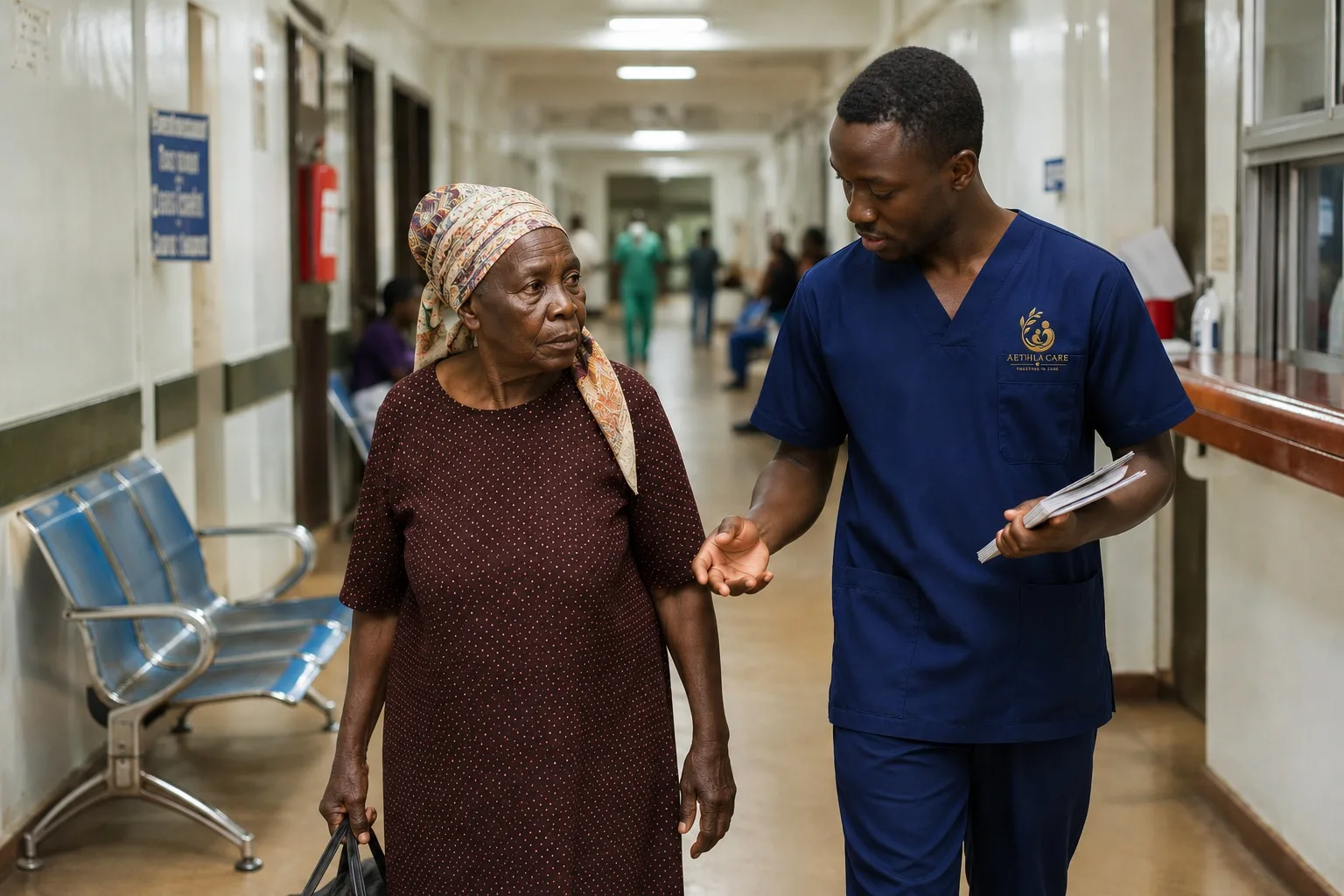
# Elderly Care at Home vs Nursing Home Care in Uganda: What Families Should Consider
**Elderly care at home or nursing home care in Uganda—which is better for an older parent?**
There is no single answer.
The right care arrangement depends on the older person's health, mobility, independence, safety, preferences, family situation, home environment, need for supervision, access to healthcare and the level of support required each day.
For many families in Uganda, the decision is not simply about choosing between “home” and a “nursing home.” There may be several options, including family caregiving, a caregiver visiting the home, domestic and practical support, companionship, nursing or clinical support where appropriate, specialist appointments, mobility assistance, hospital support and coordinated care.
The most important question is therefore:
**What type and level of support will allow this particular older person to live as safely, independently and comfortably as possible?**
The World Health Organization (WHO) emphasizes person-centred and integrated approaches to older people's care. Its 2025 Integrated Care for Older People (ICOPE) handbook describes assessment of an older person's capacities and social support needs, followed by development and monitoring of a personalized care plan. WHO also recognizes home and community-based care as an important component of long-term care.
That approach is particularly relevant to families in Uganda, where older people may live with relatives, alone, with domestic workers, or within extended-family arrangements.
This guide explains the differences between elderly care at home and residential or nursing-home care, what families should consider, when each option may be appropriate, and how families can create a practical care plan.
---
## Quick answer: elderly care at home vs nursing home care
**Elderly care at home** means an older person continues living in their own home while receiving some combination of family support, caregiving, companionship, domestic assistance, transport, appointment coordination or healthcare support.
**Nursing home or residential care** generally means an older person moves into a facility where accommodation and ongoing support are provided as part of a residential arrangement. The exact services, staffing and clinical capabilities vary considerably between facilities.
Neither option is automatically better.
Home care may suit an older person who wants to remain in familiar surroundings and whose support needs can be safely managed at home.
Residential care may be considered when an older person requires a level of continuous supervision, accommodation or support that cannot realistically be provided in their existing home environment.
The decision should be based on the person's actual needs—not simply their age.
---
# 1. What is elderly care at home in Uganda?
Elderly care at home means supporting an older person while they continue living in their familiar environment.
The level of assistance can vary significantly.
One person might only need help with:
* Shopping * Cooking * Cleaning * Laundry * Errands * Appointments * Transport * Companionship * Household organization
Another older person may require more regular personal support with daily routines, mobility or family coordination.
Someone recovering after hospitalization may temporarily need a much more structured arrangement before gradually becoming more independent.
This is why “home care” should not automatically be interpreted as “nursing care.”
A home-care arrangement should begin with understanding what the person actually needs.
WHO's current ICOPE guidance similarly emphasizes person-centred assessment, social support needs and personalized care planning rather than treating every older person as having the same requirements.
---
# 2. What is nursing home or residential care?
A nursing home, residential care facility or other form of residential elderly care involves the older person living away from their usual home and receiving support within a facility.
The exact model can vary.
A facility might provide:
* Accommodation * Meals * Daily assistance * Personal care * Supervision * Social activities * Medication support * Nursing services * Healthcare coordination * Rehabilitation or therapy * Emergency response arrangements
However, families should never assume that every facility provides all of these services.
The term “nursing home” can mean different things in different contexts.
Before choosing residential care, families should establish exactly what the facility provides, who provides it, what qualifications staff have, what healthcare arrangements exist, how emergencies are handled, and what is included in the fees.
---
# 3. Home care and nursing-home care are not simply “better” or “worse”
A common mistake is to turn the decision into a debate:
**“Is home care better than a nursing home?”**
That question is too broad.
A more useful question is:
**“Which care environment can safely and realistically meet this person's current needs while respecting their preferences and dignity?”**
An older person may thrive at home with appropriate support.
Another person may become increasingly isolated or unsafe if they remain at home without sufficient assistance.
Conversely, moving someone into residential care may provide more consistent supervision but could also involve leaving a familiar home, neighbourhood, routines and social environment.
The decision therefore requires an individual assessment.
---
# 4. The first consideration: what does the older person want?
The older person's preferences should be part of the conversation.
This can sometimes be difficult.
Families may be trying to solve a practical problem while the older parent is focused on independence, familiarity and dignity.
An older person may say:
> “I don't want someone looking after me.”
But that may not mean they reject all assistance.
They may actually object to losing control over their daily life.
A better conversation could be:
* What would make living at home easier? * Which activities have become difficult? * What would you still like to do yourself? * What type of help would you accept? * What are you worried about? * Would you prefer someone to visit during the day? * Would you feel safer having someone nearby? * What would make you consider moving? * What would you absolutely not want?
This can reveal solutions that families may otherwise overlook.
---
# 5. Familiar surroundings can matter
Home is more than a physical building.
For an older person, home may represent:
* Familiar routines * Neighbours * Family memories * Religious or community connections * Personal belongings * Familiar rooms * Local shops * Gardens * Pets * Social relationships * Independence
WHO's healthy ageing guidance emphasizes that physical and social environments influence older people's ability to maintain functioning and participate in activities that matter to them.
For this reason, the home environment should be considered as part of the care plan.
The question is not simply:
**“Can we keep Mum at home?”**
It is:
**“Can Mum live safely and meaningfully at home with the right support?”**
---
# 6. Assess the person's daily activities
Before deciding between home and residential care, make a simple assessment of everyday life.
Ask whether the older person can safely manage:
### Personal routines
Can they:
* Bathe? * Dress? * Use the toilet? * Maintain personal hygiene? * Prepare basic meals? * Eat and drink adequately?
### Mobility
Can they:
* Walk around the home? * Get in and out of bed? * Use stairs? * Get into a vehicle? * Attend appointments? * Move around outside safely?
### Household tasks
Can they:
* Cook? * Clean? * Shop? * Do laundry? * Manage basic household organization?
### Communication
Can they:
* Use a phone? * Explain what they need? * Communicate with family? * Attend appointments and understand instructions?
### Healthcare organization
Can they:
* Attend appointments? * Keep track of medical documents? * Communicate with healthcare professionals? * Obtain prescribed medicines through the appropriate channels?
These questions do not replace a professional clinical assessment.
They simply help a family understand the practical level of support required.
---
# 7. Consider mobility and fall risks
Mobility can dramatically change the care equation.
An older person who walks independently may require relatively little physical assistance.
Someone with significant mobility limitations may need help moving between rooms, getting into vehicles or attending appointments.
Families should consider:
* Stairs * Uneven surfaces * Bathroom safety * Lighting * Bed height * Access to the entrance * Walking routes * Transport * Availability of someone to assist when needed
Falls are particularly important because an apparently simple change in mobility can significantly increase a person's need for support.
If there has been a recent fall, repeated falls, sudden deterioration in walking ability or another concerning change, families should seek appropriate professional medical assessment rather than attempting to solve the problem solely through domestic caregiving.
---
# 8. Consider whether the person lives alone
Living alone does not automatically mean an older person needs residential care.
Many older people live independently for years.
However, living alone can increase the importance of planning.
Ask:
* Who checks on the person? * Who can respond if something goes wrong? * How quickly can family members reach them? * Is there a trusted neighbour? * Can they contact someone in an emergency? * Can they manage meals? * Can they attend appointments? * Can they obtain household necessities? * Is the home secure?
For families living outside Uganda, this becomes even more important.
A son or daughter in Australia, the United Kingdom, United States, Canada, UAE or South Africa may not be able to physically check on a parent every day.
In such circumstances, structured care coordination can help bridge the distance.
---
# 9. Home care can be flexible
One of the major advantages of home-based support is that it can potentially be adjusted as needs change.
For example, a family could begin with:
Stage 1:
A few visits each week for companionship, errands and household support.
Then:
Stage 2:
More frequent support for meals, routines and appointments.
Then:
Stage 3:
Additional caregiver or healthcare coordination if the person's needs increase.
The reverse can also happen.
Following recovery from an illness or hospital stay, an older person may initially require significant assistance but gradually regain independence.
A care arrangement should therefore be reviewed rather than treated as permanent from day one.
---
# 10. Residential care can provide a different structure
Residential care may provide a more consistent environment when an older person needs support that cannot reasonably be organized in their existing home.
Potential reasons for considering residential care can include:
* A need for continuous supervision * Significant difficulties with daily activities * An unsafe home environment that cannot be reasonably adapted * Lack of available family support * Care needs that exceed what a home arrangement can reliably provide * A need for structured accommodation and support
However, the exact suitability depends on the facility.
A residential setting is not automatically equivalent to a hospital.
A nursing home is also not necessarily equipped to manage every medical emergency or complex clinical condition.
Families must understand the distinction between residential support and acute healthcare.
---
# 11. When might home care be a practical option?
Home care may be worth considering when an older person:
* Wants to remain at home * Can safely live in their current environment with appropriate support * Needs assistance with household tasks * Needs companionship * Needs help organizing appointments * Needs transport or mobility assistance * Needs support following hospital discharge * Has family members who want to remain involved * Needs regular but not necessarily continuous assistance * Benefits from familiar surroundings
Again, this is not a clinical rule.
The suitability of home care depends on the individual circumstances.
---
# 12. When might residential care need to be considered?
Families may need to explore residential options when:
* The person cannot safely remain at home despite reasonable support * There is no reliable way to provide necessary supervision * Their care requirements have become too complex for the available home arrangement * The home environment presents serious unresolved safety concerns * Family caregivers are no longer able to provide the required level of support * A suitable residential facility can provide a more appropriate level of ongoing assistance
A decision like this should be made carefully and, where relevant, with appropriate professional input.
It should not be based solely on convenience.
---
# 13. The role of family caregivers in Uganda
Family remains central to care for many older people.
A family may share responsibilities between:
* Children * Spouses * Grandchildren * Siblings * Relatives * Neighbours * Community members * Paid caregivers * Healthcare professionals
This can be a strength.
But it can also create hidden pressure.
One family member may end up doing most of the work while other relatives assume everything is being managed.
A written care plan can help.
For example:
| Responsibility | Person | | ------------------------ | ------------------------ | | Daily check-in | Daughter | | Household support | Caregiver | | Medical appointments | Son | | Transport | Family/transport support | | Specialist communication | Family coordinator | | Emergency contact | Daughter | | Financial administration | Son | | Weekly family update | Care coordinator |
This can be particularly useful for diaspora families.
---
# 14. What if the family lives abroad?
Distance changes the practical situation.
A family member in Australia may care deeply about their parent in Kampala but cannot easily visit after every hospital appointment.
The same applies to Ugandans living in:
* The United Kingdom * United States * Canada * United Arab Emirates * South Africa * Other countries
The solution does not necessarily have to be residential care.
A structured home-care and coordination arrangement may allow the parent to remain at home while relatives participate remotely.
Depending on the person's needs, support could involve:
* Home visits * Companionship * Household assistance * Appointment coordination * Transport * Specialist appointment organization * Hospital support * Family communication * Mobility assistance * Practical errands
Aethla Care's diaspora care approach is designed around this kind of coordination rather than making medical decisions on behalf of families.
---
# 15. Home care does not mean doing everything yourself
Another misconception is that choosing home care means the family must personally provide all care.
That is not necessarily true.
A family can build a support network.
For example:
**Older parent**
↓
**Family**
↓
**Caregiver / home support**
↓
**Healthcare professionals where required**
↓
**Transport / mobility support**
↓
**Specialist appointments**
↓
**Family communication**
The purpose of coordination is to make these pieces easier to organize.
Aethla Care's model is built around understanding the family's need, clarifying the appropriate care route, coordinating support and keeping the family informed.
---
# 16. What about a maid?
This is particularly important in Uganda.
A domestic worker or maid and an elderly caregiver are not automatically the same role.
A maid may primarily help with:
* Cleaning * Laundry * Cooking * Household tasks * General domestic routines
An elderly caregiver may provide support related to the older person's daily routine, companionship, mobility assistance or personal support, depending on their role and training.
Some families may legitimately need both.
The key is to define responsibilities clearly.
Do not assume that because someone works in the home they are automatically qualified or appropriate to provide healthcare or personal care.
---
# 17. What about nursing care?
Nursing is a healthcare profession.
A nurse's responsibilities, qualifications and scope are different from those of a domestic worker or general caregiver.
If an older person has significant medical needs, families should clarify:
* What healthcare support is required? * Who is responsible for clinical decisions? * Is professional nursing required? * How frequently is it required? * Who manages communication with the treating healthcare team? * What happens if the person's condition changes?
Aethla Care does not replace a doctor, nurse or hospital.
Where specialist or healthcare support is needed, Aethla's role is to help families understand and coordinate the appropriate route rather than provide diagnosis or make clinical decisions.
---
# 18. Compare the two options carefully
| Consideration | Care at Home | Residential/Nursing Home | | ---------------------- | ----------------------------------------- | ---------------------------------------------- | | Familiar environment | Usually yes | No, person relocates | | Family involvement | Can remain high | Can remain high but requires planning | | Flexibility | Often highly adaptable | Depends on facility | | Household support | Can be arranged | Usually part of facility services | | Companionship | Can be arranged | Often available, depending on facility | | Medical support | Depends on arrangement | Depends heavily on facility | | Continuous supervision | May require substantial planning | May be available, depending on facility | | Privacy | Usually greater familiarity | Shared/residential environment | | Community connection | Maintained more easily | May change after relocation | | Travel to appointments | Must be coordinated | Facility may coordinate, depending on services | | Family distance | Can be managed through coordination | Family still needs communication | | Cost | Depends on level and frequency of support | Depends on facility and services | | Suitability | Depends on home environment and needs | Depends on facility capabilities and needs |
The important point is that neither column is universally superior.
---
# 19. Ask these questions before choosing a nursing home
If your family is considering residential care in Uganda, ask the facility:
### About care
1. What types of older people do you support? 2. What level of assistance is available? 3. Is nursing care available? 4. What happens if someone becomes medically unwell? 5. How are emergencies handled?
### About staff
6. Who provides day-to-day care? 7. What training do staff receive? 8. How many staff members are normally available? 9. Is there overnight supervision? 10. Who is responsible for contacting the family?
### About accommodation
11. Is the room private or shared? 12. Can family visit? 13. What are visiting arrangements? 14. What personal belongings can the resident bring? 15. Are bathrooms accessible?
### About healthcare
16. How are medical appointments handled? 17. How is medication managed? 18. Which healthcare providers are involved? 19. What happens after hospitalization? 20. How are changes in health communicated to relatives?
### About money
21. What is included in the fee? 22. What costs are additional? 23. Are transport costs separate? 24. Are medical costs separate? 25. What happens if the person's care needs increase?
Never rely only on a brochure or website.
Where possible, families should visit and ask direct questions.
---
# 20. Ask these questions before arranging home care
For a home-based arrangement, ask:
* What exactly does the older person need help with? * How many hours of support are required? * Who will provide the support? * What are their responsibilities? * What are they not responsible for? * Who is the emergency contact? * Who coordinates appointments? * Who provides transport? * What happens if the caregiver cannot attend? * How will family members receive updates? * How will concerns be reported? * When will the care arrangement be reviewed?
Good care coordination begins with clarity.
---
# 21. Think about the home itself
Before deciding that an older person should remain at home, assess the environment.
Look at:
### Bathroom
* Is it easy to access? * Is the floor slippery? * Can the person enter and leave safely?
### Bedroom
* Is the bed accessible? * Is there adequate lighting? * Can the person move safely around the room?
### Kitchen
* Can the person safely prepare food? * Are cooking appliances appropriate for their abilities?
### Entrance
* Are there stairs? * Is there a safe route into the home?
### Outdoor areas
* Are paths clear? * Are surfaces uneven? * Is lighting sufficient?
Sometimes small environmental changes can make a significant practical difference.
---
# 22. Don't wait for a crisis
One of the biggest mistakes families make is waiting until something goes wrong.
Planning early gives everyone more choices.
For example, a family may begin by asking:
**“What support would help Mum remain independent over the next year?”**
rather than waiting until:
**“Mum has fallen. She is in hospital. What do we do now?”**
Early planning can help families identify:
* Who can help * Which tasks are becoming difficult * What transport is available * Which appointments need coordination * Whether home modifications are needed * What happens during emergencies * How relatives will share responsibilities
---
# 23. Reassess the care arrangement over time
An older person's needs can change.
A plan that works today may not work six months from now.
Families should periodically ask:
* Is the person still safe at home? * Are they becoming more dependent? * Are they isolated? * Are they missing appointments? * Are household tasks becoming difficult? * Has mobility changed? * Are family caregivers becoming overwhelmed? * Does the caregiver arrangement still work? * Does the person still want the current arrangement?
WHO's ICOPE framework emphasizes assessment, personalized care planning and ongoing implementation and monitoring, reinforcing the idea that older-person care should be responsive rather than static.
---
# 24. A practical decision framework for Ugandan families
If your family is unsure what to choose, work through these five questions.
### Question 1: What does the person want?
Start with their preferences.
### Question 2: What do they actually need?
Separate household assistance from personal care, nursing and specialist healthcare needs.
### Question 3: Can the home environment support those needs safely?
Consider mobility, accessibility, supervision and available family support.
### Question 4: Can the family reliably organize the required support?
Consider relatives, caregivers, transport, healthcare coordination and emergency arrangements.
### Question 5: What happens if their needs increase?
A good plan should include a review process.
If the answers indicate that home care is workable, families can build a home-based support plan.
If the answers indicate that home care cannot safely meet the person's needs, residential options may need to be explored.
---
# 25. How Aethla Care can help families coordinate elderly care in Uganda
Aethla Care is designed around the idea that families should not have to organize every part of care separately.
Depending on the situation, Aethla Care can help families coordinate areas such as:
* Elderly care support * Home and family assistance * Companionship * Domestic support * Mobility and transport coordination * Specialist appointments * Healthcare navigation * Post-hospital practical support * Family communication * Diaspora care coordination
The exact route depends on the person's needs and the support available.
Aethla Care does not diagnose medical conditions or replace doctors, nurses or hospitals.
Instead, the process begins with understanding what the family needs.
**Tell us what you need → clarify the care route → coordinate support → keep the family informed.**
For families in Kampala, Wakiso, Entebbe, Mukono and other parts of Uganda, availability can depend on the type of support required and the location.
---
# 26. Elderly care should protect independence, not simply provide assistance
Good elderly care is not necessarily about doing everything for someone.
Sometimes the most appropriate support is the minimum assistance needed to help the person continue doing things for themselves.
For example, instead of automatically preparing every meal, support might involve helping with shopping or meal preparation while allowing the older person to participate.
Instead of taking over every household task, support might focus on the tasks they can no longer safely manage.
Instead of making decisions for them, family members can help them understand their options and remain involved.
This reflects the broader person-centred approach promoted by WHO.
Older people are individuals—not simply recipients of care.
---
# 27. Frequently Asked Questions
## Is home care better than a nursing home in Uganda?
There is no universal answer. Home care may be suitable when an older person can safely remain at home with appropriate support. Residential care may be appropriate when their needs cannot realistically or safely be managed at home.
## Can an elderly person live alone in Uganda?
Yes, some older people live independently. The important question is whether their home environment, health, mobility, support network and emergency arrangements make independent living reasonably safe and sustainable.
## Does home care mean a caregiver lives with the elderly person?
Not necessarily. Home care can involve scheduled visits, daytime support, companionship, household assistance or other arrangements. The appropriate model depends on the person's needs.
## Is a maid the same as an elderly caregiver?
No. Domestic work and elderly caregiving are different roles, although responsibilities can sometimes overlap depending on the arrangement. Families should clearly define responsibilities and not assume that a domestic worker is qualified to provide healthcare.
## Does elderly home care include nursing?
It can involve coordination of nursing support where appropriate, but general home caregiving is not the same as professional nursing. Families should identify whether clinical care is actually required.
## What if my parent lives in Uganda and I live abroad?
A family can potentially arrange local support while remaining involved remotely. Care coordination can include home support, companionship, appointments, mobility, transport and family communication.
## When should a family consider residential care?
Residential care may need to be considered when an older person's needs cannot be safely and reliably met at home, despite reasonable support, or when a suitable residential setting can provide a level of ongoing assistance that the home environment cannot.
## Can elderly care arrangements change over time?
Yes. Care needs can change after illness, hospitalization, changes in mobility or other circumstances. Families should periodically review whether the current arrangement remains appropriate.
## How do I arrange elderly care in Uganda?
Start by identifying the older person's needs, preferences, location, daily routines, mobility, healthcare requirements and available family support. Then determine whether home-based support, healthcare coordination, transport, domestic assistance, residential care or a combination of services is appropriate.
---
# Elderly Care at Home vs Nursing Home Care in Uganda: Final Checklist
Before making a decision, ask:
### About the older person
* What does the person want? * What can they still do independently? * What activities are becoming difficult? * Has their mobility changed? * Do they live alone?
### About the home
* Is the home safe? * Are bathrooms and entrances accessible? * Are there stairs? * Can support workers reach the home easily?
### About family
* Who is available locally? * Who lives abroad? * Who can respond during an emergency? * How will responsibilities be shared?
### About care
* Is domestic assistance needed? * Is companionship needed? * Is a caregiver needed? * Is professional nursing required? * Are specialist appointments needed? * Is transport required?
### About the future
* What happens if the person's needs increase? * When will the arrangement be reviewed? * Who will coordinate changes?
The goal should not simply be to find “a caregiver” or “a nursing home.”
The goal is to build a care arrangement that makes sense for the individual person.
---
# Final Thoughts
For families in Uganda, the choice between elderly care at home and residential care should be approached as a care-planning decision rather than a simple question of which option is better.
Home care can allow an older person to remain connected to familiar surroundings, family and community while receiving practical support.
Residential care can provide a structured living environment where appropriate support is available.
Both options can have a place.
The most important factors are the older person's preferences, actual care needs, safety, mobility, home environment, family capacity, access to healthcare and the availability of reliable support.
For Ugandan families—and especially families coordinating care from abroad—the best starting point is often not:
**“Should we put Mum in a nursing home?”**
It is:
**“What does Mum need, what does she want, and what support would allow her to live safely and with dignity?”**
That question creates a much better foundation for planning.