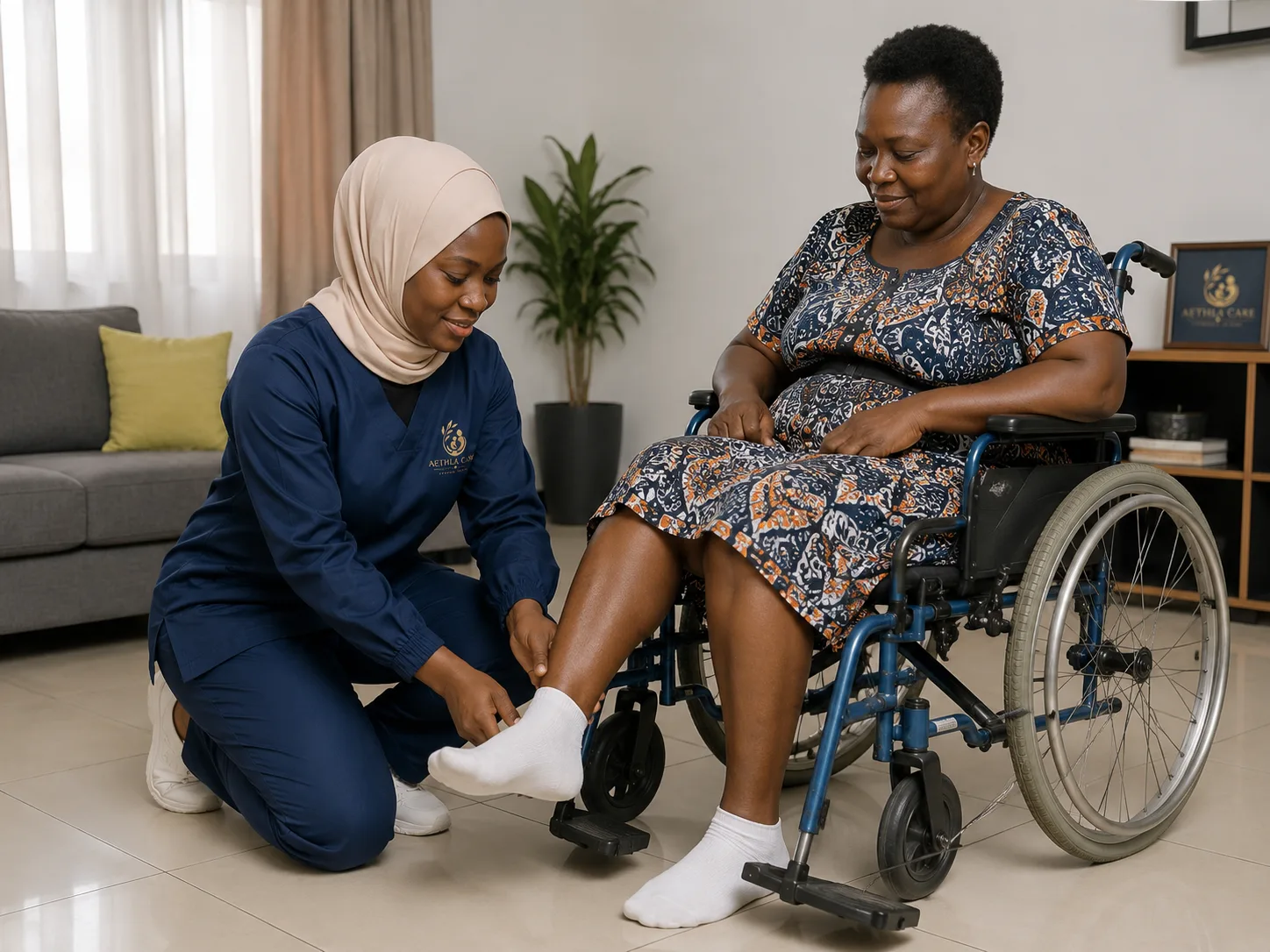
# Disability Support Services in Uganda: What Families Need to Know
Finding the right disability support in Uganda can be difficult for families.
A person living with a disability may need very different types of support depending on their age, abilities, communication preferences, mobility, health needs, family situation, education, employment and daily routine.
Some people may need occasional assistance with transport.
Others may need help with personal routines, household activities, communication, mobility, appointments or community participation.
Some may require rehabilitation or assistive technology.
Others may need a combination of professional healthcare, family support and practical assistance at home.
The most important starting point is therefore not simply:
**“What disability service do we need?”**
It is:
**“What does this particular person need to live safely, independently and with dignity?”**
For families in Kampala, Wakiso, Entebbe, Mukono and other parts of Uganda, disability support can involve several different systems and providers.
This guide explains **disability support services in Uganda**, what families should consider, the difference between disability support and medical care, rehabilitation and assistive technology, home support, mobility assistance, specialist appointments, caregiver support, transport and how families living abroad can coordinate support for relatives in Uganda.
---
# Quick answer: What disability support is available in Uganda?
Disability support can include different forms of practical, social, health and rehabilitation assistance.
Depending on the person's circumstances, families may need to consider:
* Home and family support * Personal assistance * Mobility support * Transport * Specialist healthcare navigation * Rehabilitation * Physiotherapy * Occupational therapy * Speech and communication support * Assistive technology * Wheelchairs and mobility aids * Hearing-related assistive products * Vision-related assistive products * Communication support * Education support * Employment-related accommodation * Family and caregiver support * Community participation * Appointment coordination * Travel assistance
Not every person needs all of these services.
The appropriate combination should be based on the individual's needs and preferences.
Uganda's Persons with Disabilities Act, 2020 provides for rights and protections including non-discrimination, accessibility, rehabilitation and access to health services, while the Ministry of Health has been working to integrate rehabilitation and assistive technology into the health system.
---
# 1. What does disability support mean?
Disability support is a broad term.
It can refer to practical assistance that helps a person participate in everyday life.
That might mean helping someone:
* Move around their home * Travel to an appointment * Communicate * Manage daily routines * Access healthcare * Attend school * Participate in work * Engage with family * Participate in community activities * Use assistive equipment * Maintain independence
Disability support is therefore not automatically medical care.
A person may have a disability without needing nursing care.
Another person may have a disability alongside a medical condition and require healthcare support.
The distinction matters.
---
# 2. Disability is not the same for everyone
Two people with the same broad disability category may have very different support requirements.
For example, two people with physical disabilities may differ in:
* Mobility * Strength * Communication * Independence * Housing * Family support * Employment * Transport needs * Assistive technology * Healthcare needs
Similarly, two people with visual impairments may have different levels of independence and different communication preferences.
This is why disability support should begin with the person rather than a generic package.
---
# 3. Person-first disability support
A useful approach is to understand the individual before proposing services.
Ask:
**What can the person already do?**
**What do they want to do?**
**Where do they need assistance?**
**What barriers are preventing them from doing it?**
**What support would increase their independence?**
This is different from assuming that a diagnosis automatically determines the care plan.
The goal should be to support the person's abilities rather than unnecessarily replacing them.
WHO describes rehabilitation as helping people optimize functioning and reduce disability in interaction with their environment, including through environmental modification, assistive products, education and adaptation of tasks.
---
# 4. Uganda's legal framework for persons with disabilities
Uganda's **Persons with Disabilities Act, 2020** is an important part of the country's disability framework.
The Act states that persons with disabilities are entitled to fundamental rights and freedoms and that government and other persons should respect and promote those rights.
It also addresses non-discrimination in areas including health services.
The Act specifically states that a health unit should not discriminate against a person with a disability and includes requirements relating to accessibility and certain equipment, including wheelchairs and accessible examination tables.
The Act also addresses habilitation and rehabilitation, requiring the relevant authorities to provide rehabilitation services and programmes and to inform persons with disabilities, families, caregivers and communities about available services.
These provisions are important because disability support is not simply a private family responsibility.
There is a broader legal and public-policy framework around disability rights, access and participation.
---
# 5. What is rehabilitation?
Rehabilitation is different from general home assistance.
WHO defines rehabilitation as a set of interventions designed to optimize functioning and reduce disability in interaction with a person's environment.
Rehabilitation may help someone improve or maintain their ability to:
* Move * Communicate * Think * See * Hear * Eat * Perform everyday activities * Participate in family and community life
Rehabilitation may involve different professionals depending on the person's needs.
For example:
* Physiotherapists * Occupational therapists * Speech and language professionals * Rehabilitation doctors * Nurses * Other healthcare professionals
Families should use appropriately qualified professionals for clinical rehabilitation.
A general caregiver should not be presented as a substitute for a rehabilitation professional.
---
# 6. Why rehabilitation matters in Uganda
Uganda's Ministry of Health has identified rehabilitation and assistive technology as important parts of the health system.
The Ministry's Uganda Rapid Assistive Technology Assessment reported that the government was progressively prioritizing rehabilitation and assistive technology as essential healthcare services.
The Ministry's strategic work has also emphasized strengthening rehabilitation and assistive technology services and integrating them within the wider health system.
This matters for families because rehabilitation should not automatically be viewed as an optional extra.
For some people, rehabilitation can be an important part of maintaining function, independence and participation.
---
# 7. What is assistive technology?
Assistive technology includes products and systems that help people maintain or improve functioning and independence.
WHO gives examples including:
* Wheelchairs * Hearing aids * Spectacles * Prostheses * Products supporting memory * Other assistive devices
WHO says assistive technology can support independence, participation and dignity.
The right product depends on the person's needs.
A wheelchair, for example, should not simply be selected because it is available.
Fit, function, environment and the person's requirements matter.
---
# 8. Assistive devices in Uganda
Uganda's Persons with Disabilities Act includes assistive devices within its legal framework and defines them broadly, including devices such as:
* Wheelchairs * Crutches * White canes * Orthopaedic appliances * Readers * Braille and tactile materials * Large-print materials * Other supportive devices
The Act also provides for government support relating to assistive devices, including provision at no cost or subsidized prices under specified provisions.
Families should verify current availability, eligibility and access arrangements rather than assuming that a particular device is immediately available.
---
# 9. Disability support at home
Many people with disabilities want to remain at home and participate in normal family life.
Home support may involve:
* Daily routines * Household organization * Meal preparation * Errands * Appointment coordination * Mobility assistance * Companionship * Transport coordination * Family communication
The type and amount of support should depend on what the person actually needs.
Someone may need support for only a few hours each week.
Another person may require more frequent assistance.
---
# 10. Personal assistance versus nursing care
These are not automatically the same service.
### Personal or practical support
May include:
* Routine assistance * Mobility support * Household activities * Companionship * Transport * Community participation
### Nursing care
May involve clinical responsibilities that require appropriately qualified healthcare professionals.
The exact duties depend on the person's clinical needs and the professional's scope of practice.
Families should therefore ask:
**“What type of support does my relative actually require?”**
rather than simply searching for “a caregiver.”
---
# 11. Disability support and healthcare
A person with a disability may need ordinary healthcare just like anyone else.
They may also encounter additional barriers.
For example:
* Difficulty reaching healthcare facilities * Inaccessible entrances * Communication barriers * Lack of suitable equipment * Difficulty transferring to examination equipment * Difficulty understanding information * Need for an interpreter or communication support
Uganda's Persons with Disabilities Act specifically addresses non-discrimination in health services and accessibility requirements.
Families can therefore ask healthcare facilities practical questions before an appointment.
---
# 12. Questions to ask a healthcare facility
Before taking a person with a disability to a healthcare appointment, ask:
1. Is the facility accessible? 2. Is there an accessible entrance? 3. Is accessible parking available? 4. Are accessible toilets available? 5. Can a wheelchair be used inside? 6. Is the examination area accessible? 7. Can an accompanying person attend? 8. Is communication support available where needed? 9. Does the facility require a referral? 10. What documents should the patient bring?
The answers may vary by facility.
Confirm before travelling where possible.
---
# 13. Disability support and transport
Transport can be one of the most important practical issues.
A person may be able to function independently once they arrive at their destination but still struggle to get there.
Transport planning may need to consider:
* Wheelchair access * Transfer ability * Walking distance * Vehicle height * Companion requirements * Journey duration * Destination accessibility * Return arrangements
WHO identifies inaccessible and unaffordable transportation as a significant barrier for people with disabilities.
Transport should therefore be considered part of access, not an afterthought.
---
# 14. Wheelchair users and transport
A wheelchair user may need one of several different transport arrangements depending on their circumstances.
Ask:
* Can the person transfer from the wheelchair? * Does the wheelchair fold? * Can the wheelchair fit safely in the vehicle? * Can the person sit safely during the journey? * Does the destination have accessible entry? * Is someone available to assist?
Do not assume that a normal car is suitable for every wheelchair user.
Confirm the transport arrangement before the journey.
---
# 15. Disability support and specialist appointments
Some people with disabilities may require specialist healthcare or rehabilitation.
Appointments may involve:
* Specialist doctors * Rehabilitation professionals * Physiotherapy * Occupational therapy * Speech and communication services * Vision services * Hearing services
A family may need help coordinating several appointments.
This is particularly challenging when the patient has limited mobility or when the family member responsible for coordination lives overseas.
A structured appointment plan can reduce confusion.
---
# 16. Supporting a person with a physical disability
Physical disabilities can affect:
* Walking * Balance * Transfers * Reaching * Carrying * Dressing * Household tasks * Transportation
But physical disability does not automatically mean dependence.
A support plan should identify what the person can do independently.
For example:
**Can walk independently:** no walking support required.
**Needs assistance on stairs:** support for stairs only.
**Uses wheelchair outdoors:** transport and outdoor mobility support required.
This is much more useful than simply writing:
**“Needs disability care.”**
---
# 17. Supporting someone with a visual disability
People with visual disabilities may benefit from support with:
* Navigation * Reading information * Transport * Appointments * Identifying locations * Accessing written information
The person may already have excellent independent navigation skills.
Do not assume that blindness means the person needs help with everything.
Ask what assistance they want.
---
# 18. Supporting someone with a hearing disability
Support may involve:
* Written communication * Sign-language interpretation where available * Clear face-to-face communication * Communication technology * Appointment coordination * Family support
Uganda's Persons with Disabilities Act includes provisions relating to communication and promotes the development and use of sign language and communication support in public institutions.
Families should ask the individual what communication method they prefer.
---
# 19. Supporting someone with communication difficulties
Some people may understand more than they can communicate verbally.
Support may involve:
* Extra time * Written communication * Visual communication * Familiar communication methods * A trusted person who understands how the individual communicates
The person should not automatically be spoken about as though they are not present.
Whenever possible, speak directly to them.
---
# 20. Disability support for children
Children with disabilities may have different support needs from adults.
Families may need to coordinate:
* Healthcare * Rehabilitation * Education * Transportation * Communication * Family routines * Specialist appointments * Assistive devices
The child's age and developmental stage matter.
Parents and guardians should also consider how support can encourage participation and independence as the child develops.
Uganda's Persons with Disabilities Act includes provisions concerning inclusive education and support for learners with disabilities.
---
# 21. Disability support for older adults
Older adults may acquire disabilities or experience reduced functioning alongside ageing.
A person may therefore require a combination of:
* Elderly care * Disability support * Mobility assistance * Healthcare navigation * Home support * Transport * Rehabilitation
These needs should be considered together.
Aethla Care's integrated model is designed around coordinating different practical support routes rather than treating every family need as a completely separate service.
---
# 22. Disability support after stroke or injury
A person recovering from stroke, injury or another health condition may have temporary or longer-term functional limitations.
They may require rehabilitation and practical support.
Possible needs can include:
* Mobility assistance * Communication support * Home adaptation * Transport * Specialist appointments * Rehabilitation * Family education * Assistance with daily routines
Clinical rehabilitation decisions should come from appropriately qualified professionals.
A caregiver or family-support worker can help with agreed practical tasks but should not independently create a clinical rehabilitation programme.
---
# 23. Disability support after hospital discharge
Leaving hospital does not necessarily mean that the person's support needs have ended.
Families should consider:
* How will the person get home? * Can they safely enter the home? * Do they need help moving around? * Are follow-up appointments arranged? * Is rehabilitation required? * Is assistive equipment needed? * Is someone available to help at home?
This is where **post-hospital care, disability support and transport coordination** can overlap.
---
# 24. Home accessibility
The home environment can have a major impact on independence.
Look at:
### Entrance
Can the person enter safely?
### Bathroom
Can they access and use it safely?
### Bedroom
Can they move around the room?
### Kitchen
Can they access what they need?
### Pathways
Are there obstacles?
### Stairs
Can they use them safely?
### Lighting
Is there sufficient visibility?
### Furniture
Can they move between rooms?
The appropriate changes depend on the individual.
For more complex accessibility or rehabilitation needs, seek professional assessment.
---
# 25. Disability support and family caregivers
Family members often provide significant support.
A parent may care for an adult child.
A spouse may support a partner.
An adult child may support an ageing parent with a disability.
This can be meaningful and important.
But family caregivers can also need support themselves.
They may need:
* Respite * Practical assistance * Transport support * Appointment coordination * Information * Household support * Someone to share responsibilities
The goal should not be to replace family.
It can be to make family support more sustainable.
---
# 26. What does a disability caregiver do?
The role depends on the agreed service.
A practical disability support worker or caregiver might assist with:
* Daily routines * Mobility * Household tasks * Appointments * Transport * Community participation * Companionship * Communication support
The exact responsibilities should be clearly agreed.
If clinical nursing is required, an appropriately qualified healthcare professional should be involved.
---
# 27. How to choose disability support for a family member
Start with the person's needs.
Create a simple assessment:
### Mobility
What can they do independently?
### Communication
How do they communicate?
### Daily activities
Where do they need assistance?
### Healthcare
Are there regular medical appointments?
### Rehabilitation
Is professional rehabilitation involved?
### Transport
Can they travel independently?
### Home
Are environmental changes needed?
### Community
What activities matter to them?
### Family
Who is available to help?
This gives the family a clearer picture of the support required.
---
# 28. Questions to ask a disability support provider
Before engaging a service, ask:
1. What exactly does the service include? 2. Who will provide the support? 3. What experience do they have with the person's support needs? 4. What tasks can they perform? 5. What tasks are outside their role? 6. How is safeguarding handled? 7. What happens if the assigned support person is unavailable? 8. How are family updates handled? 9. How is the person's privacy protected? 10. How are complaints handled? 11. What happens if the person's needs change? 12. Is transport included? 13. Is appointment accompaniment included? 14. Is the service clinical or non-clinical?
Clear answers are important.
---
# 29. Safeguarding and disability support
Families should take safeguarding seriously.
A person with a disability may be particularly vulnerable to:
* Neglect * Abuse * Financial exploitation * Unwanted control * Social isolation * Poor treatment * Inappropriate handling of personal information
Families should establish:
* Who provides support * What their responsibilities are * Who supervises the arrangement * How concerns are reported * Who can be contacted if something goes wrong
The person's dignity and autonomy should remain central.
---
# 30. Financial boundaries
Before starting support, establish:
* What the service costs * What is included * What is not included * Transport arrangements * Additional expenses * Payment schedule * Cancellation arrangements * Extra hours * Emergency arrangements
Avoid vague agreements.
A written understanding is preferable.
---
# 31. Disability support for diaspora families
Families abroad often face a particular challenge.
They may want to support a relative in Uganda but cannot be physically present.
For example:
**A brother in Sydney has a sister with a disability in Kampala.**
He may need to coordinate:
* Home support * Specialist appointments * Transport * Rehabilitation appointments * Family communication * Mobility assistance
The solution is not necessarily one provider doing everything.
Instead, a coordinator can help identify which parts require:
* Healthcare professionals * Rehabilitation professionals * Caregivers * Drivers * Family * Specialist providers
---
# 32. Disability support in Uganda from Australia
If you live in Australia and are coordinating support for a family member in Uganda, begin by documenting:
**Person**
Who needs support?
**Location**
Where do they live?
**Needs**
What can they do independently?
**Challenges**
What is difficult?
**Healthcare**
Are there appointments or rehabilitation needs?
**Mobility**
Do they use equipment?
**Family**
Who is nearby?
**Support**
What help is required?
This information allows a coordinator to understand the situation before recommending a route.
---
# 33. Disability support in Uganda from the UK, USA or Canada
The same process can work for diaspora families in:
* UK * USA * Canada * Australia * UAE * South Africa * Other countries
The key is to separate **clinical decisions** from **practical coordination**.
The overseas family can communicate preferences and provide support.
Healthcare professionals make clinical decisions.
Local support providers manage agreed practical responsibilities.
A coordinator can help connect the pieces.
---
# 34. Disability support and community participation
Disability support should not focus exclusively on healthcare.
A person may want to:
* Visit friends * Attend church or mosque * Attend family events * Go shopping * Study * Work * Participate in sports * Attend community activities
If transportation, mobility or communication barriers prevent participation, practical support may help.
WHO describes rehabilitation as supporting participation in education, work, recreation and meaningful life roles, not simply treating a health condition.
That broader perspective matters.
---
# 35. Independence should remain the goal
Good support does not necessarily mean doing everything for the person.
If someone can safely perform a task independently, they should generally be allowed to do so.
For example:
**Instead of feeding someone who can feed themselves, provide the assistance they actually need.**
**Instead of speaking for someone who can communicate, give them time to speak.**
**Instead of automatically pushing someone in a wheelchair, ask whether they want assistance.**
Small decisions can have a significant impact on dignity.
---
# 36. Disability support and assistive technology
Assistive technology can sometimes reduce dependence.
Examples include:
* Wheelchairs * Walking aids * Hearing aids * Spectacles * Prostheses * Communication devices * Memory-support tools
WHO says assistive technology can improve functioning and independence and support participation in daily life.
However, families should not simply purchase equipment based on an internet search.
Where assessment is needed, use appropriately qualified professionals to determine what is suitable.
---
# 37. Rehabilitation versus caregiving
These services can work together but should not be confused.
### Rehabilitation
Focuses on optimizing functioning and reducing disability.
### Caregiving
Provides practical support with everyday needs.
### Healthcare
Addresses clinical assessment and treatment.
### Transport
Helps the person reach essential destinations.
### Care coordination
Connects practical services and helps the family organize them.
A person may need all five.
But one provider should not automatically be presented as performing all five roles.
---
# 38. What Aethla Care can do
Aethla Care's disability support approach is based on understanding the person first.
Depending on the individual's circumstances and available service route, Aethla Care can help coordinate practical areas such as:
* Home and family support * Disability-related assistance * Mobility support * Transport * Specialist appointment coordination * Healthcare navigation * Family communication * Practical travel * Community participation support * Coordination with relevant professional or partner services
Aethla Care does not diagnose disability or replace qualified clinical professionals.
Where specialist assessment, rehabilitation or medical treatment is required, the appropriate healthcare or rehabilitation professional should remain involved.
The goal is to make the surrounding care journey easier to coordinate.
**Tell us what you need → clarify the care route → coordinate support → keep the family informed.**
---
# 39. How Aethla Care approaches disability support
The starting question is:
**“What does this person need?”**
Not:
**“What package can we sell?”**
That means considering:
* The person's abilities * Their routines * Their preferences * Their communication * Their mobility * Their family * Their home * Their appointments * Their transport * Their community activities * Their longer-term goals
This person-first approach can help families avoid arranging unnecessary support.
---
# 40. A practical disability support plan
Families can create a simple plan.
### Person
Name, age and preferences.
### Strengths
What can they do independently?
### Support needs
What assistance is required?
### Communication
How do they communicate?
### Mobility
How do they move around?
### Healthcare
Which appointments or providers are involved?
### Rehabilitation
Is professional rehabilitation required?
### Assistive technology
What equipment is currently used?
### Home
What accessibility issues exist?
### Transport
How do they travel?
### Family
Who is involved?
### Community
What activities are important?
### Emergency information
Who should be contacted if circumstances change?
This can become the foundation for a coordinated support plan.
---
# 41. Signs that support arrangements need reviewing
Support may need to be reviewed if:
* The person's mobility changes * A new diagnosis occurs * They experience an injury * They leave hospital * Their caregiver becomes unavailable * Their home changes * They begin using assistive equipment * Their communication needs change * Their family circumstances change * They begin or stop rehabilitation * Their work or education changes
Disability support should not necessarily remain unchanged for years.
Needs can change.
---
# 42. Common mistakes families make
## Mistake 1: Defining the person by their disability
The disability is only one part of the person.
## Mistake 2: Doing everything for them
Too much assistance can reduce independence.
## Mistake 3: Confusing caregiving with healthcare
Clinical responsibilities require appropriate professionals.
## Mistake 4: Ignoring transport
A person may have excellent healthcare support but still be unable to reach appointments.
## Mistake 5: Buying equipment without assessment
Not every wheelchair, hearing aid or mobility device is suitable for every person.
## Mistake 6: Forgetting the caregiver
Family caregivers may need support too.
## Mistake 7: Ignoring accessibility
The building, vehicle and home environment all matter.
## Mistake 8: Not asking the person
The person receiving support should be involved whenever possible.
## Mistake 9: Creating unclear service boundaries
Everyone should understand who is responsible for what.
## Mistake 10: Trying to coordinate everything from overseas alone
A trusted local coordinator can reduce the practical burden.
---
# 43. Disability Support Checklist for Families in Uganda
### Understanding the person
☐ What can they do independently?
☐ What support do they want?
☐ What barriers do they face?
☐ What are their communication preferences?
### Healthcare
☐ Are there specialist appointments?
☐ Is rehabilitation required?
☐ Are healthcare records organized?
☐ Does the healthcare facility provide appropriate accessibility?
### Mobility
☐ Do they use a wheelchair?
☐ Do they use a walking aid?
☐ Do they need transport?
☐ Do they need an accompanying person?
### Home
☐ Is the entrance accessible?
☐ Is the bathroom suitable?
☐ Are pathways clear?
☐ Are additional adaptations needed?
### Family
☐ Who provides support?
☐ Who coordinates appointments?
☐ Who handles transport?
☐ Who communicates with family abroad?
### Service provider
☐ Are responsibilities clearly defined?
☐ Are safeguarding arrangements clear?
☐ Is there a backup plan?
☐ Is the person's privacy protected?
---
# 44. Frequently Asked Questions
## What disability support services are available in Uganda?
Disability support can include home assistance, mobility support, transport, rehabilitation, assistive technology, specialist healthcare navigation, communication support and community participation assistance. The appropriate combination depends on the person's individual needs.
## What is the difference between disability care and disability support?
Disability support is a broad term covering practical and social assistance. Disability care may sometimes include more intensive personal or healthcare-related support. Families should define exactly what service is required.
## Can a person with a disability live independently?
Yes, some people with disabilities live highly independently, while others need different levels of support. Disability does not automatically mean that a person cannot live independently.
## Does every person with a disability need a caregiver?
No. Some people need little or no regular assistance. Others need practical support with particular activities.
## What is rehabilitation?
Rehabilitation is a set of interventions designed to optimize functioning and reduce disability in interaction with the person's environment. It can support independence and participation.
## What is assistive technology?
Assistive technology includes products such as wheelchairs, hearing aids, spectacles, prostheses and other devices that can improve functioning and independence.
## Can Aethla Care provide disability support in Uganda?
Aethla Care can coordinate disability-related home, mobility, transport, appointment and family-support services depending on the person's needs, location and available service route.
## Can Aethla Care provide rehabilitation?
Aethla Care should not be understood as replacing qualified rehabilitation professionals. Where rehabilitation is needed, the appropriate professional or verified partner route should be involved.
## Can Aethla Care arrange transport for someone with a disability?
Depending on the person's needs and service availability, Aethla Care can coordinate travel and mobility support.
## Can I arrange disability support for a relative in Uganda while living overseas?
Yes. Families living in Australia, the UK, USA, Canada, UAE and other countries can coordinate practical support for relatives in Uganda through appropriate local arrangements.
## How do I choose a disability caregiver?
Start by understanding what the person actually needs. Then check the support person's experience, responsibilities, communication ability, reliability, safeguarding arrangements and boundaries.
## Should the person with a disability be involved in planning their support?
Whenever possible, yes. The person should be involved in decisions about their routines, preferences, support and independence.
## Does Uganda have laws protecting persons with disabilities?
Yes. Uganda's Persons with Disabilities Act, 2020 provides a legal framework addressing rights, non-discrimination, accessibility, rehabilitation, health services and other areas.
## Does Uganda provide for rehabilitation services?
Uganda's legal and health-system framework recognizes rehabilitation, and the Ministry of Health has been working to strengthen rehabilitation and assistive technology within the health system.
---
# Final Thoughts
Disability support in Uganda should not begin with a list of services.
It should begin with the person.
What can they do?
What do they want to do?
What barriers are preventing them?
What support would make life easier without unnecessarily taking away their independence?
For some people, the answer may be transport.
For others, it may be home support.
For another person, it may involve rehabilitation, assistive technology or specialist healthcare.
Some families may need several services working together.
This is particularly true when a person has complex needs or when family members live abroad.
Uganda's legal framework recognizes important rights and protections for persons with disabilities, while the health system is also strengthening rehabilitation and assistive technology services.
For families, the practical challenge is often connecting the right support at the right time.
That is where coordinated care can help.
Aethla Care's role is to help families understand the support route, coordinate practical services and keep the family informed while appropriate healthcare and rehabilitation decisions remain with qualified professionals.
Whether the need is in **Kampala, Wakiso, Entebbe, Mukono or another part of Uganda**, the starting point is the same:
**Understand the person.**
**Understand the need.**
**Clarify the support required.**
**Coordinate the right route.**
**Review it as circumstances change.**
For Ugandans living abroad, local coordination can make it easier to support a parent, sibling, child or other relative without having to manage every practical detail from another country.
**Aethla Care — Trusted Care for Every Stage of Life.**