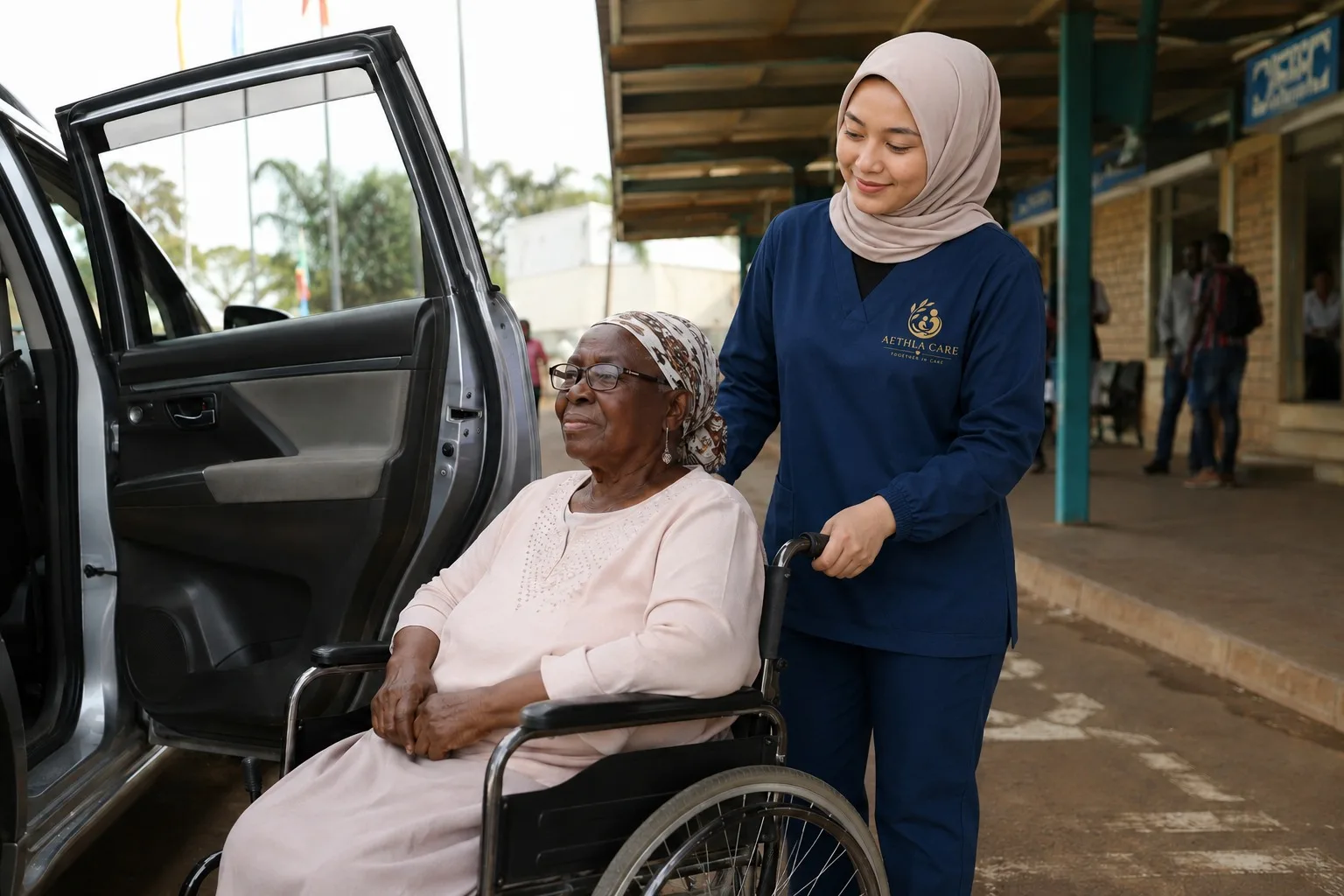
Disability Care in Uganda: A Complete Guide to Disability Support, Home Care and Independence
Finding the right support for a person living with a disability can be difficult.
Families may know that a loved one needs additional help, but they may not know exactly what type of support to look for.
Should they search for a caregiver?
Home care?
A nurse?
Transport?
A specialist?
Physiotherapy?
A support worker?
Or simply someone who can help coordinate everything?
The answer depends on the individual.
**Disability care in Uganda should start with the person, not simply with a diagnosis or disability label.
A person's abilities, routines, preferences, communication needs, mobility, home environment, family support and goals all matter.
Aethla Care Uganda takes this person-centred approach to disability support. Its current disability-support pathway focuses on understanding the individual before proposing a route, including practical support around routines, independence, mobility, access, transport, community participation and communication with families and professionals.
This guide explains disability care and disability support in Uganda, what families should consider when arranging support, how home-based assistance can work, how mobility and healthcare access fit into the care journey, and how families living outside Uganda can coordinate support for relatives at home.
What Is Disability Care in Uganda?
Disability care is support designed around the needs and preferences of a person living with a disability.
It is not one single service.
Different people may require completely different forms of assistance.
One person may need help with mobility.
Another may need assistance with personal routines.
Someone else may need support attending appointments.
Another person may need help communicating with family members or navigating their community.
Some people may require professional healthcare or rehabilitation services.
Others may be largely independent and only need occasional practical assistance.
Therefore, disability care should not begin with the assumption:
"This person has a disability, so they need a caregiver."
Instead, a better starting question is:
"What is this person trying to do, what is becoming difficult, and what support would help?"
That approach respects the individual's independence and recognises that disability affects people differently.
Aethla Care's current disability-support model explicitly starts with the person's strengths, routines, goals and communication preferences rather than a generic package.
Disability in Uganda: What Does the Latest Data Show?
Understanding disability in Uganda requires current evidence.
The Uganda Bureau of Statistics' National Population and Housing Census 2024 Disability Monograph provides one of the most important current national sources.
According to the latest UBOS disability fact sheet, 13.2% of people aged two years and above have a disability. The prevalence is reported as 13.8% among females and 12.5% among males. The same source reports that **46.8% of people aged 60 years and above have a disability.
The census-based data also identifies several forms of functional difficulty, including:
- Remembering or concentrating - Walking or climbing steps - Seeing - Hearing - Self-care - Communication
The fact sheet reports walking or climbing steps as a functional difficulty for 5.0% of people aged two and above, while difficulties with seeing, hearing, self-care, communication and remembering or concentrating are also reported.
These statistics are important for understanding the scale and diversity of disability in Uganda.
However, statistics should not be used to assume what an individual person needs.
A disability statistic describes a population. It does not create an individual care plan.
What Types of Disability Support Are Available?
Disability support can involve many different areas.
Depending on the individual situation, families may need to explore:
Home support
Practical assistance with daily routines and activities.
Mobility support
Help with getting around the home or travelling to important destinations.
Appointment support
Assistance organising or attending medical or specialist appointments.
Healthcare navigation
Help understanding practical questions, appointments and routes to qualified professionals.
Community participation
Support that helps a person participate in activities outside the home.
Family coordination
Helping different family members understand responsibilities and communicate.
Personal routines
Support around activities of daily living where appropriate.
Rehabilitation
Where clinically appropriate, professional rehabilitation services such as physiotherapy or other specialist services may be required.
Transport
Assistance planning journeys when mobility or accessibility creates a barrier.
Aethla Care currently identifies disability support, healthcare navigation, specialist appointments and travel and mobility support as separate but potentially connected care pathways.
Disability Care Should Be Person-Centred
A person-centred approach means that support begins with the individual.
Imagine two people with the same broad disability category.
One may live independently.
The other may need significant daily assistance.
Their care plans should not automatically be identical.
A useful assessment should consider:
- What can the person do independently? - What do they want help with? - What are their goals? - How do they communicate? - What mobility challenges do they experience? - What does their home environment look like? - What support does the family already provide? - What professional support is already involved? - What activities are important to them? - What barriers prevent them from participating fully?
Aethla's current disability-support pathway is built around this principle: understand the person before proposing a route.
What Does a Disability Caregiver Do?
A caregiver's responsibilities depend on the agreed care arrangement.
Possible support may include:
- Assistance with everyday routines - Mobility assistance - Companionship - Household support - Assistance with appointments - Support with errands - Communication with family members - Help organizing daily activities - Support with community participation
However, families should distinguish between caregiving and clinical healthcare.
A caregiver should not automatically be assumed to have the qualifications required to provide nursing, medical treatment, diagnosis, therapy or other clinical services.
Where professional healthcare is required, the appropriate qualified professional should be involved.
This distinction is particularly important for people with complex healthcare needs.
Disability Care vs Nursing Care
These services are not necessarily the same.
Disability care
Disability care may involve practical support that helps someone manage daily life and maintain independence.
This may include assistance with routines, mobility, communication, household activities and participation in everyday activities.
Nursing care
Nursing is professional healthcare delivered by an appropriately qualified nurse.
The type of nursing support required depends on the individual's health condition and clinical needs.
Rehabilitation
Rehabilitation may involve professionals such as physiotherapists or other specialists depending on the individual's needs.
Medical care
Doctors and other licensed healthcare professionals handle clinical diagnosis, treatment and medical decisions within their professional scope.
A person with a disability may require one of these services or several at different times.
The right question is therefore not:
"Which disability service should I buy?"
It is:
"Which parts of this person's life require support, and which professionals or services are appropriate for those needs?"
Home-Based Disability Support in Uganda
For some people, home is the most practical place to receive support.
Home-based support may help with:
- Daily routines - Household activities - Mobility - Personal support - Family coordination - Appointment preparation - Community participation
The suitability of home support depends on the person's circumstances.
Families should consider:
- Is the home accessible? - Is there enough space for the required support? - Are there safety concerns? - Does the person need clinical care? - Who is available when the caregiver is not? - What happens during an emergency? - Does the person want support at home?
The goal should not be to move every responsibility onto a caregiver.
The goal should be to create an environment where the person can participate as independently as reasonably possible.
Disability and Independence
One of the most important principles of disability support is independence.
Needing assistance with one activity does not mean someone cannot make decisions about their own life.
A person may need help getting into a vehicle but still decide where they want to go.
Someone may need assistance preparing a meal but still choose what they want to eat.
Someone may need help attending a hospital appointment but still participate in discussions about their healthcare.
Someone may need support communicating but still have preferences, goals and decisions that should be respected.
Good disability support focuses on removing barriers while allowing the person to remain involved in decisions about their own life.
Aethla Care identifies dignity, choice, privacy and independence among the principles guiding its wider care model.
Disability Rights and Accessibility in Uganda
Disability support is not only about practical care.
People with disabilities have rights.
Uganda's **Persons with Disabilities Act, 2020** provides legal protections relating to the rights and freedoms of persons with disabilities and establishes provisions concerning non-discrimination and accessibility, among other matters.
The Act includes provisions concerning accessibility to buildings open to the public, including requirements relating to accessible entrances, pathways, toilets, stairs, elevators and ramps in applicable circumstances.
This matters when families think about disability support.
Accessibility can influence whether a person can:
- Enter a healthcare facility - Use public buildings - Attend appointments - Travel - Participate in community activities - Access services - Work or study - Maintain social relationships
Care is therefore only one part of a broader disability-support environment.
Disability and Healthcare Access
Healthcare access can become more complicated when mobility, communication or accessibility creates barriers.
A person may know they need medical attention but face practical difficulties getting there.
For example:
"My brother needs to see a specialist, but he has difficulty walking and I don't know how we will get him to the appointment."
The problem is not necessarily finding the doctor.
It may involve:
1. Identifying the appropriate specialist. 2. Arranging the appointment. 3. Understanding the location. 4. Planning transport. 5. Determining whether an accompanying person is needed. 6. Preparing relevant questions and documents. 7. Planning the journey home.
Aethla Care's healthcare-navigation pathway is designed to help families organise practical questions and coordination while making clear that it is not a hospital or clinic and does not replace qualified medical advice.
Disability Support and Specialist Appointments
Some people with disabilities may need access to specialists or rehabilitation professionals.
The appropriate professional depends entirely on the person's situation.
Possible specialist or professional pathways may include:
- Physiotherapy - Rehabilitation - Orthopaedic care - Neurology - Paediatrics - Audiology - Ophthalmology - Other specialist services
Families should not self-diagnose based on an internet article.
A blog can help explain how to navigate the process.
A qualified healthcare professional should determine diagnosis and treatment.
Aethla currently allows families to request specialist appointment coordination, with the organisation stating that live appointment availability is not displayed unless connected to an actual scheduling system. A coordinator confirms requests with the relevant provider or partner.
Mobility Support for People With Disabilities
Mobility can affect almost every part of daily life.
A person may have difficulty:
- Leaving home - Getting into a vehicle - Travelling to hospital - Attending work - Going to school - Visiting family - Participating in community activities - Going shopping - Attending religious or social events
Mobility support should begin by understanding the actual journey.
For example:
Where does the person need to go?
How far is the journey?
Can they transfer into a vehicle?
Do they need an accompanying person?
What communication support is required?
What happens if the appointment runs late?
How will they return home?
Aethla's travel and mobility pathway specifically focuses on the journey itself, including transport, accompanying-person needs, appointment-related travel, mobility and communication requirements.
Disability Support for Families in Kampala
Kampala is Aethla Care's starting location for care coordination.
Families searching for disability support may use terms such as:
- Disability support Kampala - Disability care Kampala - Disability caregiver Kampala - Home care for disabled people Kampala - Mobility support Kampala - Disability assistance Kampala - Caregiver for disabled person Kampala
But useful local SEO requires more than repeating those phrases.
Families need to know:
- What type of support can be discussed? - How does the process work? - What does Aethla coordinate? - What services require a professional or partner? - How is availability confirmed?
Aethla currently identifies Kampala as its launch focus for care coordination.
Disability Support in Wakiso
Wakiso is another early Aethla Care location.
Families may be searching for:
- Disability support Wakiso - Disability care Wakiso - Disability caregiver Wakiso - Home support Wakiso - Mobility support Wakiso
Availability depends on the actual service requirement.
Aethla states that Wakiso is a priority area as it develops practical support around the Kampala metropolitan region.
Families should therefore provide both:
Their location
and
The type of support required.
That allows the appropriate route to be clarified.
Disability Support in Entebbe
Entebbe is included within Aethla's early service footprint.
A person living with a disability in Entebbe may require support around:
- Home routines - Appointments - Mobility - Transport - Community participation - Family coordination
Aethla specifically identifies Entebbe as a location where families can ask about care routes and travel or mobility support.
Disability Support in Mukono
Mukono is also part of Aethla Care's early coordination planning.
Families searching for disability support in Mukono should explain the person's specific requirements rather than assuming that every service is available locally.
This is especially important where the request involves specialist healthcare, transport or professional services.
Aethla confirms that availability depends on the type of support required and is checked before a family proceeds.
Disability Support Across Uganda
Aethla Care's ambition is Uganda-wide, but responsible geographic information requires accuracy.
A company should not claim that a service is physically available in every district simply because the website targets Uganda.
Instead, Aethla's current approach is to allow families outside its early locations to submit their location and care need so the team can explain whether there is an appropriate route to explore.
This approach is better for users and for long-term search credibility.
As the organisation expands, individual location pages can be developed around genuinely available services.
Potential future content could cover:
- Disability support Jinja - Disability support Mbarara - Disability support Gulu - Disability support Mbale - Disability support Fort Portal - Disability support Masaka - Disability support Hoima - Disability support Lira - Disability support Arua
Disability Care for Children in Uganda
Children living with disabilities can have different support needs from adults.
Families may need to think about:
- School - Communication - Mobility - Therapy or rehabilitation - Daily routines - Family support - Appointments - Transport - Social participation
Parents should seek appropriate professional assessment where clinical, developmental or therapeutic questions arise.
A care-coordination service can help organize practical questions and routes, but it should not replace a qualified clinician.
Disability Care for Older Adults
Disability and ageing can overlap.
As people grow older, some may experience changes that affect mobility, communication, daily routines or independence.
The UBOS 2024 census-based data reports that **46.8% of people aged 60 years and above have a disability.
An older adult may therefore require support that combines:
- Elderly care - Disability support - Mobility assistance - Healthcare navigation - Appointment coordination - Family support
This is one reason an integrated care approach can be useful.
Families do not always have to view each challenge as a completely separate problem.
For example, an older person may need help with mobility, attending appointments, communicating with healthcare professionals and maintaining daily routines at the same time.
Understanding the person's complete situation can help families identify the most appropriate support route.
Disability Support and Family Caregivers
Families often provide much of the day-to-day support for a relative with a disability.
That support can include:
- Transport - Meals - Household tasks - Appointments - Communication - Personal assistance - Financial administration - Emotional support
Over time, the main family caregiver may become overwhelmed.
This does not mean the family has failed.
It may simply mean the support system needs strengthening.
A more sustainable approach can involve identifying:
What does the family do well?
What is becoming too difficult?
What should be handled by a professional?
What can remain with family?
What can the person do independently?
This can create a more balanced care plan.
How Can I Arrange Disability Support for a Relative in Uganda from Abroad?
A family member living overseas can begin the process remotely.
The first step should be gathering accurate information.
For example:
- Where does the person live? - What disability-related challenges are they experiencing? - What can they currently do independently? - What support do they already receive? - What additional support does the family think may help? - Are there current healthcare professionals involved? - Is transport required? - Who should be included in communication?
Aethla's diaspora-care pathway is designed for families living outside Uganda who need to coordinate practical support for relatives in Uganda.
The process may involve discussing areas such as home support, appointments, hospital support, travel assistance and family communication, while making clear that Aethla does not make medical decisions for families.
Clinical decisions remain with appropriately qualified healthcare professionals.
How Do I Choose a Disability Care Provider in Uganda?
Families should ask detailed questions before proceeding.
1. What exactly is being provided?
Avoid vague descriptions.
Families should understand the specific support being offered and what is included.
2. Who provides the service?
Ask whether the support is provided by:
- Aethla - A partner - An independent professional - Another organisation
Clear roles help families understand who is responsible.
3. What qualifications are required?
This is especially important when clinical, nursing or therapeutic support is involved.
The person providing care should have the appropriate skills and qualifications for their role.
4. Is the service actually available in the person's location?
Geographic availability should be confirmed before making arrangements.
5. How are responsibilities divided?
Everyone should understand who is responsible for what.
This helps avoid confusion between family members, caregivers, healthcare professionals and organisations.
6. How is communication handled?
Good communication is particularly important when family members live abroad.
Families should understand how updates, concerns and important information will be shared.
7. How is consent handled?
The person's preferences, privacy and decisions should be respected.
8. What happens when circumstances change?
Disability support needs can change over time.
There should be a process for reviewing and adjusting support when necessary.
Disability Care and Dignity
A person with a disability is not defined by the assistance they receive.
Good support should preserve dignity.
That means:
- Speaking directly to the person - Respecting preferences - Asking before helping - Respecting privacy - Supporting independence - Avoiding unnecessary assumptions - Communicating clearly - Involving the person in decisions
Disability support should focus on removing barriers while recognizing the person's abilities, choices and goals.
A person receiving support should still have control over their own life and the decisions that affect them.
Aethla Care's broader care principles specifically emphasize dignity, choice, privacy and independence.
Disability Support and Community Participation
Disability support should not necessarily stop at the front door.
A person's life may involve:
- Family - Work - School - Business - Faith communities - Friends - Sports - Shopping - Healthcare - Community events
If mobility or accessibility creates a barrier, practical support may help the person participate more fully in everyday life.
The goal of disability support is not only to assist with tasks.
It is also about helping people maintain relationships, pursue interests and take part in activities that are important to them.
Aethla's disability-support pathway specifically identifies community participation as one area families may need to explore.
What If We Don't Know What Support Is Needed?
This is one of the most common reasons families delay asking for help.
They may think:
"We don't know what service to request."
That is okay.
A care conversation does not necessarily need to begin with a service name.
A family can explain:
"My sister has a disability and lives in Kampala. She can manage most things independently, but getting to appointments has become difficult and our family lives in different countries. We need help figuring out the practical arrangements."
That information may be enough to begin identifying the appropriate route.
Aethla's current care-request process is designed around this principle: families describe the situation and location first, and a coordinator helps clarify the practical route rather than requiring families to know the correct service label in advance.
Frequently Asked Questions About Disability Care in Uganda
What is disability care in Uganda?
Disability care is support designed around the practical, personal, social and healthcare-related needs of a person living with a disability. The appropriate support depends on the person's individual abilities, preferences, environment and goals.
Where can I find disability support in Uganda?
Start by identifying the person's location and what they need help with. Depending on the situation, support may involve home assistance, mobility, appointment coordination, healthcare navigation or professional disability and rehabilitation services.
Does Aethla Care provide disability support in Uganda?
Aethla Care has a disability-support pathway focused on understanding the person's needs, routines, independence, mobility, access and communication before clarifying the appropriate route.
Can a person with a disability receive support at home?
Yes. Depending on the individual's needs and the available service, home-based support may help with daily routines, mobility, practical activities and family coordination.
Does disability support mean the person needs a full-time caregiver?
No. Support requirements vary considerably. Some people may need occasional assistance while others may require more regular support.
Can Aethla Care help with mobility support?
Aethla has a travel and mobility-support pathway that can explore transport, accompanying-person needs, appointment-related journeys, timing and communication requirements. Availability and the role of any provider or partner should be confirmed for each request.
Can Aethla Care help someone with a disability attend a specialist appointment?
Aethla has healthcare-navigation and specialist-appointment pathways. A coordinator can help clarify the practical route, while clinical care and medical decisions remain with qualified healthcare professionals.
Can I arrange disability support for a relative in Uganda while living overseas?
Yes. Aethla's diaspora-care pathway is designed for families coordinating practical support for relatives in Uganda from countries including Australia, the UK, USA, Canada, UAE and South Africa.
What does Ugandan law say about people with disabilities?
Uganda's Persons with Disabilities Act, 2020 provides legal protections relating to the rights and freedoms of persons with disabilities, including provisions concerning non-discrimination and accessibility.
How common is disability in Uganda?
The UBOS 2024 Disability Monograph fact sheet reports that 13.2% of people aged two years and above have a disability, while 46.8% of people aged 60 years and above are reported as having a disability.
What should I do if I don't know which disability service my relative needs?
Describe the person's situation rather than trying to choose a service name. Explain where they live, what they can do independently, what has become difficult and what support the family is considering.
Does Aethla Care make medical decisions?
No. Aethla's healthcare-navigation information states that it provides coordination and practical support rather than medical diagnosis or advice. Clinical decisions remain with appropriately qualified healthcare professionals and the family.
Disability Care in Uganda: A Person Comes First
Disability support should never begin and end with a diagnosis.
The same disability can affect two people in completely different ways.
One person may need assistance with mobility.
Another may need communication support.
Someone else may need help attending appointments.
Another person may need occasional household assistance.
Some people may need professional rehabilitation or clinical care.
Others may primarily need practical support that enables them to remain independent.
The starting point should therefore be the person.
What do they want to do?
What can they already do?
Where are the barriers?
What support would make the biggest practical difference?
Who needs to be involved?
What professional input is required?
This is the foundation of person-centred disability support.
Aethla Care's disability-support pathway is built around this approach: understand the individual, clarify the practical route, make roles clear and confirm availability before a family commits to the next step.
For families in Kampala, Wakiso, Entebbe, Mukono and other parts of Uganda, the first step is simple:
Explain the situation.
Tell Aethla Care where support is needed, what the person is finding difficult and what type of assistance the family is considering.
You do not have to know the perfect service name before starting the conversation.
Looking for Disability Support in Uganda?
Aethla Care provides a starting point for families exploring disability support, elderly care, home and family support, healthcare navigation, specialist appointments and travel or mobility assistance.
The team can help clarify the practical route, Aethla's role and what needs to be confirmed before the next step.
Aethla Care Uganda — care made easier to navigate.
Sources and Further Reading
Uganda Bureau of Statistics — National Population and Housing Census 2024 Disability Monograph The principal current national statistical source used in this article.
Uganda Bureau of Statistics — Disability Monograph Fact Sheet Current headline statistics from the 2024 census-based disability analysis.
Persons with Disabilities Act, 2020 — Uganda Legal Information Institute Ugandan legal provisions concerning rights, non-discrimination and accessibility.
Aethla Care — Disability Support Current Aethla Care disability-support pathway and approach.
Aethla Care — Healthcare Navigation Current information on specialist coordination and healthcare navigation.
Aethla Care — Travel & Mobility Support Current information on mobility and journey coordination.
Aethla Care — Diaspora Care Current information for families coordinating care for relatives in Uganda from overseas.