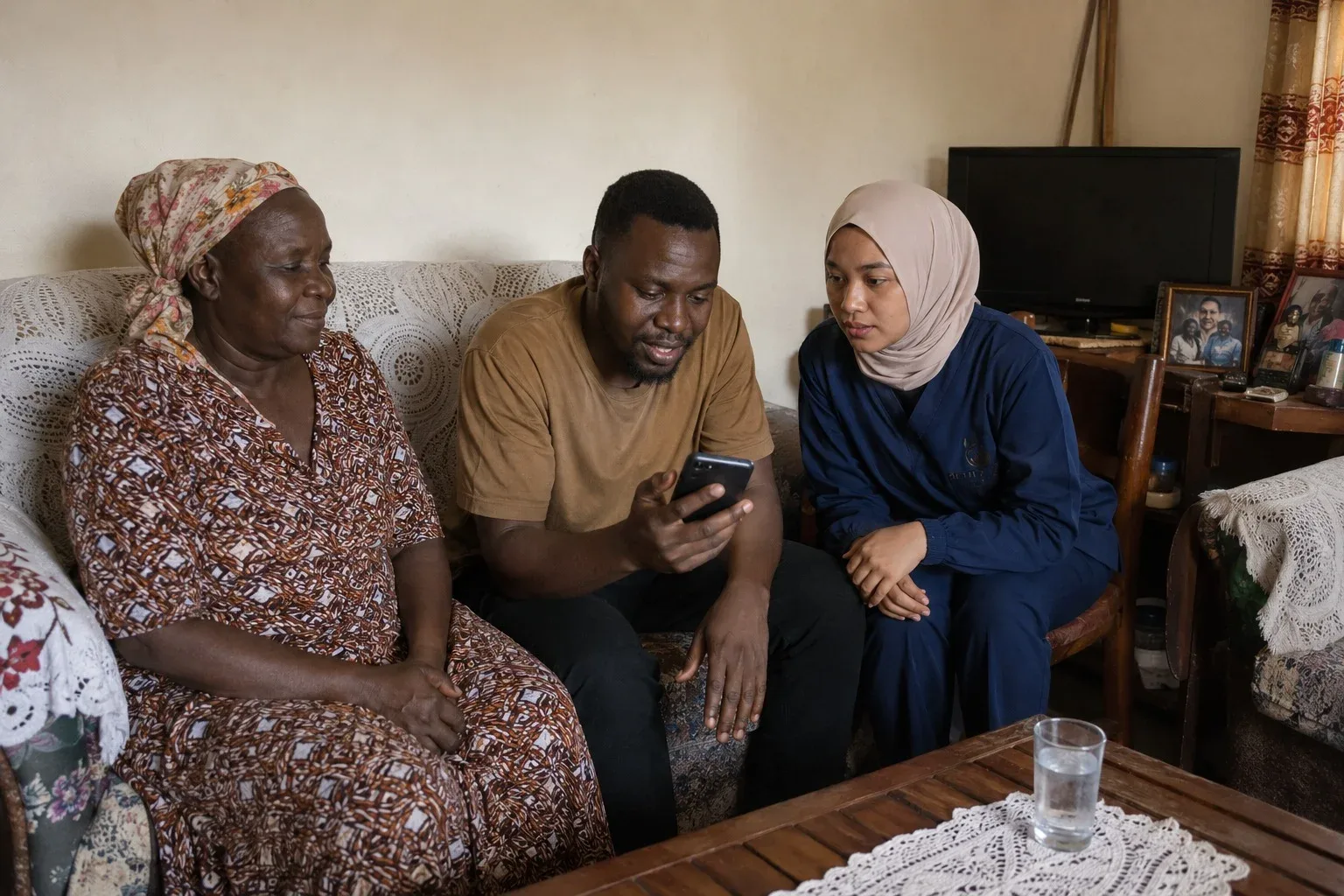
# Diaspora Care in Uganda: A Complete Guide to Caring for Parents and Family From Abroad
**Primary Keyword:** diaspora care Uganda
**Secondary Keywords:** care for parents in Uganda from abroad, elderly care Uganda from abroad, home care Uganda for parents, care for parents in Uganda, Ugandan diaspora care, healthcare for parents in Uganda, elderly care Kampala, caregiver Uganda, specialist appointments Uganda, healthcare navigation Uganda, family care coordination Uganda, care for elderly parents Uganda, remote family care Uganda
**Related Geographic Searches:** care for parents in Uganda from Australia, care for parents in Uganda from the UK, care for parents in Uganda from the USA, care for parents in Uganda from Canada, care for parents in Uganda from UAE, care for parents in Uganda from South Africa, care for parents in Kampala from abroad
**Search Intent:** Informational + service discovery + family care coordination
---
# Quick Answer: How Can Ugandans Abroad Arrange Care for Parents in Uganda?
If you live outside Uganda and your parents, grandparents or relatives live in Uganda, you can coordinate much of their practical care remotely.
The process usually begins by understanding:
1. Where your relative lives. 2. What support they currently receive. 3. What has changed. 4. What they want help with. 5. Whether they need practical home support, healthcare navigation, mobility assistance or specialist care. 6. Who in Uganda is already involved. 7. Who will coordinate each part of the care plan. 8. How family members abroad will receive updates. 9. Which services are actually available in the person's location. 10. When the arrangement should be reviewed.
The family member abroad does **not** necessarily need to manage everything personally.
A local care-coordination service can potentially help connect the practical pieces while healthcare professionals remain responsible for clinical decisions.
Aethla Care Uganda's diaspora-care service is designed around this model: families outside Uganda can explain a care need, discuss the practical support required and establish the appropriate next step in Uganda.
The countries involved may include **Australia, the United Kingdom, United States, Canada, United Arab Emirates, South Africa and other countries where Ugandans live and work.**
---
# What Is Diaspora Care?
Diaspora care refers to the practical coordination of care and family support when a person lives outside the country where their parent or relative lives.
For Ugandan families, this often means:
**A son in Australia supporting his mother in Kampala.**
**A daughter in the UK coordinating care for her father in Wakiso.**
**A family member in the United States helping an elderly parent in Entebbe.**
**A sibling in Canada arranging an appointment for a relative in Uganda.**
**A Ugandan professional in Dubai helping coordinate support for parents back home.**
**A family member in South Africa arranging practical assistance for an ageing parent in Kampala.**
The country changes.
The underlying problem is similar:
> **How do you make sure your family member in Uganda receives appropriate support when you cannot be physically present every day?**
That is the central problem diaspora care is designed to address.
---
# Why Caring for Family in Uganda From Abroad Can Be Difficult
Distance creates a coordination problem.
You may speak with your parent every day but still not know exactly what is happening.
A parent might say:
> "Everything is fine."
But perhaps:
- They have stopped going out. - They are struggling with transport. - They have missed appointments. - Household tasks are becoming difficult. - A spouse is becoming overwhelmed. - They recently left hospital. - They need to see a specialist. - They need help but do not want to ask for it.
The family member abroad may only discover the problem after it has become serious.
This is one reason why a structured care plan can be useful.
---
# Diaspora Care Is More Than Sending Money
Financial support is important for many families.
But money alone does not coordinate care.
Someone still needs to know:
- What is happening? - Who is helping? - Has the appointment happened? - Did the parent get to hospital? - What practical support is required? - What did the healthcare professional recommend? - Who is following up? - What happens next?
A family can therefore think about diaspora care in four broad categories:
### Financial support
Helping with agreed family expenses.
### Practical support
Helping organise everyday assistance.
### Healthcare coordination
Helping navigate appointments, referrals and healthcare-related logistics.
### Family communication
Keeping relatives connected and informed.
These areas can overlap, but they are not identical.
---
# Who Might Need Diaspora Care Support?
Diaspora care is not limited to elderly parents.
It can involve:
- Older parents - Grandparents - People living with disabilities - Relatives recovering after hospitalisation - Family members who need help attending appointments - Parents who need household assistance - Families managing increasing care responsibilities - Relatives who need mobility or travel support - Families coordinating multiple providers
The appropriate arrangement depends on the person's circumstances.
---
# Caring for Elderly Parents in Uganda From Abroad
Ageing can gradually change what a person needs.
An older parent may remain independent while requiring additional assistance in one or two areas.
For example:
**Parent A**
Lives independently but needs transport to medical appointments.
**Parent B**
Needs household help several days per week.
**Parent C**
Has recently been discharged from hospital and requires additional practical support.
**Parent D**
Needs help coordinating several appointments.
**Parent E**
Lives with reduced mobility and needs assistance with travel and community activities.
These are all different care situations.
There is no reason to assume they require the same service.
---
# A Person-Centred Approach to Elderly Care
The World Health Organization's current Integrated Care for Older People guidance promotes a person-centred approach involving assessment, identification of social-care and support needs, personalised care planning, implementation and monitoring.
WHO also describes integrated care as extending across homes, primary care, hospitals, long-term care and communities, with the aim of supporting older people to maintain functional ability and participate in their communities.
For a Ugandan family living abroad, this has a practical implication:
**Do not start by asking which package you should buy. Start by asking what the person needs.**
---
# Step 1: Talk to Your Parent
The parent should be involved in the conversation whenever they are able to participate.
Ask:
- How are things going? - What has become difficult? - What would you like help with? - What do you want to continue doing yourself? - Are appointments becoming difficult? - Is transport a problem? - Are you comfortable having someone assist at home? - Who currently helps you? - Is there anything you have been worried about but have not mentioned?
This conversation can reveal more than a checklist.
---
# Step 2: Identify What Has Changed
Instead of saying:
**"Mum needs elderly care."**
try to identify the actual change.
For example:
**"Mum has started finding shopping difficult."**
Or:
**"Dad can manage at home but needs help getting to hospital."**
Or:
**"My parents are managing, but my sister is overwhelmed by doing everything herself."**
Or:
**"Dad came home from hospital and now needs additional support."**
These descriptions allow the family to consider a more appropriate response.
---
# Step 3: Identify Existing Support
Before arranging additional care, map the existing family network.
| Person | Current role | |---|---| | Parent | Daily decisions | | Spouse | Household support | | Local sibling | Visits | | Relative | Transport | | Neighbour | Occasional check-ins | | Healthcare professional | Clinical care | | Caregiver | Agreed practical support | | Relative abroad | Coordination |
This prevents duplication.
It also identifies gaps.
---
# What Types of Diaspora Care Can Be Arranged?
## 1. Elderly Care
Depending on the situation, families may explore:
- Home support - Companionship - Daily routine assistance - Mobility support - Appointment assistance - Family coordination - Post-hospital support
---
## 2. Home and Family Support
Not every family needs a full-time caregiver.
Some need practical assistance with:
- Household routines - Meals - Errands - Appointments - Reminders - Family organisation - Companionship
This can be particularly useful for older people who remain largely independent.
---
# 3. Specialist Appointments
Families abroad may need help arranging access to a specialist.
The practical process can involve:
1. Identifying the health concern or existing referral. 2. Understanding which type of specialist may be appropriate. 3. Identifying a suitable facility or provider. 4. Checking referral or documentation requirements. 5. Coordinating the appointment. 6. Arranging transport. 7. Organising an accompanying person where needed. 8. Communicating the practical details to the family abroad.
Aethla Care can help coordinate a specialist appointment request where a suitable provider route exists.
However, Aethla is not the clinical provider.
Diagnosis, treatment and clinical recommendations remain the responsibility of qualified healthcare professionals.
---
# 4. Healthcare Navigation
Healthcare navigation is particularly valuable when family members are not physically present.
A family may need help understanding:
- Where to start - Which facility to contact - Whether a referral may be required - What documents may be needed - How to prepare for an appointment - How to coordinate transport - What the next practical step is
Uganda's National Essential Health Care Package provides a framework for health-service planning and includes referral and evacuation services as well as a dedicated geriatric-care cluster.
This illustrates why healthcare should be viewed as a pathway rather than a single appointment.
---
# 5. Hospital Support and Post-Hospital Care
Hospital discharge can create a new set of family responsibilities.
An older person may suddenly need:
- Transport - Follow-up appointments - Additional home assistance - Mobility support - Family monitoring - Help maintaining agreed routines - Further professional care
Families abroad should ask:
**Who will physically be there?**
and:
**Who will coordinate the practical arrangements?**
Clinical instructions should come from the treating healthcare team.
A family-support or coordination service can help organise the practical side of implementing those instructions.
---
# 6. Transport and Mobility
Transport is often overlooked.
A family might successfully arrange an appointment but forget that the parent cannot comfortably travel alone.
Consider:
- Vehicle access - Mobility - Journey duration - Accompanying person - Arrival at the facility - Return journey - Assistance after the appointment
For some families, transport is not an isolated service.
It is an essential part of the care pathway.
---
# 7. Disability Support
Diaspora families may also need to coordinate support for relatives living with disabilities.
Possible needs include:
- Mobility - Transport - Home support - Rehabilitation pathways - Assistive technology - Appointment coordination - Communication - Family support
Uganda's Ministry of Health launched its National Rehabilitation and Assistive Technology Strategic Plan 2025–2030 in 2026, with a focus on expanding equitable access to rehabilitation and assistive technology services.
For families, this reinforces the importance of considering independence and access rather than focusing only on dependency.
---
# 8. Childcare and Family Support
Diaspora care is not only about parents.
A Ugandan living abroad may also need help coordinating practical support for:
- Children - New mothers - Newborns - Families recovering after childbirth - Relatives with disabilities - Households facing temporary support needs
The appropriate service should be based on the family's actual circumstances.
---
# 9. Domestic Help and Household Assistance
Sometimes the family does not need medical care at all.
The problem may simply be that an older parent is struggling with:
- Cleaning - Cooking - Shopping - Laundry - Errands - Household organisation
This is where domestic or household support can be relevant.
It should not automatically be presented as healthcare.
Clear role definitions protect both families and service providers.
---
# Which Countries Can Ugandans Abroad Be Supported From?
The same Uganda-based care process can potentially serve Ugandans living in many countries.
### Australia
Families in Melbourne, Sydney, Brisbane, Perth, Adelaide and other Australian locations may need to coordinate care for relatives in Uganda.
### United Kingdom
Families living in London, Birmingham, Manchester and elsewhere in the UK may need support for parents and relatives in Uganda.
### United States
Ugandans living across the US may need local support for parents who remain in Uganda.
### Canada
Families in Toronto, Vancouver, Calgary, Edmonton and elsewhere may need assistance coordinating care.
### United Arab Emirates
Families in Dubai, Abu Dhabi, Sharjah and other UAE locations may need help coordinating care in Uganda.
### South Africa
Ugandans living in Johannesburg, Pretoria, Cape Town, Durban and other locations may need support for relatives back home.
### Other countries
The same principle applies to families living in:
- Germany - Sweden - Norway - Netherlands - France - Ireland - New Zealand - Qatar - Saudi Arabia - Kenya - Rwanda - Tanzania - Other African countries - Other parts of the Middle East - Other parts of Europe - Other parts of Asia
The country where the family member lives is usually less important than the **location and needs of the person receiving care in Uganda**.
---
# Why the Uganda Side of the Arrangement Matters Most
A common mistake is to focus too much on where the diaspora family lives.
For example:
**"I live in Australia."**
That information is useful.
But for arranging care, other questions are often more important:
**Where does Mum live?**
**What does she need?**
**Who is nearby?**
**What services are required?**
**What support is already available?**
The receiving person's location determines what practical options may exist.
---
# Kampala, Wakiso, Entebbe and Mukono
Aethla Care currently has an early service footprint focused on:
- Kampala - Wakiso - Entebbe - Mukono
Service availability varies according to the support requested.
Families outside these locations can provide their location and describe the care need so that an appropriate route can be assessed.
This is particularly important for diaspora families because they may not know what is actually available in a particular Ugandan town.
---
# How to Manage Care When You Have Several Siblings Abroad
A diaspora family may have relatives scattered across several countries.
For example:
- One sibling in Australia - One in the UK - One in Uganda - One in the United States
Without a clear structure, everyone may assume someone else is handling the problem.
A shared care plan can help.
---
# Create One Family Care Record
Keep one central record containing:
- Parent's location - Main family contact - Backup contact - Relevant appointments - Provider contacts - Transport information - Important documents - Current support arrangements - Review dates
The family can decide who has access.
Sensitive information should only be shared with people who need it.
---
# Divide Responsibilities
One person does not have to do everything.
For example:
**Sibling in Uganda:** physical visits
**Sibling in Australia:** family coordination
**Sibling in UK:** appointment administration
**Sibling in USA:** agreed financial responsibilities
**Care provider:** practical support
**Healthcare professional:** clinical care
This can make the family system more sustainable.
---
# Establish a Communication Routine
Families should decide how information will move.
For example:
**Parent → local contact → family group**
and after healthcare appointments:
**Healthcare provider → authorised family contact → wider family**
The exact arrangement will depend on consent, privacy and the circumstances.
---
# What If You Cannot Visit Uganda Often?
Many diaspora families cannot travel frequently.
Work, children, finances and immigration responsibilities may make regular visits difficult.
That does not mean you cannot remain involved.
You can still:
- Call regularly - Arrange practical support - Coordinate family responsibilities - Keep appointment records - Help organise transport - Participate in important decisions - Stay informed about changes - Visit when possible
Remote involvement works best when it is structured rather than reactive.
---
# How to Choose a Care Provider in Uganda From Abroad
Choosing a provider remotely requires additional care.
Ask:
### Who provides the service?
Do not assume that the company receiving your request is the person actually delivering the service.
### What exactly will they do?
Get the responsibilities clearly defined.
### What are they not responsible for?
This is equally important.
### How is supervision handled?
Especially when the family is overseas.
### How are updates provided?
Know what communication you should expect.
### What happens if the provider is unavailable?
Ask about contingency arrangements.
### How is sensitive information handled?
Privacy should be considered from the beginning.
### Is the service actually available in the parent's location?
Confirm this before making arrangements.
---
# Red Flags for Diaspora Families
Be particularly cautious if a provider:
- Guarantees medical outcomes - Claims to provide clinical care without appropriately qualified professionals - Cannot identify who will deliver the service - Cannot explain responsibilities - Claims an appointment is confirmed when it has not been verified - Gives no clear communication process - Pressures you to pay immediately - Provides vague answers about pricing - Cannot explain what happens when circumstances change
A transparent provider should be able to explain its role.
---
# How Much Does Diaspora Care in Uganda Cost?
There is no single standard price.
The cost depends on:
- Type of service - Hours - Frequency - Location - Number of visits - Transport - Professional involvement - Complexity - Whether services are coordinated or directly provided
Families should avoid comparing prices without comparing what is actually included.
A cheaper service may involve fewer hours or fewer responsibilities.
A higher-cost service may include additional coordination or professional input.
Ask for a clear explanation.
---
# A Simple Diaspora Care Planning Framework
A family can use this seven-step framework.
## Step 1 — Understand
What is happening?
## Step 2 — Listen
What does your parent or relative want?
## Step 3 — Assess
What practical and healthcare-related needs exist?
## Step 4 — Map
Who is already helping?
## Step 5 — Coordinate
What responsibilities need to be assigned?
## Step 6 — Communicate
How will family members receive updates?
## Step 7 — Review
Has anything changed?
This framework can be used whether the family member lives in Australia, the UK, USA, Canada, UAE, South Africa or elsewhere.
---
# Diaspora Care Checklist
### Person
- [ ] Where does my parent/relative live? - [ ] What has changed? - [ ] What do they want? - [ ] What can they still do independently?
### Healthcare
- [ ] Are there current health concerns? - [ ] Are there upcoming appointments? - [ ] Is specialist care required? - [ ] Has there been a recent hospital stay? - [ ] Is rehabilitation involved?
### Home
- [ ] Is household help required? - [ ] Is companionship required? - [ ] Is mobility becoming difficult? - [ ] Are daily routines becoming harder?
### Family
- [ ] Who is physically nearby? - [ ] Who is the primary contact? - [ ] Who is the backup? - [ ] Who coordinates appointments? - [ ] Who receives updates?
### Provider
- [ ] Who actually delivers the service? - [ ] What exactly is included? - [ ] What is excluded? - [ ] How is availability confirmed? - [ ] What happens if circumstances change?
---
# When Should Diaspora Families Start Planning?
You do not need to wait until there is an emergency.
Consider starting the conversation when:
- Your parent is becoming less independent. - A spouse is struggling. - A sibling is overwhelmed. - Appointments are becoming difficult. - Transport is becoming a problem. - Your parent has recently left hospital. - You are receiving worrying messages from relatives. - Your parent has started asking for more help. - You are travelling repeatedly to solve care problems. - Your family wants a plan before a crisis.
Early planning does not mean assuming something bad will happen.
It means creating options.
---
# What Aethla Care Does for Diaspora Families
Aethla Care Uganda is designed to give families abroad a local starting point for care coordination.
The process is simple:
### 1. Tell Aethla what is happening.
Explain the person's location and needs.
### 2. Clarify the care requirement.
A coordinator helps determine what type of support may be relevant.
### 3. Establish the appropriate route.
This may involve Aethla directly, a partner, another provider or healthcare facility, depending on the request.
### 4. Coordinate the next practical step.
The family receives clarity about what happens next.
### 5. Keep the family connected.
Where appropriate, communication and updates can be incorporated into the arrangement.
Aethla's role is not to replace the family.
It is to help the family coordinate practical support in Uganda.
---
# What Aethla Care Does Not Do
Aethla should not be presented as:
- A hospital - A medical clinic - A replacement for a doctor - A replacement for emergency services - A substitute for clinical diagnosis - A guarantee of appointment availability - A universal provider available in every Ugandan location
Clinical decisions remain with qualified professionals.
Availability must be confirmed.
And emergencies should be directed to appropriate emergency healthcare services rather than waiting for a care-coordination response.
---
# Frequently Asked Questions
## What is diaspora care in Uganda?
Diaspora care is the coordination of practical, family and healthcare-related support for relatives in Uganda when the family member arranging or funding the care lives abroad.
## Can I arrange care for my parents in Uganda from Australia?
Yes. Families in Australia can begin a care request remotely and coordinate practical support for relatives in Uganda.
## Can I arrange elderly care for my parents from the UK?
Yes. The same diaspora-care process can be used by families living in the UK.
## Can Ugandans in the USA arrange care for parents in Uganda?
Yes. A family member in the United States can coordinate care remotely with relatives and service providers in Uganda.
## Can families in Canada arrange care for relatives in Uganda?
Yes. Families can begin remotely and establish the appropriate local support route.
## Can Ugandans in Dubai arrange care for parents in Uganda?
Yes. Families living in the UAE can initiate a care request for relatives in Uganda.
## Can families in South Africa arrange care in Uganda?
Yes. Families living in South Africa can coordinate support remotely for relatives in Uganda.
## Can Aethla Care arrange specialist appointments?
Families can request specialist appointment coordination. The appointment must be confirmed through the relevant provider or partner; Aethla does not assume live availability.
## Can Aethla provide a caregiver?
Depending on the requested service, location and current availability, Aethla may operate or coordinate an appropriate care route. The exact role should be confirmed before arrangements are made.
## Can Aethla help with hospital transport?
Aethla can explore appropriate travel and mobility support routes where available.
## Can Aethla help someone living with a disability?
Aethla can help families explore practical disability, mobility, healthcare-navigation and support routes depending on the person's needs and location.
## What if my parent lives outside Kampala?
Provide the location and care requirement. Aethla's current early footprint includes Kampala, Wakiso, Entebbe and Mukono, while support outside those areas needs to be confirmed.
## Can I arrange care without travelling to Uganda?
Yes. Many parts of the coordination process can begin remotely.
## Does diaspora care replace family involvement?
No. The purpose is to make family involvement more manageable, not to remove the family from the process.
## Does Aethla provide medical advice?
No. Healthcare navigation and care coordination do not replace professional medical assessment or treatment.
---
# Why a Single Diaspora Care Hub Is Better for Families
Families do not necessarily think in terms of:
**"I need an Australia-to-Uganda care page."**
They think:
**"I live overseas and my mother needs help in Uganda."**
That is why the main Aethla page should answer the broader question.
The country-specific searches can still be addressed naturally within this pillar:
- Care for parents in Uganda from Australia - Care for parents in Uganda from UK - Care for parents in Uganda from USA - Care for parents in Uganda from Canada - Care for parents in Uganda from UAE - Care for parents in Uganda from South Africa - Care for parents in Uganda from other countries
But the central subject remains:
# **Diaspora Care in Uganda**
That gives Aethla one clear topical authority hub rather than fragmenting the subject across many similar pages.
---
# Final Thoughts
Distance should not mean that families lose visibility into the wellbeing of their loved ones.
For Ugandans living abroad, caring for parents and relatives in Uganda can involve much more than sending money or making occasional phone calls.
It can involve:
- Elderly care - Home support - Healthcare navigation - Specialist appointments - Hospital support - Post-hospital care - Mobility and transport - Disability support - Childcare and family assistance - Domestic support - Family communication
The most effective starting point is not a particular country or service.
It is the person.
Understand what has changed.
Listen to what they want.
Identify the practical gaps.
Map the family network.
Separate clinical care from practical support.
Then coordinate the appropriate services.
Whether you live in **Australia, the UK, USA, Canada, UAE, South Africa, Europe, the Middle East, another African country or elsewhere in the world**, the care question remains the same:
> **How can I help my family member in Uganda receive the right support when I cannot always be there personally?**
Aethla Care Uganda provides a local starting point for answering that question.
**Tell us where your family member lives in Uganda, what support they need and how you would like the care process coordinated.**
---
# Factual References
### World Health Organization — Integrated Care for Older People (ICOPE), 2nd Edition
WHO's second edition ICOPE handbook, published in September 2025, describes a person-centred pathway involving assessment, identification of social-care and support needs, development of a personalised care plan, implementation and monitoring.
### World Health Organization — Person-Centred Integrated Care
WHO describes integrated care for older people as extending across homes, primary care, hospitals, long-term care and communities, with an emphasis on person-centred and coordinated care.
### Uganda Ministry of Health — National Essential Health Care Package
Uganda's National Essential Health Care Package was published in 2024 as a framework for directing health-service planning and investment. It includes a geriatric-care cluster and identifies referral and evacuation services within the health system.
### Aethla Care Uganda — Diaspora Care
Aethla Care's diaspora-care service provides a route for families living abroad to explain a care requirement and coordinate practical support for relatives in Uganda.
---
## Important Care Information
This article provides general information for families and is not medical advice, diagnosis or treatment.
Healthcare decisions should be made with appropriately qualified healthcare professionals.
Aethla Care does not replace doctors, nurses, hospitals, therapists or other licensed clinical providers.
Service availability, geographic coverage, provider participation and appointment availability can change and should be confirmed before making arrangements.
**Last reviewed: September 2026**