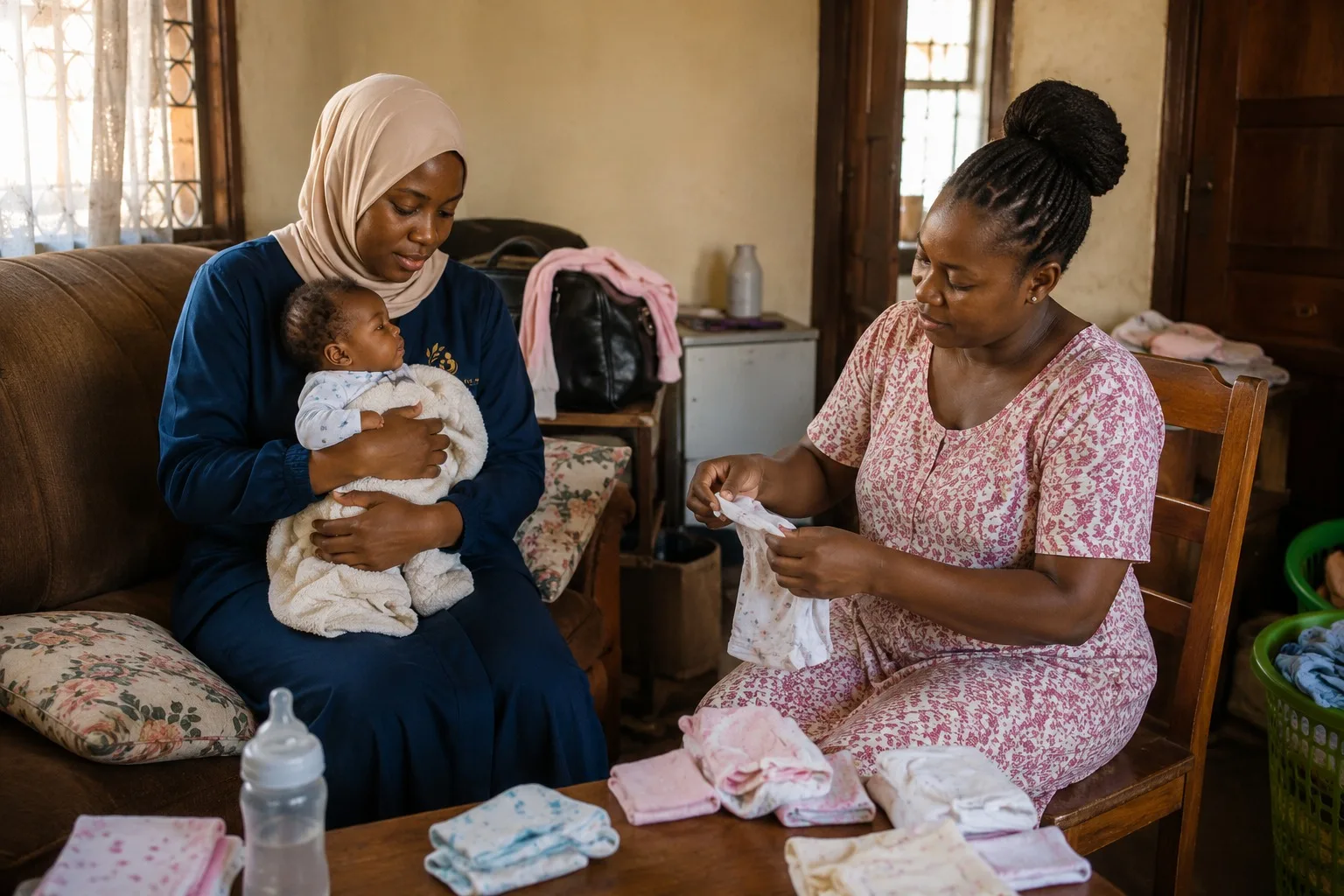
Childcare in Uganda: What Parents and Families Need to Know
Finding the right childcare in Uganda can be a major decision for parents, guardians and extended families.
Whether you are looking for a babysitter in Kampala, a nanny for a newborn, practical childcare support in Wakiso, help for a growing family in Entebbe or support for relatives caring for children in Uganda, the right arrangement needs to be more than simply finding someone who is available.
Families need to consider safety, reliability, routines, communication, responsibilities, experience, household expectations and, where necessary, access to qualified healthcare professionals.
New parents may also need additional practical support during the first weeks and months after a baby arrives. This can include help with household routines, childcare organization, family communication, appointments, transport and creating a manageable daily routine.
Aethla Care Uganda provides a care coordination and family-support route for these situations. Its childcare and newborn support service is designed around the family's circumstances rather than simply selling a predefined service.
This guide explains childcare and newborn support in Uganda, the different types of support families may consider, what to look for when choosing a babysitter or nanny, and how families can approach childcare planning more safely and clearly.
What Is Childcare in Uganda?
Childcare refers to the practical supervision, care and support provided to children while parents or guardians are working, resting, travelling, attending appointments or managing other responsibilities.
Childcare arrangements can take many forms.
A family may need:
- A babysitter for several hours - A regular nanny - Part-time childcare - Full-day childcare - Newborn support - After-school childcare - Weekend childcare - Temporary childcare - Childcare while parents work - Childcare during family travel - Support for a relative caring for a child - Help coordinating childcare and other family responsibilities
The appropriate arrangement depends on the child's age, the family's schedule, the household environment and the level of responsibility required.
Childcare should therefore begin with a clear understanding of what the family actually needs.
What Is Newborn Support?
Newborn support is practical assistance around the home and family during the early period after a baby is born.
It can include helping parents organize routines, household responsibilities, childcare arrangements, communication and practical support.
It is important to distinguish **practical newborn support from clinical newborn healthcare.
Medical assessment, diagnosis, treatment, medication decisions and other clinical matters should be handled by appropriately qualified healthcare professionals.
The World Health Organization identifies essential newborn care as including areas such as thermal care, feeding support, infection prevention, assessment of health problems and recognition of situations requiring timely referral.
UNICEF Uganda likewise provides guidance on keeping newborns warm and safe, maintaining clean and dry cord and skin care, feeding and seeking appropriate care when a newborn may be sick or at risk.
For families, this means that a childcare or family-support arrangement should have clear boundaries around what is practical support and what requires a qualified healthcare professional.
Why Families in Uganda May Need Childcare Support
Modern family life can create many competing responsibilities.
Parents may need to work, operate businesses, attend university, travel, care for older relatives, manage a household or attend medical appointments.
In some families, grandparents and extended relatives provide important childcare support. In others, parents may have limited family support nearby.
A family might therefore need childcare because:
1. Parents are returning to work
Returning to work after having a baby can require careful planning.
Parents may need to establish:
- Who will care for the child? - During which hours? - Who handles feeding routines? - Who collects the child? - Who communicates with parents? - What happens if the normal caregiver is unavailable?
Planning these responsibilities before returning to work can reduce confusion.
2. Parents need occasional help
Not every family needs a full-time nanny.
Some may simply need someone to provide childcare for a few hours while a parent:
- Works from home - Attends an appointment - Runs errands - Travels locally - Gets some rest - Handles another family responsibility
3. A new baby has changed the household routine
A newborn can change how a household operates.
Parents may need additional practical support with:
- Household organisation - Childcare routines - Communication between family members - Appointments - Transport - Family responsibilities - Returning to work
Aethla Care's newborn-support approach specifically focuses on practical family needs, routines, handovers and communication rather than presenting itself as a replacement for clinical healthcare.
Babysitter vs Nanny vs Newborn Caregiver vs Nurse
One of the most important questions for parents is understanding what type of person they actually need.
These roles should not automatically be treated as interchangeable.
Babysitter
A babysitter generally provides temporary childcare for an agreed period.
A family might use a babysitter when:
- Parents are going out - Parents have an appointment - A parent needs temporary assistance - The family needs occasional childcare
The exact responsibilities should be agreed in advance.
Nanny
A nanny generally provides more regular childcare and may become part of a family's ongoing household routine.
Responsibilities may include:
- Supervising children - Supporting daily routines - Helping with age-appropriate activities - Preparing or organising children's meals where agreed - School-related routines - Communicating with parents
The precise role should always be agreed between the family and caregiver.
Newborn Support
Newborn support may focus on the practical side of helping a family adjust to life with a new baby.
This could involve:
- Helping organise routines - Supporting household coordination - Helping parents manage practical responsibilities - Supporting communication and handovers - Helping coordinate appointments or transport where appropriate
Nurse or Other Healthcare Professional
A nurse, midwife, doctor or other licensed healthcare professional has a different role.
Clinical healthcare should be provided by appropriately qualified professionals.
Families should not assume that a babysitter or nanny is qualified to provide medical care simply because they have experience caring for children.
How to Choose a Babysitter or Nanny in Uganda
Choosing childcare is ultimately a question of trust, responsibility and suitability.
Parents should consider several areas before agreeing to an arrangement.
1. Experience
Ask about previous childcare experience.
Useful questions include:
- What ages of children have you cared for? - What type of childcare have you provided? - Have you cared for newborns? - Have you worked with multiple children? - What responsibilities did you previously have?
Experience should be considered alongside the specific needs of your child.
2. References and Verification
Where possible, families should establish appropriate references and verification.
Ask:
- Can previous employers or families provide references? - What identity information is available? - What experience can be verified? - Has the caregiver worked in a similar household before?
The level of verification should match the responsibility involved.
3. Communication
Good childcare requires clear communication.
Parents should establish:
- How updates will be provided - Who should be contacted in an emergency - How changes in routine will be communicated - Who can collect the child - What information should remain private
4. Reliability
A caregiver's reliability matters enormously.
A family should discuss:
- Working hours - Days required - Expected arrival times - Leave arrangements - Backup plans - What happens if the caregiver cannot attend
5. Child-Specific Needs
Every child is different.
The family should communicate relevant information about:
- Daily routines - Sleep - Meals - School - Activities - Communication - Family preferences - Special requirements
Where medical or developmental needs exist, families should ensure that appropriate professional guidance is obtained.
Questions to Ask Before Hiring a Babysitter or Nanny
Before agreeing to childcare, parents can use a simple checklist.
About Experience
- How long have you provided childcare? - What age groups have you cared for? - Have you cared for newborns? - Can you provide references?
About Responsibilities
- What childcare tasks are you comfortable doing? - Are household duties included? - Are school pickups included? - Are meals included? - What responsibilities are outside your role?
About Safety
- What would you do if a child became unwell? - Who would you contact? - Are you comfortable following the family's safety instructions?
About Communication
- How will parents receive updates? - Can the caregiver use WhatsApp or another agreed communication method? - Who should be contacted if the normal routine changes?
About Schedules
- What hours are available? - Are evenings possible? - Are weekends possible? - What happens if additional hours are needed?
The goal is not simply to find someone who says yes.
The goal is to establish whether the arrangement is appropriate for the child and the household.
Childcare Safety: What Parents Should Discuss
Child safety should be discussed before childcare begins.
Families should establish clear rules about:
- Who is allowed to collect the child - Visitors to the home - Taking children outside - Transport - Screen use - Food and drinks - Sleeping arrangements - Bathing - Photos and social media - Contact with other people - Emergency contacts - Communication with parents
Families should also consider privacy.
For example, parents may want clear rules about:
- Sharing photographs of children - Posting information online - Discussing the family with outsiders - Accessing household information - Sharing addresses or travel plans
Clear expectations protect both the child and the caregiver.
Newborn Support at Home
The first weeks after birth can be demanding for families.
Parents are adapting to a new routine while also managing sleep, feeding, household responsibilities, appointments and family expectations.
Practical support can help reduce some of the organizational pressure.
Examples include:
Household Routine Planning
Families can decide:
- Who handles which tasks? - Who helps with meals? - Who supports older children? - Who handles appointments? - Who communicates with relatives?
Childcare Planning
Families can establish:
- Who provides childcare? - When is childcare required? - Who provides backup? - How are handovers handled?
Family Communication
Relatives may want to help but may not know what the parents actually need.
A clearer communication plan can help prevent misunderstandings.
Appointment Coordination
Parents may need help organizing transport, schedules and communication around appointments.
Where clinical decisions are involved, the appropriate healthcare professional remains responsible for medical advice.
Newborn Care: What Every Family Should Understand
Practical support does not replace professional healthcare.
Families should have access to appropriate maternity, postnatal and newborn healthcare.
WHO guidance describes essential newborn care as including warmth, feeding, infection prevention, assessment and timely referral when necessary.
UNICEF Uganda similarly emphasises keeping newborns warm, keeping the umbilical cord and skin clean and dry, and seeking appropriate care when a baby may be sick or at risk.
For parents, the important principle is simple:
A childcare provider should know the limits of their role.
If a child or newborn has a health concern, parents should seek appropriate medical guidance rather than relying on a babysitter or general childcare provider to diagnose or treat the problem.
Childcare for Working Parents in Uganda
For working parents, childcare planning is often about reliability.
The question is not only:
"Who can look after my child?"
It is also:
"Can this arrangement reliably fit our working life?"
Parents should consider:
- Working hours - Commute time - School schedules - Backup arrangements - Public holidays - Family emergencies - Transport - Communication - Changes in work schedules
A childcare plan should also allow parents to understand what happens when something changes.
For example, if a caregiver becomes unavailable, is there a backup person?
If a parent is delayed at work, who remains responsible for the child?
These practical questions can make a major difference.
Childcare for Families Living Abroad
Childcare and family support can become particularly complicated when parents or relatives live outside Uganda.
A parent living in:
- Australia - The United Kingdom - The United States - Canada - The UAE - South Africa - Or another country
may need to coordinate childcare or family support for relatives in Uganda.
Distance creates additional questions:
- Who is physically available? - Who can visit the household? - Who can communicate with the family? - Who can coordinate appointments? - Who provides updates? - Who is responsible for decisions?
A care coordination platform can help families create a clearer route without pretending that distance removes the need for local verification.
Aethla Care's wider model is specifically designed to help families coordinate support in Uganda, including family members who live abroad.
Childcare in Kampala, Wakiso, Entebbe and Mukono
Local intent is important when families search for childcare online.
People may search for:
- Babysitter in Kampala - Nanny in Kampala - Childcare services Kampala - Newborn support Kampala - Babysitter Wakiso - Childcare Wakiso - Babysitter Entebbe - Nanny Entebbe - Childcare Mukono - Newborn support Mukono
However, families should not assume that a provider is available simply because a website mentions a location.
Aethla Care currently identifies Kampala, Wakiso, Entebbe and Mukono as its early service footprint, with availability depending on the type of support required and confirmation before a family proceeds.
Families outside those areas can still provide their location and care need so that the appropriate route can be assessed.
How Much Does Childcare Cost in Uganda?
There is no single childcare price that applies to every family.
The cost of childcare can depend on factors such as:
- Child's age - Number of children - Hours required - Part-time or full-time arrangement - Daytime or nighttime support - Location - Live-in or live-out arrangement - Experience required - Additional responsibilities - Transport requirements - Special childcare needs
Families should therefore be cautious about websites that publish one universal "Uganda nanny price" as though every childcare arrangement is identical.
A better approach is to define the actual requirement first and then establish the applicable arrangement and cost.
How Aethla Care Can Help Families Explore Childcare Support
Aethla Care Uganda approaches childcare as part of a wider family-support system.
The starting point is not simply:
"Do you have a babysitter?"
Instead, the conversation can begin with:
"What does this family need help with?"
That may involve childcare, newborn support, household responsibilities, appointments, transport or communication.
Aethla's current childcare and newborn-support route focuses on practical support planning, routines, handovers, communication and guidance routes for questions that require qualified professionals.
The organisation also distinguishes between different roles, including:
- Aethla-operated services - Aethla-coordinated services - Partner-delivered services - Information-only guidance
This distinction is important because families should understand who is actually providing a service before proceeding.
Aethla therefore should not be viewed simply as a generic babysitter directory.
It is intended to be a coordination point connecting families with appropriate care and support routes.
What Makes a Good Childcare Arrangement?
A strong childcare arrangement usually has five characteristics.
1. Clear Responsibilities
Everyone knows what they are responsible for.
Parents and caregivers should understand what tasks are included and what tasks are outside the agreed role.
2. Clear Communication
Parents and caregivers know how to communicate.
This includes updates, changes to routines, concerns and important information about the child.
3. Appropriate Boundaries
Childcare responsibilities should be separated from clinical responsibilities.
A babysitter or nanny may provide practical childcare support, but medical decisions and healthcare treatment should be handled by qualified healthcare professionals.
4. Reliability
The arrangement should work within the family's real schedule.
Parents should understand working hours, availability, backup plans and what happens if circumstances change.
5. Respect for the Child and Family
The child's wellbeing, routines, privacy and family preferences should be respected.
The best childcare arrangement is therefore not necessarily the most complicated.
It is the one that is clear, suitable, safe and workable for the family.
Childcare and Newborn Support FAQ
How can I find a babysitter in Uganda?
Start by defining the child's age, required hours, location, responsibilities and type of support needed. Then consider experience, references, verification, communication and reliability before agreeing to an arrangement.
How do I find a babysitter in Kampala?
Families in Kampala can explore childcare providers and coordination services based on their specific requirements. Aethla Care currently includes Kampala within its early service footprint, with availability confirmed according to the type of support requested.
Can I arrange childcare in Uganda while living abroad?
Yes, families living outside Uganda can coordinate childcare and family-support needs remotely, although local availability and the precise provider arrangement should be confirmed before proceeding.
What is the difference between a babysitter and a nanny?
A babysitter usually provides temporary or occasional childcare, while a nanny generally provides more regular ongoing childcare. The exact responsibilities depend on the arrangement agreed with the family.
Can a babysitter provide medical care to my newborn?
Families should not assume that a babysitter is qualified to provide clinical care. Medical concerns should be directed to appropriately qualified healthcare professionals.
Does Aethla Care provide newborn support?
Aethla Care has a childcare and newborn-support route focused on practical family support, routines, handovers, communication and identifying appropriate next steps. The exact role and availability are confirmed before a family proceeds.
Can Aethla Care help me find a nanny?
Aethla Care can help families explore the appropriate childcare route and clarify what support is available. The precise provider arrangement, role and availability should be confirmed rather than assumed.
Can Aethla help with childcare for relatives in Uganda?
Families can discuss childcare and wider family-support requirements with Aethla, including situations where relatives or family members are coordinating support from another location.
Is Aethla Care a hospital or clinic?
No. Aethla Care is a care coordination and family-support platform. Clinical services are provided by appropriately licensed professionals or partner facilities where applicable.
Does Aethla Care only provide childcare?
No. Aethla Care connects families with multiple care and support pathways, including elderly care, disability support, childcare, maternity and family support, home and family support, specialist appointments, healthcare navigation and travel or mobility support.
What if I live outside Kampala?
Tell Aethla your location and care need. The organization currently identifies Kampala, Wakiso, Entebbe and Mukono as its early service footprint, while requests outside those areas can be assessed for a suitable route.
Childcare in Uganda Should Start With the Family
Childcare is not simply about finding someone to watch a child.
It is about creating a support arrangement that works for the child, the parents, the caregiver and the wider household.
For a newborn, that may mean practical help while parents establish new routines.
For a working parent, it may mean reliable childcare during working hours.
For a family living abroad, it may mean coordinating support for relatives in Uganda.
For a growing household, it may mean combining childcare with home support, appointments, transport and family coordination.
The right starting point is therefore to understand the situation before choosing a service.
Aethla Care's approach is built around that principle:
Understand the family's need, clarify the appropriate route, explain Aethla's role and then identify the practical next step.
Looking for Childcare or Newborn Support in Uganda?
If your family needs help understanding childcare, newborn support or another family-care requirement, Aethla Care can help you begin with a care conversation.
You can explain:
- Where you are located - The age of the child - What type of support you need - How often support is required - When you need it - Whether there are other family responsibilities involved
A care coordinator can then help clarify the appropriate route and what Aethla's role can be.
Aethla Care Uganda
Phone: +256 795896044 WhatsApp/Text: +256 754319227 Email: support@aethlacare.org Location: 4th Floor, AHA Towers, 7 Lourdel Rd, Kampala, Uganda
Start with the need. Clarify the route. Coordinate the support.