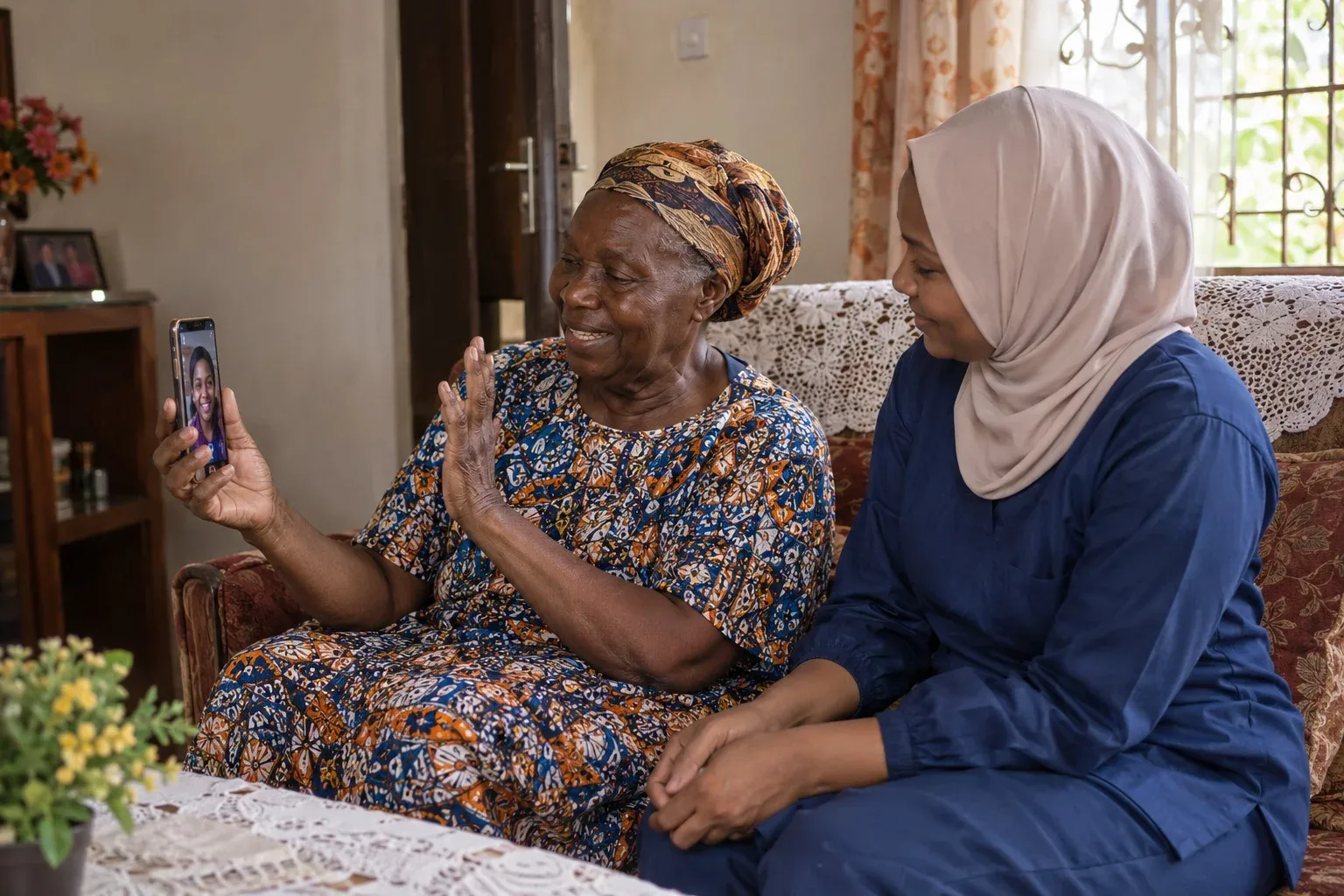
# Care for Parents in Uganda From the USA: A Complete Guide to Elderly Care, Home Support and Healthcare Coordination
**Meta Title:** Care for Parents in Uganda From the USA | Aethla Care
**Meta Description:** Living in the USA while your parents live in Uganda? Learn how to arrange elderly care, home support, specialist appointments, transport and healthcare coordination in Uganda.
**Suggested URL Slug:** `/care-for-parents-uganda-from-usa/`
**Primary Keyword:** care for parents in Uganda from USA
Secondary Keywords:
- care for parents in Uganda from the USA - elderly care Uganda from USA - caring for parents in Uganda from America - home care for parents in Uganda from USA - caregiver Uganda from USA - elderly care Kampala - healthcare for parents in Uganda - Uganda diaspora care - diaspora care Uganda - care coordination Uganda - home care Uganda - elderly support Uganda - specialist appointments Uganda - transport for elderly Uganda - care for ageing parents in Uganda - parent care Uganda - looking after parents in Uganda from USA - arrange elderly care Uganda - family care Uganda
**Search Intent:** Informational + commercial investigation + high-intent diaspora care
---
# Care for Parents in Uganda From the USA
If you live in the United States while your parents live in Uganda, staying involved in their care can become increasingly complicated as they age.
You may be able to:
- call every day - send money - pay medical expenses - speak with relatives - help arrange appointments - travel to Uganda when possible
But there are many things you cannot do from the United States.
You cannot immediately drive your parent to an appointment.
You cannot inspect the home after a fall.
You cannot always be there when your parent is discharged from hospital.
You cannot personally handle every household task.
And if several relatives are involved, it can become difficult to know exactly who is doing what.
This is why **caring for parents in Uganda from the USA is fundamentally a coordination challenge as well as a family challenge.**
The solution is not necessarily to find one person who does everything.
A better starting point is to understand your parent's needs, identify the gaps and build an appropriate local support system in Uganda while keeping the family in the USA actively involved.
The World Health Organization's Integrated Care for Older People (ICOPE) framework emphasises person-centred assessment, identification of social-care and support needs, personalised care planning, implementation and monitoring. Its current guidance also gives greater attention to community-level involvement and support for carers.
For a family living in America, that translates into a practical process:
**Understand → assess → coordinate → communicate → review.**
---
# Quick Answer: How Can I Care for My Parents in Uganda From the USA?
If your parents live in Uganda and you live in the USA:
1. Speak directly with your parents about their needs. 2. Establish where they live and who is currently supporting them. 3. Identify changes in mobility, independence and daily routines. 4. Separate household assistance from healthcare. 5. Identify appointment and transport requirements. 6. Determine whether elderly care or home support is needed. 7. Verify any caregiver or domestic-support provider. 8. Establish a local contact who can respond physically when required. 9. Create a clear communication process between Uganda and the USA. 10. Keep important care information organised. 11. Create an emergency and escalation plan. 12. Review the arrangement regularly.
The objective is not to manage your parent's entire life remotely.
It is to make sure that **the right person is responsible for the right task**.
---
# Why Is Caring for Parents in Uganda From the USA So Challenging?
Distance affects both everyday care and emergency response.
A parent may need something simple:
- groceries - cleaning - transport - companionship - help getting to an appointment
But because you are overseas, something that would take you an hour if you were in Uganda may require several phone calls and messages.
There can also be uncertainty about:
- whether a task was completed - who completed it - whether an appointment was confirmed - whether your parent arrived safely - whether their needs have changed
A reliable local coordination structure can reduce this uncertainty.
---
# Start With Your Parent's Actual Needs
Do not begin with:
> “I need to hire a caregiver for my mother.”
Begin with:
> “What does my mother actually need help with?”
These are very different questions.
Your parent might need:
- weekly cleaning - grocery assistance - transport - companionship - appointment coordination - help after hospital discharge
rather than full-time elderly care.
WHO's personalised-care guidance emphasises the active involvement of older people, family members and caregivers in developing care plans and making decisions about support.
Your parent should therefore be part of the conversation wherever possible.
---
# Questions to Ask Your Parent
Ask practical questions.
### Daily life
- What has become difficult? - What do you still manage comfortably? - Are there tasks you no longer want to do alone?
### Mobility
- Are you comfortable travelling alone? - Do you have difficulty walking? - Do you need help getting to appointments?
### Household
- Is cooking becoming difficult? - Can you manage cleaning and laundry? - Do you need help shopping?
### Healthcare
- Do you have upcoming appointments? - Has a doctor asked you to see a specialist? - Have you recently been discharged from hospital?
### Social wellbeing
- Do you spend much of the day alone? - Would you like more companionship?
### Preferences
- What type of help would you accept? - What type of help would you prefer not to have?
These questions help create a person-centred plan rather than imposing one.
---
# Does an Older Parent Automatically Need Full-Time Care?
No.
Age alone does not determine the level of support someone needs.
One older person may remain highly independent.
Another may need occasional practical assistance.
Another may need substantial daily support.
WHO's ICOPE approach focuses on functional ability and individual needs, including areas such as cognition, mobility, vitality, vision, hearing and psychological capacity, alongside social support and care needs.
The appropriate support should therefore be based on the individual.
---
# Understanding the Different Types of Care
One of the biggest sources of confusion for diaspora families is the word **care**.
Care can mean several different things.
## Elderly support
May involve:
- companionship - daily routines - practical assistance - family coordination
## Domestic support
May involve:
- cleaning - cooking - laundry - shopping - errands
## Healthcare
May involve:
- nursing - clinical assessment - rehabilitation - medical treatment
## Healthcare navigation
May involve:
- identifying an appropriate provider - appointment coordination - referral navigation - practical preparation
## Mobility support
May involve:
- transport - appointment accompaniment - assistance with journeys
These services should not automatically be treated as interchangeable.
---
# Caregiver vs Maid vs Nurse: What's the Difference?
| Role | Typical focus | |---|---| | Maid/domestic worker | Household tasks | | Caregiver | Agreed personal, daily-living or companionship support | | Nurse | Professional nursing and clinical care | | Doctor/specialist | Medical assessment and treatment | | Transport provider | Travel and mobility | | Care coordinator | Organising appropriate support routes |
The exact duties of an individual provider must always be established before an arrangement begins.
---
# How to Arrange Elderly Care for a Parent in Uganda From the USA
A practical process starts with an assessment.
## Step 1: Confirm location
Where exactly does your parent live?
## Step 2: Understand the need
What support is required?
## Step 3: Establish frequency
Is help needed:
- occasionally? - weekly? - several times per week? - daily?
## Step 4: Define the role
What tasks should the provider perform?
## Step 5: Verify the person or provider
Check identity, experience and references where appropriate.
## Step 6: Establish communication
How will you receive updates in the USA?
## Step 7: Plan escalation
What happens if your parent's situation changes?
## Step 8: Review
Does the arrangement continue to meet your parent's needs?
---
# How to Choose a Caregiver for Your Parent in Uganda
If your parent needs a caregiver, define the position carefully.
Ask:
### What experience does the person have?
Experience caring for an older person may be relevant, but the specific needs matter.
### What will they actually do?
Write down the responsibilities.
### What will they not do?
This is equally important.
### Who supervises the arrangement?
Someone should know whether the arrangement is working.
### How are concerns escalated?
If the parent becomes unwell, there should be a clear process.
---
# How to Verify a Caregiver From the USA
Distance means you may not be able to meet the person personally.
Where appropriate, consider verifying:
- identity - references - previous employment - experience - agreed working hours - responsibilities - communication arrangements
If using a service provider, ask how its caregivers or partners are selected and checked.
A family should be cautious about making large commitments before understanding exactly who will provide the service.
---
# What If Your Parent Only Needs a Maid?
This is a common situation.
Your parent may be independent but no longer want to handle:
- cleaning - laundry - cooking - shopping - errands
A domestic-support arrangement may be more appropriate than a caregiver.
The role should be clearly defined.
Do not automatically expect a domestic worker to provide nursing or clinical services.
---
# Can a Maid Also Provide Elderly Support?
Possibly, depending on the arrangement and the person's responsibilities and experience.
But the family should distinguish between:
**household assistance**
and
**care responsibilities.**
For example:
A person may be able to cook meals and clean the house.
That does not automatically mean they are qualified to provide clinical care.
---
# What If My Parent Needs Personal Care?
Personal-care needs require more careful planning.
Depending on the situation, your parent may need assistance with activities such as:
- getting dressed - bathing - mobility - daily routines
The family should establish what assistance is required and whether the person providing it has the appropriate experience.
If clinical care is needed, an appropriately qualified healthcare professional should be involved.
---
# How to Arrange Healthcare for Parents in Uganda From the USA
Healthcare coordination can involve several separate tasks.
### 1. Understand the healthcare need
What has the healthcare professional recommended?
### 2. Identify the provider
Where should your parent go?
### 3. Request the appointment
Establish the appointment process.
### 4. Confirm the appointment
Make sure the date and time are actually confirmed.
### 5. Arrange transport
Determine how your parent will get there.
### 6. Prepare documents
Make sure relevant documents are available.
### 7. Plan follow-up
Record the next steps.
This process is particularly useful when the family member making arrangements is thousands of kilometres away.
---
# Specialist Appointments for Parents in Uganda
Your parent may be told they need to see a specialist.
The family may then need to determine:
- which specialist - which facility - whether a referral is required - how to request the appointment - what documents are needed - how your parent will travel
Aethla Care's healthcare-navigation pathway can help families explore specialist appointment requests and practical coordination.
The specialist remains responsible for clinical assessment and treatment decisions.
---
# Do Not Confuse Navigation With Medical Advice
Healthcare navigation is about helping a family understand and coordinate practical steps.
It is not:
- diagnosis - treatment - prescribing - independent clinical assessment
For example:
**Navigation question:**
> “How do we arrange a specialist appointment?”
**Medical question:**
> “What treatment should my father receive?”
The second question belongs with an appropriately qualified healthcare professional.
---
# How to Arrange Transport for an Elderly Parent in Uganda
Transportation can be one of the most overlooked parts of a care plan.
Suppose your father has an appointment at a healthcare facility.
You may have arranged the appointment.
But who:
- picks him up? - helps him into the vehicle? - waits with him? - helps him navigate the facility? - takes him home?
The journey includes more than driving from A to B.
---
# Transport and Mobility Support
Uganda's National Essential Health Care Package includes screening and management of limited mobility for elderly patients, including mobility assistive devices and assessment and management of physical spaces and home adaptations intended to help prevent falls.
This demonstrates why mobility should be considered as part of broader older-person support.
For a family in the USA, transport planning may be especially important when the parent cannot safely travel independently.
---
# What If My Parent Has Difficulty Walking?
Consider:
- home accessibility - transport - appointment accompaniment - mobility devices where clinically appropriate - rehabilitation - fall risks
Do not make assumptions about what equipment or treatment your parent needs.
Healthcare professionals should assess clinical requirements.
Families can, however, identify the practical problem:
> “My father can no longer travel to appointments independently.”
That is enough to begin discussing an appropriate mobility-support route.
---
# What If My Parent Has a Disability?
Ageing and disability can overlap.
A parent may need:
- accessible transportation - personal assistance - home adaptations - rehabilitation - communication support - assistance with daily activities
Uganda's broader health framework includes rehabilitation and mobility-related services, while WHO's older-person care framework encourages attention to functional ability and individual support needs.
The appropriate arrangement depends on the individual.
---
# Caring for a Parent Who Lives Alone in Uganda
A parent living alone may still be independent.
But the family should know:
- who checks on them - who can respond locally - how they get to appointments - who helps with shopping - who they call in an emergency - who informs the family in America
The objective is not necessarily to prevent independent living.
It is to make independent living more manageable where appropriate.
---
# Build a Local Support Network
A useful network may include:
### Parent
The person whose wishes and needs guide the arrangement.
### Local relative
Someone who can respond physically.
### Care provider
A caregiver or domestic-support provider if needed.
### Healthcare provider
Doctor, specialist, nurse or other qualified professional.
### Transport provider
Someone responsible for agreed journeys.
### Overseas family
The family member or members in the USA.
### Coordinator
Where appropriate, a care-coordination service.
---
# What If Several Siblings Are Involved?
This is common in diaspora families.
One sibling may live in:
- New York
another in:
- Washington
another in:
- California
while the parent remains in Uganda.
Without clear responsibilities, everyone can assume someone else is handling the issue.
Create a simple responsibility table.
| Responsibility | Person | |---|---| | Main family contact | Sibling A | | Local Uganda contact | Relative B | | Appointments | Assigned person | | Transport | Assigned provider | | Household support | Domestic support | | Emergency escalation | Family contact |
The exact arrangement depends on the family.
---
# Create a Shared Parent Care Record
A simple document can include:
## Parent
- name - location - living arrangements
## Family
- local contacts - USA contacts
## Healthcare
- providers - appointments - relevant documents
## Support
- caregiver - domestic support - transport
## Communication
- agreed update process
## Emergency
- escalation contacts
This can reduce confusion when multiple family members are involved.
---
# Using WhatsApp and Technology
Technology can help families coordinate from America.
Useful tools may include:
- WhatsApp - video calls - shared calendars - digital documents - appointment reminders
But technology should complement local support.
A video call cannot replace:
- an in-person check - transport - household assistance - professional healthcare
---
# How Often Should You Call Your Parent?
There is no universal answer.
Consider:
- health - independence - living arrangement - support available - personal preference
A family might decide on:
- daily check-ins - several calls per week - weekly care reviews
But the right frequency is individual.
Consistency and clear escalation arrangements matter more than choosing an arbitrary number.
---
# Signs Your Parent's Support Needs May Be Increasing
Pay attention to changes such as:
- missed appointments - repeated falls - difficulty managing household tasks - increasing reliance on neighbours - difficulty travelling independently - social withdrawal - frequent hospital visits - difficulty managing familiar routines
These signs do not establish a diagnosis.
They indicate that the family may need to reassess the support arrangement.
---
# What If My Parent Has Recently Been Discharged From Hospital?
Hospital discharge can be a major transition.
Before your parent returns home, consider:
- transportation - home environment - follow-up appointments - household support - rehabilitation requirements - professional care if needed - family communication
Uganda's National Essential Health Care Package provides a national framework for health-service planning and includes mobility-related interventions relevant to older people.
The practical question is:
**Who is going to help your parent manage the transition home?**
---
# Post-Hospital Support Should Be Planned Early
Do not wait until your parent is already home to start asking:
> “Who is going to help?”
Before discharge, try to establish:
1. How will they get home? 2. Who will be there? 3. What follow-up is required? 4. Who handles transport? 5. What household support is needed? 6. Who communicates with the family?
This makes the transition more organised.
---
# What If My Parent Refuses Help?
Your parent may not want a caregiver.
They may fear:
- losing independence - losing privacy - unfamiliar people - unnecessary expense - family interference
Listen to those concerns.
Try asking:
> “What kind of help would you be comfortable with?”
Perhaps your parent accepts:
- weekly cleaning - shopping - transport - appointment accompaniment
while rejecting full-time care.
That can still be a meaningful solution.
---
# Person-Centred Care Matters
WHO's personalised-care guidance describes care planning as a collaborative process involving the older person, family and caregivers, with shared decision-making and follow-up.
This means your parent should not simply become the subject of a family WhatsApp group.
Where possible, they should be part of decisions about:
- who enters their home - what help they receive - how often support occurs - what routines are maintained
---
# How Much Does Elderly Care Cost in Uganda?
There is no single nationwide price.
Costs can vary based on:
- location - hours - service type - provider experience - qualifications - transport - complexity - frequency
When arranging care from the USA, ask for a clear explanation of:
- service scope - hours - fees - transport - additional charges - cancellation arrangements
Do not assume that the cheapest option is necessarily appropriate, and do not assume that the most expensive option provides everything your parent needs.
The important question is:
**What exactly is being provided for the stated cost?**
---
# How Families in the USA Can Avoid Care-Service Problems
Distance can make families vulnerable to poor communication.
Be cautious if a provider:
- cannot clearly explain its service - refuses to identify who provides the care - makes unrealistic medical promises - demands unexplained payments - refuses to provide references - cannot explain what happens if the caregiver is absent - cannot explain how families receive updates
Transparency is particularly important when the family member making the payment lives overseas.
---
# Questions to Ask Before Hiring a Care Provider in Uganda
Ask:
### Coverage
“Do you currently support my parent's location?”
### Service
“What exactly is included?”
### Provider
“Who will actually provide the service?”
### Verification
“How are caregivers or partners selected?”
### Communication
“How will I receive updates in the USA?”
### Escalation
“What happens if my parent's needs change?”
### Availability
“Is the service currently available?”
### Cost
“What exactly am I paying for?”
These questions help turn an uncertain arrangement into a clearly defined one.
---
# Caring for Parents in Kampala From the USA
Kampala is a major location for healthcare, employment and family activity in Uganda.
However, urban distance and travel time can still make appointments difficult for an older person.
A parent may live relatively close to a facility but still need:
- transport - accompaniment - appointment coordination - household support
A local care plan should consider the actual journey rather than just the map distance.
---
# Caring for Parents in Wakiso From the USA
If your parent lives in Wakiso, establish the specific locality rather than simply recording “Wakiso.”
This helps determine:
- travel requirements - existing family support - appointment routes - potential service coverage
Aethla currently highlights Wakiso within its early service footprint.
---
# Caring for Parents in Entebbe From the USA
Parents in Entebbe may need combinations of:
- elderly support - household assistance - healthcare navigation - transport - family coordination
The correct arrangement depends on individual circumstances.
---
# Caring for Parents in Mukono From the USA
For parents living in Mukono, the same principles apply.
Identify:
- where they live - who supports them - what has changed - what practical help is missing
Then explore the appropriate route.
---
# What If My Parent Lives Somewhere Else in Uganda?
Aethla's current early footprint highlights:
- Kampala - Wakiso - Entebbe - Mukono
Families outside these locations can provide their parent's location and care requirement so the appropriate route can be assessed.
This is important because service availability may differ by location and type of support.
---
# How Aethla Care Can Help USA-Based Families
Aethla Care provides a Uganda-based care and family-support platform for families who need to coordinate practical support for relatives in Uganda.
A family in the USA can begin by explaining:
**Who needs support?**
**Where do they live?**
**What do they need?**
**What support already exists?**
**What is missing?**
Depending on the circumstances, the care route may involve:
- elderly care - home and family support - healthcare navigation - specialist appointment coordination - transport and mobility support - practical family coordination - diaspora care
The exact role and availability should be confirmed before any service commitment.
---
# Aethla Care Is Not a Hospital or Medical Clinic
Aethla Care's role is centred on care coordination, practical support and navigation.
It does not replace:
- doctors - nurses - specialists - hospitals - rehabilitation professionals - other qualified healthcare providers
Clinical decisions remain with appropriately qualified healthcare professionals.
This distinction should remain clear throughout any family care arrangement.
---
# How Aethla's Diaspora Care Process Works
The starting point is straightforward.
## 1. Tell us about your parent
Provide:
- location - age where relevant - current situation - support needed
## 2. Clarify the need
Determine whether the requirement is:
- elderly support - home assistance - healthcare navigation - transport - another practical need
## 3. Establish the route
Clarify whether Aethla can:
- provide - coordinate - connect with a partner - provide information
## 4. Confirm the next step
The family should understand what will happen next.
## 5. Keep communication clear
This is particularly important when family members live in another country.
---
# The Four Questions Every Overseas Family Should Ask
Before arranging care, answer:
### 1. Who needs help?
Your parent.
### 2. What do they need?
Be specific.
### 3. Who is responsible?
Assign each task.
### 4. Who communicates changes?
Create a clear reporting route.
If these four questions are unanswered, the care arrangement may still be too vague.
---
# A Practical USA-to-Uganda Parent Care Plan
## Stage 1: Conversation
Speak with your parent.
## Stage 2: Assessment
Understand their current situation.
## Stage 3: Family mapping
Identify local and overseas relatives.
## Stage 4: Gap analysis
Determine what is missing.
## Stage 5: Service planning
Identify the appropriate type of support.
## Stage 6: Verification
Check the provider.
## Stage 7: Communication
Establish how updates are provided.
## Stage 8: Review
Reassess the arrangement regularly.
This approach is more sustainable than simply hiring someone and hoping the arrangement works.
---
# USA-to-Uganda Parent Care Checklist
### Parent
- [ ] Parent's preferences understood - [ ] Location confirmed - [ ] Living arrangements documented - [ ] Daily abilities understood - [ ] Current challenges identified
### Healthcare
- [ ] Healthcare providers identified - [ ] Upcoming appointments documented - [ ] Specialist requirements understood - [ ] Recent hospitalisation considered - [ ] Follow-up needs documented
### Practical support
- [ ] Household assistance considered - [ ] Caregiver needs assessed - [ ] Transport considered - [ ] Appointment accompaniment considered - [ ] Mobility requirements considered
### Family
- [ ] Local contact identified - [ ] USA contact identified - [ ] Emergency contact established - [ ] Communication system agreed
### Provider
- [ ] Identity checked - [ ] Experience checked - [ ] References considered - [ ] Responsibilities documented - [ ] Costs understood - [ ] Availability confirmed
### Ongoing
- [ ] Care arrangement reviewed - [ ] Changes communicated - [ ] Escalation process understood
---
# Frequently Asked Questions
## How can I arrange care for my parents in Uganda from the USA?
Start by assessing their actual needs and identifying what requires local support. Then explore elderly care, home support, transport, healthcare navigation and appointment coordination as appropriate.
## Can I arrange elderly care in Uganda while living in America?
Yes. You can coordinate care remotely while local people or providers handle tasks requiring physical presence in Uganda.
## Can Aethla Care help families in the USA?
Aethla Care's diaspora-care pathway is designed for families outside Uganda who need to coordinate practical support for relatives in Uganda.
## Can Aethla arrange a caregiver for my parent?
Where an appropriate route exists, Aethla can help families explore elderly and home-support arrangements. The actual provider, responsibilities and availability should be confirmed.
## Can I arrange a specialist appointment for my parent from the USA?
Aethla's healthcare-navigation pathway can help families explore specialist appointment requests and practical coordination. The relevant healthcare provider must confirm the actual appointment.
## Can someone take my parent to hospital?
Depending on the circumstances and available support route, transport or appointment-accompaniment support may be coordinated.
## What if my parent lives outside Kampala?
Aethla currently highlights Kampala, Wakiso, Entebbe and Mukono as its early service footprint. Families outside these areas can provide the location and care need so the appropriate route can be assessed.
## What if my parent lives alone?
Assess their independence, mobility, household requirements and emergency support. Living alone does not automatically mean that full-time care is required.
## How do I choose a caregiver in Uganda from America?
Define the role first, then verify identity, experience, references, responsibilities, communication and escalation arrangements.
## Is a maid the same as an elderly caregiver?
No. Domestic workers generally focus on household tasks, while caregiving can involve additional daily-living or personal support. Clinical healthcare is a separate professional role.
## How much does elderly care cost in Uganda?
There is no universal price. Costs depend on location, hours, service type, provider experience, transport and complexity.
## What if my parent does not want a caregiver?
Ask what type of support they would accept. They may prefer occasional household assistance, transport or appointment support instead of full-time care.
## Can I coordinate everything through WhatsApp?
WhatsApp can help with communication, but it should not replace appropriate in-person support, professional healthcare or a proper emergency plan.
---
# Final Thoughts: Caring for Parents in Uganda From America
Living in the United States while your parents live in Uganda can create emotional and practical challenges.
But distance does not mean you have to step away from your parent's care.
You can remain involved in:
- planning - communication - family decisions - financial support - appointment coordination - reviewing care arrangements
At the same time, local people can handle tasks requiring physical presence.
The key is to avoid trying to solve every problem with one person.
Your parent may need:
**a caregiver for daily support**
**a domestic worker for household tasks**
**a healthcare professional for clinical care**
**a transport provider for appointments**
**a coordinator for practical organisation**
**family members for emotional and financial support**
These roles can complement one another.
Uganda's Ministry of Gender, Labour and Social Development states that the National Council for Older Persons has a role in guiding, monitoring and advising stakeholders on quality service delivery to older people, and in coordinating between government departments, service providers and older persons.
Uganda's Ministry of Health's National Essential Health Care Package also recognises older-person needs such as limited mobility, mobility management, home adaptations and caregiver support.
WHO's current ICOPE approach similarly emphasises person-centred, coordinated care, social support, personalised care plans and ongoing monitoring.
For a family in the USA, the practical lesson is simple:
> **You do not have to choose between being thousands of kilometres away and being involved in your parent's care.**
You can remain actively involved from America while building reliable support around your parent in Uganda.
The process starts with four questions:
**Who needs help?**
**What do they need?**
**Who can provide each part of that support?**
**How will the family stay informed?**
Once those questions are answered, caring across continents becomes much more manageable.
**Aethla Care — Trusted Care for Every Stage of Life.**
---
# Factual References
### Uganda Ministry of Health — National Essential Health Care Package
Uganda's Ministry of Health published the National Essential Health Care Package in August 2024 as a framework for directing planning and investment in health-service delivery.
The package includes screening and management of limited mobility for elderly patients, including mobility assistive devices and assessment of physical spaces and home adaptations intended to help prevent falls.
### Uganda Ministry of Gender, Labour and Social Development — National Council for Older Persons
The National Council for Older Persons was established under the National Council of Older Persons Act 2013. The Ministry states that its functions include communicating the needs and concerns of older persons and coordinating between government departments, service providers and older people.
### World Health Organization — ICOPE Second Edition
WHO's second edition of its ICOPE guidance provides a person-centred pathway that includes basic and in-depth assessment, personalised care planning, implementation and monitoring. It also places increased emphasis on community-level involvement and support for carers.
### World Health Organization — Ageing and Health
WHO describes ICOPE as an approach intended to reorient health and social services toward more person-centred and coordinated care and to support functional ability in older age.
---
## Healthcare and Care Information Note
This article provides general information about arranging care and family support for parents living in Uganda while relatives live in the United States. It is not medical, nursing, legal, financial or immigration advice.
Diagnosis, treatment, medication decisions, clinical assessment and emergency care should be handled by appropriately qualified healthcare professionals.
Aethla Care is not a hospital or medical clinic and does not replace qualified healthcare professionals.
Service coverage, caregiver availability, partner arrangements, transport options and costs can change. Families should confirm current arrangements before making commitments.
For urgent or potentially life-threatening situations, seek appropriate emergency medical assistance rather than relying on routine care coordination.