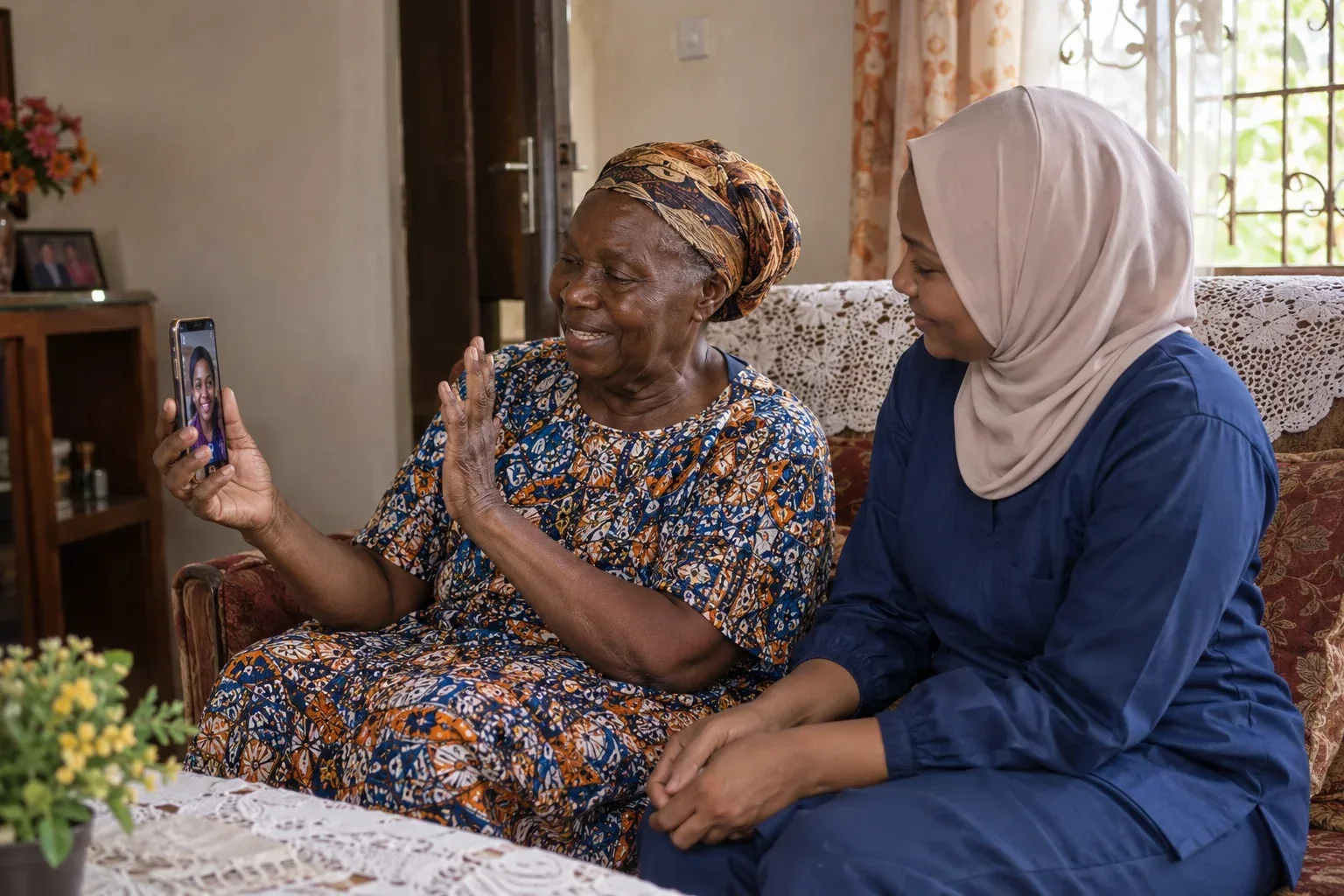
# Care for Parents in Uganda From the UK: A Complete Guide to Elderly Care, Home Support and Healthcare Coordination
**Primary Keyword:** care for parents in Uganda from UK
Secondary Keywords:
- care for parents in Uganda from the UK - elderly care Uganda from UK - caring for parents in Uganda from UK - home care for parents in Uganda - elderly care Kampala - Uganda diaspora care - diaspora care Uganda - arrange caregiver Uganda from UK - healthcare for parents in Uganda - specialist appointments Uganda - transport for elderly Uganda - elderly support Uganda - care coordination Uganda - home care Uganda - looking after parents in Uganda from UK - parent care Uganda - care for elderly parents in Uganda - UK Ugandan diaspora care
**Search Intent:** Informational + commercial investigation + diaspora care coordination
---
# Care for Parents in Uganda From the UK
Living in the United Kingdom while your parents live in Uganda can make family care more complicated.
You may be closely involved in your parent's life.
You may call regularly.
You may contribute financially.
You may speak with relatives in Uganda.
You may help with medical expenses.
But there are many things that cannot be done from the UK.
Someone may need to accompany your parent to hospital.
Someone may need to help after discharge.
Someone may need to assist with household routines.
Someone may need to organise transport.
Someone may need to check that your parent is safe at home.
And sometimes, the most difficult part is simply knowing **what is actually happening on the ground**.
This is why caring for parents from overseas is not just a financial issue.
It is a **care coordination issue**.
For Ugandan families in the UK, the objective is usually not to take control of every aspect of a parent's life from thousands of kilometres away.
It is to build a reliable local support system in Uganda while continuing to participate in important decisions from the UK.
The World Health Organization's second-edition Integrated Care for Older People (ICOPE) guidance, published in September 2025, emphasises person-centred assessment, identification of social-care and support needs, personalised care planning, implementation and monitoring. It also gives greater attention to community-level support and carers.
That approach provides a useful framework for diaspora families:
**Understand the person → identify the gaps → coordinate appropriate support → communicate → review.**
---
# Quick Answer: How Can I Care for My Parents in Uganda From the UK?
If you live in the UK and your parents live in Uganda:
1. Talk to your parents about what they actually need. 2. Understand their living arrangements. 3. Identify existing family and community support. 4. Separate household needs from healthcare needs. 5. Identify mobility and transport requirements. 6. Determine whether elderly care or home support is needed. 7. Arrange appropriate appointment or healthcare navigation support where necessary. 8. Establish a local contact who can respond physically when required. 9. Create a communication system between Uganda and the UK. 10. Verify any caregiver, domestic worker or service provider. 11. Create an emergency and escalation plan. 12. Review the care arrangement regularly.
The goal is not simply to find **a caregiver**.
The goal is to build an appropriate support system around your parent.
---
# Why Is Caring for Parents in Uganda From the UK Difficult?
Distance changes the way families provide care.
If you lived near your parent, you might be able to:
- visit after work - take them to an appointment - inspect the home - buy groceries - speak directly to healthcare professionals - arrange household assistance - respond quickly to a problem
From the UK, many of these tasks require someone locally.
You can still:
- communicate - coordinate - pay for appropriate services - participate in decisions - speak with healthcare providers where appropriate - organise appointments - communicate with relatives
But physical tasks require a person in Uganda.
This creates a simple but important distinction:
> **Remote family involvement and local physical support are complementary, not competing, forms of care.**
---
# Start With Your Parent's Needs
Before searching for a caregiver, maid, nurse or other provider, establish what your parent actually needs.
Ask:
### What is becoming difficult?
Perhaps your parent struggles with:
- shopping - cleaning - cooking - transportation - mobility - appointments - household organisation
### What can they still do independently?
This is equally important.
An older person may be able to manage many aspects of life while needing help with only a few tasks.
### What type of help would they accept?
Your parent may not want a live-in caregiver.
They might accept:
- weekly household assistance - transport - appointment accompaniment - occasional companionship - help with errands
A person-centred approach begins with the older person's priorities rather than automatically assigning a generic care package. WHO's ICOPE guidance specifically supports personalised care planning involving older people, families and caregivers.
---
# Does My Parent Need a Caregiver, Maid or Healthcare Professional?
These roles are different.
## A caregiver
May provide practical and personal support according to their agreed role.
## A domestic worker or maid
May provide household assistance such as:
- cleaning - laundry - cooking - errands
## A nurse or other healthcare professional
May provide professional clinical care within their qualifications and scope.
## A doctor or specialist
Provides medical assessment, diagnosis and treatment decisions.
## A transport provider
Provides transportation and, where specifically arranged, mobility or accompanying support.
## A care coordinator
Helps connect different practical elements and keep the family informed.
One person should not automatically be expected to perform all these roles.
---
# What Support Might an Older Parent in Uganda Need?
Every family is different, but needs commonly fall into several broad areas.
## Daily living
- household routines - meals - shopping - errands - companionship
## Mobility
- getting around safely - transport - appointment journeys - mobility-related support
## Healthcare
- appointments - referrals - specialist navigation - follow-up
## Household
- cleaning - laundry - maintenance coordination - practical organisation
## Family communication
- updates - appointment information - changes in support needs
## Post-hospital support
- transport home - household assistance - follow-up coordination - rehabilitation-related arrangements where appropriate
Uganda's National Essential Health Care Package specifically includes services relating to limited mobility, including mobility management, assistive devices, assessment of physical spaces and home adaptations intended to help prevent falls. It also identifies support for caregivers of elderly patients.
This reinforces an important point:
**Older-person care extends beyond medical treatment alone.**
---
# Caring for a Parent Who Lives Alone
If your parent lives alone in Uganda, establish what happens when something unexpected occurs.
Ask:
- Who checks on them? - Who is nearby? - Who can respond to an urgent situation? - Who takes them to an appointment? - Who helps with shopping? - Who knows their normal routine? - Who will contact the UK-based family?
A parent living alone may remain independent.
The issue is whether there is an appropriate support network around them.
---
# How to Create a Local Support Network
A practical support structure could include:
### Your parent
The central person whose preferences and needs guide the arrangement.
### Local relative
Someone who can respond physically if needed.
### Healthcare provider
The appropriate healthcare professional or facility.
### Practical support
Caregiver, domestic support or another appropriate service.
### Transport
A reliable arrangement for important journeys.
### UK family
The people coordinating communication and family decisions remotely.
### Care coordinator
Where appropriate, a service that can help connect and coordinate practical support.
The exact arrangement depends on the family.
---
# How to Arrange Elderly Care in Uganda From the UK
Begin with an assessment.
### Step 1: Identify your parent's location
For example:
- Kampala - Wakiso - Entebbe - Mukono - another part of Uganda
### Step 2: Understand the need
Is the requirement:
- companionship? - household assistance? - daily care? - mobility support? - appointment support?
### Step 3: Establish frequency
Does support need to be:
- occasional? - weekly? - several days per week? - daily? - live-in?
### Step 4: Define responsibilities
Write down exactly what the person is expected to do.
### Step 5: Verify the provider
Check identity, experience and references.
### Step 6: Establish communication
Decide how the UK family will receive updates.
### Step 7: Review
Make sure the arrangement remains suitable.
---
# How to Choose a Caregiver for a Parent in Uganda
If your parent needs a caregiver, do not select someone based solely on availability.
Consider:
## Experience
What type of older people have they supported?
## References
Can previous employers or families provide references?
## Responsibilities
Are the expected duties clear?
## Reliability
How will attendance and scheduling be managed?
## Communication
Can they communicate appropriately with your parent and family?
## Boundaries
Do they understand what is outside their role?
## Escalation
What happens if your parent becomes unwell?
The last question is particularly important.
A caregiver should know when an issue requires escalation to family or a healthcare professional.
---
# How to Verify a Caregiver From the UK
Distance makes verification even more important.
Before making an arrangement, consider verifying:
- identity - references - previous employment - experience - agreed responsibilities - working hours - payment arrangements - reporting arrangements
If a provider is coordinating the service, ask how the people delivering the service are selected and verified.
---
# What If My Parent Needs a Maid?
Sometimes families use the word “care” when the actual need is domestic support.
For example, an older parent may still be independent but find it difficult to:
- clean - wash clothes - prepare meals - shop - perform errands
In that situation, domestic assistance may be appropriate.
It is important not to turn a domestic role into an undefined healthcare role.
A written description of responsibilities can help.
---
# What If My Parent Needs Personal Care?
Personal-care needs are different from ordinary domestic work.
If your parent needs assistance with activities of daily living, the family should establish exactly what support is required and whether the person providing it has the appropriate experience or qualifications.
Where professional healthcare is involved, appropriately qualified healthcare workers should provide it.
---
# How to Arrange Healthcare for Parents in Uganda From the UK
Healthcare coordination can involve several stages.
## Identify the healthcare need
Understand why the appointment or consultation is required.
## Identify the appropriate provider
This may involve an existing healthcare provider or specialist route.
## Arrange the appointment
Confirm the request with the healthcare provider.
## Arrange transportation
Determine how the parent will travel.
## Prepare documents
Gather relevant referrals, records or other documents requested by the provider.
## Arrange follow-up
Record what needs to happen after the appointment.
This is where healthcare navigation can help families organise the practical process.
---
# Specialist Doctor Appointments for Parents in Uganda
A common problem for diaspora families is knowing how to navigate specialist care.
Your parent may be told they need:
- cardiology - paediatrics for a dependent family member - physiotherapy or rehabilitation - geriatrics - another specialist service
The family may then need to determine:
- which facility - which provider - how the appointment is requested - whether referral documentation is needed - how the parent will travel
Aethla Care's healthcare-navigation pathway can help families explore specialist appointment requests and practical coordination.
The clinical decision remains with the relevant qualified healthcare professional.
---
# Appointment Requests Are Not the Same as Confirmed Appointments
Families should be careful with this distinction.
A request for an appointment does not necessarily mean the provider has confirmed:
- date - time - doctor - facility
Before travelling, confirm the actual appointment.
This is particularly important when the patient is elderly or has mobility difficulties.
---
# How to Arrange Transport for an Elderly Parent in Uganda
Transport should be considered part of the care plan.
For example, your parent may need to attend an appointment but:
- cannot drive - cannot use public transport comfortably - has mobility difficulties - needs someone to accompany them
Consider:
- collection time - journey duration - accessibility - accompanying person - waiting time - return journey
The question is not merely:
> “Can we find a car?”
It is:
> **“Can my parent safely and practically complete the entire journey?”**
---
# Medical Transport vs Ordinary Transport
These should not automatically be treated as the same thing.
Ordinary transport may be appropriate for a person who is mobile and stable.
A person requiring clinical monitoring or specialised medical transport may require a different service.
Families should establish what type of transport is actually needed rather than assuming a standard vehicle is appropriate.
---
# Post-Hospital Care for Parents in Uganda
A hospital discharge can create a sudden need for support.
Before your parent returns home, consider:
- transport - home environment - household assistance - follow-up appointments - rehabilitation - family support - professional care where required
Uganda's National Essential Health Care Package includes rehabilitation-related and mobility-related interventions as part of its broader health-service framework.
The practical lesson for families is:
**Plan the transition home before discharge whenever possible.**
---
# What If My Parent Has Mobility Problems?
Mobility problems can affect independence.
They can make:
- shopping difficult - appointments harder - public transport challenging - household tasks more difficult - social activities less accessible
WHO's ICOPE guidance includes mobility among the intrinsic-capacity domains considered in person-centred assessment of older people.
Families should consider whether their parent needs:
- mobility assistance - accessible transport - home modifications - rehabilitation - appointment accompaniment
The exact solution should be based on the person's circumstances.
---
# What If My Parent Has a Disability?
Disability support and ageing support can overlap.
An older parent may need:
- assistance with mobility - accessible transport - home adaptations - communication assistance - personal support - rehabilitation
The family should avoid assuming that a standard domestic worker arrangement is enough.
Where specialist needs exist, appropriately qualified professionals may be required.
---
# What If My Parent Has Multiple Health Conditions?
This can make care coordination particularly difficult.
Your parent may have several appointments and different providers.
For example:
**Primary care → specialist → diagnostic service → rehabilitation → follow-up**
Without coordination, families can lose track of:
- dates - referrals - instructions - transport - follow-up
Maintaining one central care record can make the situation easier to manage.
WHO's ICOPE model is specifically structured around a pathway involving assessment, personalised care planning, implementation and monitoring rather than isolated encounters.
---
# Build a Parent Care File
Your family can create one secure digital or physical record.
Include:
### Basic information
- parent's name - location - emergency contacts
### Healthcare
- healthcare providers - specialists - appointments - relevant documents
### Support
- caregiver - domestic support - transport - relatives
### Communication
- UK family contact - local family contact - agreed update process
### Emergency planning
- who should be contacted - what the escalation process is
Do not put sensitive information into public or unsecured systems.
---
# How UK Families Can Stay Involved Remotely
You can remain involved without attempting to perform every local task.
For example, you can:
- call your parent - participate in family discussions - communicate with relatives - help organise appointments - review care arrangements - contribute financially - travel to Uganda when possible
Meanwhile, local support can handle:
- visits - transport - household tasks - appointment accompaniment - practical assistance
This creates a partnership between **remote family involvement and local care**.
---
# Use WhatsApp Carefully for Family Coordination
WhatsApp can be useful for:
- reminders - family communication - appointment updates - transport coordination
But families should distinguish informal communication from formal healthcare records.
Important documents should be stored securely.
Medical information should only be shared with people who have an appropriate reason to receive it.
---
# How Often Should You Speak to Your Parent?
There is no universal answer.
Some families speak every day.
Others communicate several times a week.
The appropriate arrangement depends on:
- independence - health - living arrangements - support network - personal preferences
Consistency is often more useful than an arbitrary number of calls.
---
# What Are Signs That Your Parent May Need More Support?
Families living in the UK should pay attention to changes such as:
- increasing difficulty with household tasks - missed appointments - repeated falls - increasing dependence on neighbours - difficulty travelling alone - increasing social isolation - frequent hospital visits - difficulty managing familiar routines - increasing difficulty communicating needs
These observations do not establish a medical diagnosis.
They are reasons to consider whether the support plan needs review.
---
# What If My Parent Says They Are Fine?
Take their response seriously.
But also look at practical evidence.
An older parent may say:
> “I'm fine.”
while relatives notice:
- unpaid bills - missed appointments - poor household conditions - difficulty shopping - increasing isolation
The response should not automatically be to take control.
Instead ask:
**What support would your parent accept?**
Perhaps they are comfortable with:
- transport - a cleaner - shopping assistance - appointment support
but not a full-time caregiver.
---
# What If My Parent Refuses a Caregiver?
Ask why.
They may be concerned about:
- privacy - independence - cost - unfamiliar people - trust - family expectations
Try a smaller intervention first if appropriate.
For example:
**Occasional household help**
may be easier to accept than:
**A full-time caregiver.**
The right arrangement depends on the person's preferences and needs.
---
# How Much Does Elderly Care Cost in Uganda?
There is no single price for elderly care across Uganda.
Costs can vary according to:
- location - hours - service type - caregiver experience - qualifications - transport - complexity - frequency
Families should request transparent information about:
- service scope - hours - fees - transport - additional costs - cancellation arrangements
Avoid providers that give vague answers about what you are actually paying for.
---
# How Can UK Families Avoid Care-Service Problems?
Before committing to a service, ask:
### Who actually provides the service?
Is it the company, an individual or a partner?
### What exactly is included?
Do not rely on vague descriptions.
### How is the provider verified?
Ask what checks are undertaken.
### What happens if the caregiver cannot attend?
There should be a contingency plan.
### What happens if my parent's needs change?
Understand how escalation works.
### How will I receive updates in the UK?
Agree this before the service begins.
---
# What Should I Ask a Uganda Care Provider?
Use this checklist.
- What services do you provide? - Which areas do you cover? - Is my parent's location currently covered? - Who will provide the service? - How are providers selected? - What experience do they have? - What tasks are included? - What tasks are excluded? - How are emergencies handled? - How are families updated? - What does the service cost? - What happens if support needs change?
These questions help turn a vague “care request” into a clearly defined arrangement.
---
# How Aethla Care Can Help UK-Based Families
Aethla Care is a Uganda-based care and family-support platform designed to help connect families with appropriate care, practical support and coordination routes in Uganda.
For a family in the UK, the process can start with a simple explanation:
**Who needs help?**
**Where do they live?**
**What do they need?**
**What support already exists?**
**What is missing?**
Depending on the request and available route, Aethla can help families explore:
- elderly care - home and family support - healthcare navigation - specialist appointment coordination - travel and mobility support - practical family coordination - diaspora care
The exact role and service arrangement should always be confirmed before the family commits.
---
# Aethla Care Is Not a Clinic or Hospital
Aethla Care should not be confused with a hospital, clinic or medical practice.
Aethla's role is centred on care coordination, practical support and navigation.
Clinical decisions remain with appropriately qualified healthcare professionals.
That means Aethla does not independently:
- diagnose conditions - prescribe treatment - replace doctors - replace hospitals - make clinical decisions for families
This distinction is important for both safety and transparency.
---
# Aethla's Diaspora Care Model
Aethla's wider model can involve several different routes.
## Directly operated support
Where Aethla provides the relevant service.
## Coordinated support
Where Aethla helps organise a practical care arrangement.
## Partner-delivered support
Where an appropriate independent partner provides the service.
## Information and navigation
Where Aethla helps the family understand possible routes without directly delivering the service.
The specific route depends on the family's request.
---
# Where Does Aethla Care Currently Support Families?
Aethla currently highlights an early footprint covering:
- Kampala - Wakiso - Entebbe - Mukono
If your parent lives elsewhere in Uganda, provide their location and care requirement so the appropriate route can be assessed.
Do not assume that every service is automatically available nationwide simply because the website serves families across Uganda.
---
# A Practical UK-to-Uganda Care Plan
A simple approach is:
## Phase 1 — Understand
Speak with your parent.
## Phase 2 — Assess
Identify practical, social, mobility and healthcare needs.
## Phase 3 — Map
List existing relatives and services.
## Phase 4 — Identify gaps
Determine what nobody is currently handling.
## Phase 5 — Coordinate
Arrange the appropriate support.
## Phase 6 — Communicate
Agree how information travels between Uganda and the UK.
## Phase 7 — Review
Reassess as circumstances change.
This approach avoids making a large commitment before understanding what is actually required.
---
# UK-to-Uganda Parent Care Checklist
## Parent
- [ ] Parent's wishes understood - [ ] Current location confirmed - [ ] Living situation understood - [ ] Independence considered - [ ] Support needs identified
## Healthcare
- [ ] Current healthcare provider identified - [ ] Appointments documented - [ ] Specialist needs identified - [ ] Follow-up requirements understood
## Practical support
- [ ] Household needs identified - [ ] Caregiver requirement assessed - [ ] Transport considered - [ ] Appointment accompaniment considered
## Family
- [ ] Local contact identified - [ ] UK contact identified - [ ] Emergency contact identified - [ ] Communication process agreed
## Provider
- [ ] Identity checked - [ ] Experience checked - [ ] References considered - [ ] Responsibilities documented - [ ] Costs understood - [ ] Availability confirmed
## Review
- [ ] Care plan reviewed regularly - [ ] Changes communicated - [ ] Emergency process understood
---
# Frequently Asked Questions
## How can I care for my parents in Uganda from the UK?
Start by understanding their needs and identifying what requires local physical support. Then coordinate appropriate elderly care, household assistance, healthcare navigation, transport and family support.
## Can I arrange elderly care in Uganda from the UK?
Yes. Families living in the UK can coordinate care for relatives in Uganda, although the actual service depends on the parent's location, needs and available providers.
## Can Aethla Care help me arrange care for my parents in Uganda?
Aethla Care's diaspora-care pathway allows families outside Uganda to explain their relative's care needs and explore appropriate support and coordination routes.
## Can Aethla arrange a caregiver for my parent?
Where an appropriate service route is available, Aethla can help families explore elderly and home-support arrangements. The actual provider and responsibilities should be confirmed before proceeding.
## Can I arrange a specialist appointment for my parent from the UK?
Healthcare navigation can help with practical appointment coordination. The appointment must ultimately be confirmed by the relevant healthcare provider.
## Can someone accompany my parent to a hospital appointment?
Depending on the circumstances and available support route, appointment and mobility assistance may be coordinated.
## What if my parent lives outside Kampala?
Aethla's current early footprint highlights Kampala, Wakiso, Entebbe and Mukono. Families outside these areas can provide the location and care requirement so an appropriate route can be assessed.
## What if my parent lives alone?
Living alone does not automatically mean someone needs full-time care. Assess independence, mobility, household needs, healthcare requirements and emergency support.
## How do I choose a caregiver in Uganda?
Define the role first, then consider identity, experience, references, responsibilities, reliability, communication and escalation arrangements.
## Is a maid the same as a caregiver?
No. A maid or domestic worker generally provides household support, while caregiving may involve additional personal or daily support responsibilities. Healthcare is a separate professional category.
## How much does elderly care cost in Uganda?
There is no single price. Costs depend on location, service, hours, qualifications, transport and complexity.
## What if my parent refuses help?
Discuss their concerns and consider whether a smaller amount of support would be acceptable. The older person's preferences should remain part of the care-planning process.
## Can I manage my parent's care entirely through WhatsApp?
WhatsApp can support communication, but it should not be treated as a substitute for appropriate local support or professional healthcare.
---
# Final Thoughts: Caring for Parents From the UK Requires a Local Plan
Living in the UK does not prevent you from being actively involved in your parent's life in Uganda.
But it does mean you need to separate two things:
**what you can do remotely**
from
**what requires someone physically present in Uganda.**
You can remain responsible for:
- communication - family decisions - financial support - planning - coordination - regular reviews
While local support may handle:
- home visits - household assistance - appointment accompaniment - transport - practical care - other agreed support
Uganda's Ministry of Gender, Labour and Social Development states that the National Council for Older Persons is mandated to guide, monitor and advise stakeholders on quality service delivery for older persons. The Ministry also publishes National Guidelines on Healthy Ageing.
Uganda's Ministry of Health has also incorporated older-person services into its National Essential Health Care Package, including limited-mobility management, home adaptations and support for caregivers of elderly patients.
The broader direction is therefore clear:
**Supporting an older person involves more than treating illness.**
It can also involve mobility, social support, home environment, caregivers, transportation, family communication and continuity of care.
For families living in the UK, the most useful question is therefore not:
> **“How do I look after my parent from thousands of kilometres away?”**
Instead ask:
> **“What does my parent need locally, what can I coordinate from the UK, and who can reliably bridge the distance?”**
That creates a much more practical care plan.
---
# Factual References
### Uganda Ministry of Gender, Labour and Social Development — National Council for Older Persons
Uganda's National Council for Older Persons was established under the National Council of Older Persons Act 2013. The Ministry states that the Council is mandated to guide, monitor and advise stakeholders on quality service delivery to older persons.
### Uganda Ministry of Gender, Labour and Social Development — National Guidelines on Healthy Ageing
The Ministry lists the National Guidelines on Healthy Ageing among its official guidelines.
### Uganda Ministry of Health — National Essential Health Care Package
The National Essential Health Care Package was published by Uganda's Ministry of Health in August 2024 as a framework for directing health-service planning and investment.
The package includes services for elderly patients relating to limited mobility, management of mobility limitations, assessment of physical spaces and home adaptations to help prevent falls. It also includes support for caregivers of elderly patients.
### World Health Organization — ICOPE Second Edition
WHO's second edition of ICOPE, published on 22 September 2025, describes person-centred assessment and pathways in primary care, including identification of social-care and support needs, personalised care planning, implementation and monitoring.
### World Health Organization — Community and Caregiver Support
WHO's updated ICOPE materials place greater emphasis on community-level action and engagement of community health workers and other stakeholders, while also considering support for carers.
---
## Healthcare and Care Information Note
This article is general information about coordinating family care and support for parents living in Uganda while relatives live in the UK. It is not medical, nursing, financial or legal advice.
Medical diagnosis, treatment, medication decisions and clinical assessment should be handled by appropriately qualified healthcare professionals.
Aethla Care is not a hospital or clinic and does not replace qualified healthcare professionals.
Caregiver availability, geographic coverage, partner arrangements, transport services and costs can change. Families should confirm the current service arrangement before making commitments.
For urgent or potentially life-threatening situations, seek appropriate emergency medical assistance rather than relying on routine care coordination.