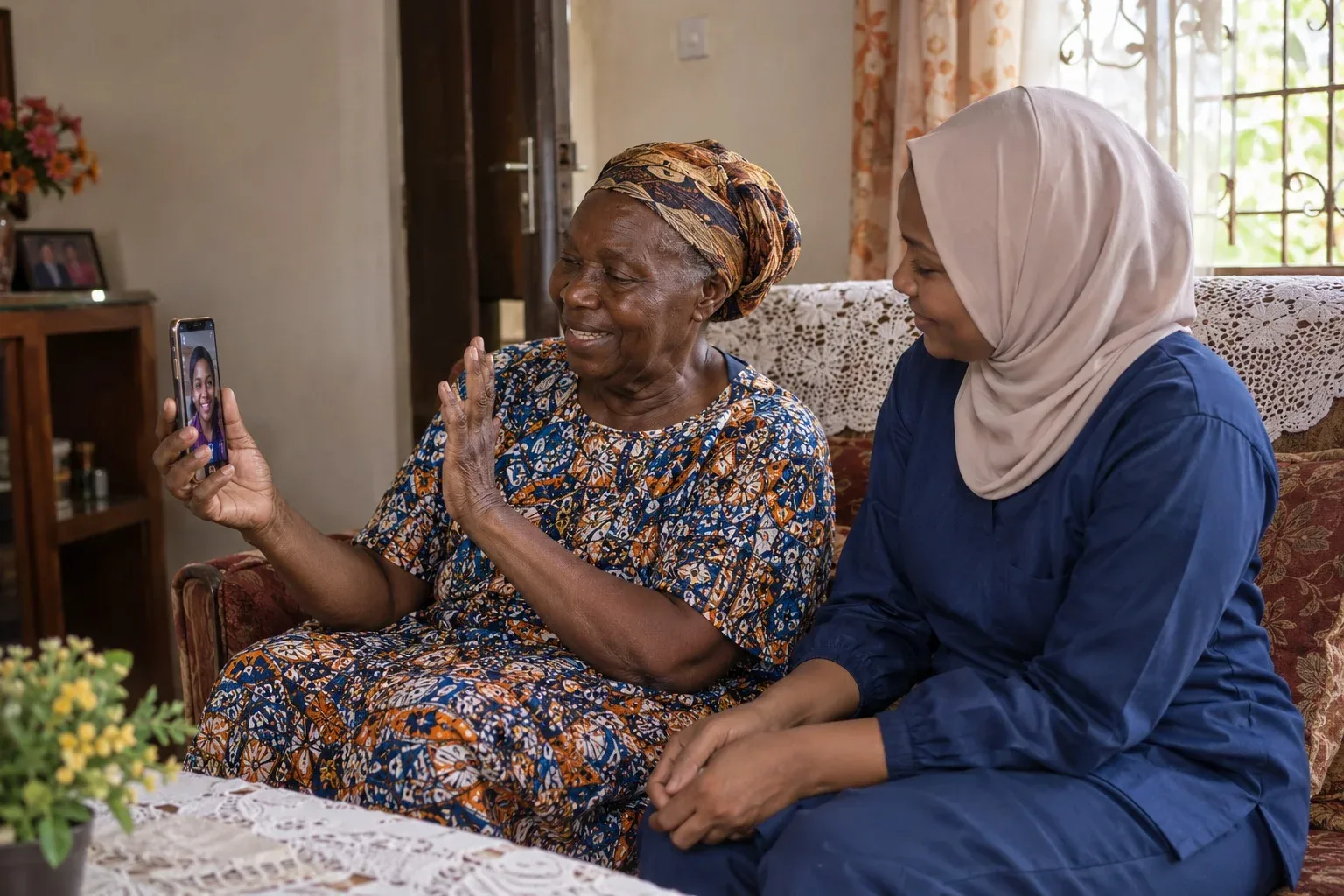
# Care for Parents in Uganda From the UAE: A Complete Guide for Families Living in the United Arab Emirates
**Primary Keyword:** care for parents in Uganda from UAE
**Secondary Keywords:** elderly care Uganda from UAE, home care for parents in Uganda, caregiver Uganda from Dubai, caregiver Uganda from Abu Dhabi, diaspora care Uganda UAE, healthcare for parents in Uganda, specialist appointments Uganda, elderly transport Uganda, family care coordination Uganda, care for elderly parents in Kampala
**Search Intent:** Informational + service discovery + care coordination
---
## Quick Answer: How Can You Arrange Care for Parents in Uganda From the UAE?
If you live in the United Arab Emirates and your parents or relatives live in Uganda, you do not necessarily need to manage every part of their care yourself.
A practical approach is to:
1. Understand what support your parent actually needs. 2. Speak with your parent and other relatives already involved. 3. Separate everyday home support from medical needs. 4. Identify whether specialist, hospital, mobility or post-discharge support is required. 5. Establish who will coordinate appointments and transport. 6. Create a reliable way for family members in Uganda and the UAE to communicate. 7. Use a trusted local care coordination route where appropriate. 8. Confirm exactly who will provide, coordinate or supervise each service. 9. Review the arrangement as your parent's needs change.
For families in Dubai, Abu Dhabi, Sharjah and elsewhere in the UAE, the biggest challenge is often not knowing what is happening on the ground in Uganda.
A local coordination point can help turn a complicated situation into a clearer sequence of practical steps.
Aethla Care Uganda provides a care-coordination route for families living abroad, including families in the UAE. Its diaspora service allows families to explain the situation, identify the required support and clarify whether Aethla can coordinate, operate or refer the relevant care route.
---
# Why Caring for Parents in Uganda From the UAE Can Be Difficult
Living abroad can make family care surprisingly complicated.
You may speak to your mother every evening.
You may speak to your father every weekend.
You may send money when something is needed.
You may have relatives, siblings or neighbours checking in.
Yet you can still feel as though you do not have a clear picture of what is actually happening.
A parent might say:
> "I'm fine."
But "fine" can mean many different things.
Perhaps they are managing, but struggling with household tasks.
Perhaps they have started missing appointments.
Perhaps walking has become difficult.
Perhaps they need help getting to hospital.
Perhaps a recent hospital discharge has created new responsibilities for the family.
Perhaps a spouse or sibling is becoming overwhelmed.
Or perhaps nothing urgent has happened, but the family wants to put reliable support in place before a crisis occurs.
This is where care coordination becomes useful.
Instead of asking only:
**"Who can look after Mum?"**
the better question may be:
**"What does Mum need help with, who is already helping, what needs professional input, and how should everyone coordinate?"**
That distinction can make the entire process easier.
---
# What Types of Care Can Families in the UAE Arrange in Uganda?
Care is not one service.
An older person may need several different forms of support at the same time.
## 1. Elderly Care at Home
An older parent may want to remain in their own home rather than move elsewhere.
Support may involve:
- Help with everyday routines - Companionship - Practical household assistance - Family coordination - Appointment support - Mobility-related assistance - Post-hospital support - Communication with relatives - Assistance identifying additional professional support
The right arrangement depends on the individual.
WHO's current approach to integrated care for older people emphasizes person-centred assessment, social-care needs, family and caregiver involvement, personalised care planning and ongoing monitoring.
That is important because elderly care should not begin with a generic package.
It should begin with the person.
---
# 2. Healthcare and Specialist Appointments
Your parent may need to see a specialist in Uganda.
For example, the family may need to explore an appointment involving:
- Cardiology - Geriatric care - Paediatrics for a dependent family member - Physiotherapy - Rehabilitation - Ophthalmology - ENT - Other specialist services
Uganda's health system operates through different levels of care, including health centres, district hospitals, regional referral hospitals and national referral hospitals.
This means that finding the right next step can sometimes involve understanding where a particular service is available and whether a referral or particular documentation is needed.
A care coordinator can help the family understand the practical pathway.
Importantly, coordination is not the same as medical decision-making.
Aethla Care is not a hospital or clinic. Clinical assessment, diagnosis and treatment remain the responsibility of qualified healthcare professionals and the relevant facility.
---
# 3. Hospital and Appointment Support
Sometimes the issue is not simply getting an appointment.
The difficulty is getting the person there.
An older parent may need:
- Someone to help organise transport - Someone to accompany them - Help understanding where they need to go - Family communication around the appointment - Assistance organising the next practical step after the appointment
For a family in the UAE, this can be particularly valuable because you cannot simply leave work in Dubai or Abu Dhabi and travel to Kampala every time an appointment changes.
A structured local support route can reduce the number of decisions that have to be handled remotely.
---
# 4. Post-Hospital Care at Home
A hospital discharge can change the situation quickly.
Before admission, your parent may have been relatively independent.
After discharge, they may temporarily need:
- More help around the home - Transport for follow-up appointments - Assistance maintaining routines - Family coordination - Mobility support - Additional professional care - Help communicating information to relatives
The discharge instructions from the treating medical team should remain the foundation for clinical follow-up.
A family support or care-coordination service should not replace those instructions.
Instead, it can help organise the practical side of implementing an agreed care plan.
---
# 5. Mobility and Travel Support
Transport is easy to overlook when you live abroad.
You may assume:
**"My brother can take Dad to the hospital."**
But what happens when your brother is working?
What happens if your father cannot comfortably use ordinary transport?
What happens when the appointment is early in the morning?
What happens when someone needs an accompanying person?
What happens after the appointment?
Mobility support should therefore be considered as part of the wider care picture.
The question is not simply:
**"Does he need a car?"**
It may be:
**"What type of journey can he safely and practically manage, and who needs to accompany him?"**
---
# 6. Disability and Independence Support
Some parents require support because of disability, reduced mobility or changes in functional ability.
A good support plan should not automatically assume that a person should have everything done for them.
The objective may instead be to help them remain as independent as reasonably possible.
That could involve exploring:
- Mobility assistance - Transport - Home routines - Communication support - Community participation - Specialist or rehabilitation pathways - Practical changes around the home
The person's preferences should remain central.
---
# Why Distance From the UAE Changes the Care Problem
There is a major difference between caring for someone who lives five minutes away and caring for someone in another country.
A family member in Uganda can physically see the situation.
A family member in the UAE often sees the situation through:
- WhatsApp messages - Phone calls - Video calls - Bank transfers - Information from relatives - Medical documents - Occasional visits
None of these necessarily provides a complete picture.
This creates what could be called a **coordination gap**.
You may know that something needs to happen without knowing:
- Who should do it - When it should happen - Where it should happen - What has already been done - What happened at the appointment - What happens next
That is why local coordination can be particularly useful for diaspora families.
---
# How to Assess What Your Parent Actually Needs
Before arranging a caregiver, start with a simple assessment.
## Ask About Daily Life
Can your parent comfortably manage:
- Bathing and personal routines? - Preparing food? - Shopping? - Cleaning? - Moving around the house? - Getting outside? - Attending appointments? - Managing ordinary household responsibilities? - Communicating with family? - Keeping track of important appointments?
Do not assume the answer.
Ask your parent.
Their perspective matters.
---
# Ask What Has Changed
A change is often more informative than a single symptom.
For example:
**"Dad has always been independent, but recently he stopped going to church."**
That may prompt a useful conversation.
Perhaps transport has become difficult.
Perhaps walking has become uncomfortable.
Perhaps he is experiencing a new health problem.
Perhaps he simply prefers staying home.
The goal is not to diagnose the reason remotely.
The goal is to identify whether further discussion with a qualified professional or practical support is appropriate.
---
# Ask Who Is Already Helping
Make a simple family map.
| Person | Current role | |---|---| | Parent | Main decision-maker where possible | | Spouse | Daily support | | Son/daughter | Appointments and finances | | Sibling | Household assistance | | Neighbour | Occasional check-ins | | Healthcare professional | Clinical care | | Care provider | Agreed practical support | | Family member in UAE | Coordination and communication |
This simple exercise can reveal gaps.
It can also prevent families from paying for support that someone else is already providing effectively.
---
# Create a Simple UAE-to-Uganda Family Care Plan
A useful remote care plan can contain six sections.
## 1. Current Situation
Write down:
- Where the parent lives - Who lives with them - Who currently helps - What has recently changed
## 2. Care Needs
Separate needs into:
**Everyday support**
and
**Professional healthcare needs**
This distinction matters.
A person might need help with meals without needing a nurse.
Someone else might need medical assessment rather than household assistance.
## 3. Appointments
Record:
- Facility - Specialist - Date - Time - Referral requirements - Transport needs - Person accompanying the parent - Follow-up requirements
## 4. Family Communication
Decide:
- Who receives updates? - How often? - Who makes practical decisions? - Who communicates with healthcare professionals? - What should happen if the situation changes?
## 5. Emergency Planning
The family should know:
- Who is physically closest - Which healthcare facility should be contacted when appropriate - Who can accompany the parent - Who should be informed - What important information is available
Remote family care should never depend on one person being permanently available.
## 6. Review
Care needs change.
A plan that works in January may not work in June.
Review it periodically.
---
# How to Choose a Caregiver for a Parent in Uganda
If your parent needs regular in-home assistance, do not choose someone solely because they are available or recommended by a friend.
Consider:
### Experience
What type of people have they supported previously?
### Responsibilities
What exactly will they be expected to do?
### Boundaries
Which tasks are outside their role?
### Reliability
How will attendance and communication be handled?
### References
Can relevant experience be verified?
### Communication
How will the family in Uganda and the UAE receive updates?
### Privacy
How will personal and family information be handled?
### Backup
What happens if the caregiver is unavailable?
A written understanding of responsibilities can prevent confusion.
---
# Caregiver Support Is Not the Same as Medical Care
This distinction is extremely important.
A caregiver may provide practical support within their role.
A healthcare professional may assess, diagnose or treat medical conditions within their professional scope.
A coordinator may organise communication and practical services.
A transport provider may help with a journey.
These roles should not be blurred.
Families should always ask:
**Who is responsible for this part of the care?**
That question protects everyone.
---
# How Specialist Appointments Work When You Live in the UAE
A common mistake is assuming that arranging a specialist appointment simply means finding a doctor's telephone number.
In practice, families may need to consider:
1. What type of specialist is appropriate? 2. Does the patient need a referral? 3. Which facility provides the relevant service? 4. What records should be taken? 5. Who will accompany the patient? 6. How will they travel? 7. What happens after the appointment? 8. Who communicates the outcome to family abroad?
Aethla Care's healthcare-navigation route allows families to request help identifying an appropriate specialist and coordinating an appointment pathway.
However, live appointment availability should always be confirmed rather than assumed.
Aethla does not present an appointment as available unless the relevant provider or scheduling route has confirmed it.
---
# How Families in Dubai or Abu Dhabi Can Stay Involved
Being abroad does not mean being uninvolved.
But involvement should be organised.
A family member in the UAE might take responsibility for:
- Coordinating with siblings - Keeping appointment records - Communicating with the parent - Managing agreed financial arrangements - Maintaining important documents - Participating in care discussions - Checking that agreed practical support is happening
Meanwhile, a relative in Uganda may handle:
- In-person visits - Transport - Appointment accompaniment - Household issues - Immediate practical needs
This creates a **distributed care team**.
The goal is not for one person to do everything.
The goal is for everyone to know their role.
---
# What About Paying for Care From the UAE?
Families often ask how much elderly care or home care in Uganda costs.
There is no single universal price.
The cost depends on factors such as:
- Type of support - Number of hours - Frequency - Location - Level of assistance required - Professional qualifications involved - Transport - Specialist services - Whether a service is directly provided or coordinated
Families should be cautious about websites or individuals promising a fixed price without first understanding the person's needs.
A clear quote should explain what is included.
It should also be clear whether additional costs could arise.
---
# Questions to Ask Before Paying for Care
Before committing to a service, ask:
- Who exactly provides the service? - Is the person employed, contracted or independently engaged? - What qualifications are required for this role? - What tasks are included? - What tasks are excluded? - How are family updates handled? - What happens if the provider is unavailable? - Who should be contacted if something changes? - Is transport included? - Are additional professional services involved? - What information will be shared with family members? - How is consent handled?
A professional care arrangement should make responsibilities understandable.
---
# Warning Signs Families Should Take Seriously
Be careful if someone:
- Refuses to explain their role - Makes medical promises they cannot substantiate - Claims to guarantee a health outcome - Cannot clearly identify who provides the service - Requests sensitive information unnecessarily - Provides no clear responsibilities - Claims an appointment is confirmed without verification - Pressures the family to pay immediately - Gives vague answers about qualifications or supervision - Cannot explain what happens if something goes wrong
Trust should be supported by transparency.
---
# What Aethla Care Can Do for Families in the UAE
Aethla Care Uganda is designed as a coordination point for families who need help navigating care in Uganda.
Depending on the request and confirmed availability, the route may involve:
### Elderly care
Exploring practical support around an older person's daily life, family responsibilities, mobility and changing needs.
### Home and family support
Helping families think through household routines and practical assistance.
### Specialist appointments
Helping identify and coordinate a specialist appointment pathway.
### Healthcare navigation
Helping families understand facilities, referrals, documents and practical next steps.
### Travel and mobility
Exploring transport and accompanying-person requirements.
### Disability support
Helping families think through independence, mobility, access and practical support.
### Diaspora communication
Helping relatives abroad remain connected to the care process.
Aethla distinguishes between services it operates, coordinates, delivers through partners and information it provides.
That distinction should remain clear before a family commits to a service.
---
# Where Aethla Care Currently Supports Families
Aethla Care's early Uganda footprint focuses on:
- Kampala - Wakiso - Entebbe - Mukono
Availability depends on the type of support required.
Families outside these locations can still provide their location and describe the need so that Aethla can determine whether a suitable route exists.
This is particularly important for diaspora families.
Do not assume that a service advertised online is automatically available in every part of Uganda.
Confirm the location first.
---
# A Practical Checklist for Ugandans in the UAE
Before arranging care for your parent, work through this checklist.
### Family
- [ ] Have I spoken directly with my parent? - [ ] Have I asked what support they actually want? - [ ] Have I spoken with relatives already helping? - [ ] Do we agree who should be involved?
### Health
- [ ] Are there current medical issues requiring professional attention? - [ ] Are there upcoming appointments? - [ ] Is a specialist involved? - [ ] Has the parent recently left hospital?
### Home
- [ ] Can the parent manage everyday routines? - [ ] Is household assistance needed? - [ ] Is companionship needed? - [ ] Has mobility changed?
### Transport
- [ ] Can the parent travel independently? - [ ] Does someone need to accompany them? - [ ] Is special mobility assistance required?
### Communication
- [ ] Who provides updates? - [ ] How frequently? - [ ] Who is the primary family contact? - [ ] What happens if circumstances change?
### Provider
- [ ] Who delivers the service? - [ ] What exactly is included? - [ ] What is outside the provider's role? - [ ] How is availability confirmed? - [ ] What is the backup plan?
---
# When Should You Start Looking for Support?
You do not necessarily have to wait for a crisis.
Consider starting a conversation when:
- Your parent is becoming less independent - A spouse is struggling to provide all the support - Appointments are becoming difficult to manage - Your parent has recently been discharged from hospital - Family members are disagreeing about responsibilities - You are repeatedly worried but cannot see the situation yourself - A parent is asking for more help - You are travelling frequently between countries to manage care - You want a clearer plan before an emergency occurs
Early planning can give the family more choices.
---
# Frequently Asked Questions
## Can I arrange care for my parents in Uganda while living in Dubai?
Yes. Families can begin the care conversation remotely by describing the person's location, needs and the type of support they are considering. A local coordinator can then clarify the practical route and what needs to be confirmed.
## Can someone in Abu Dhabi arrange elderly care in Kampala?
Yes, depending on the support required and current availability. The family should provide the parent's location and explain the type of assistance needed.
## Can Aethla Care arrange care for parents from the UAE?
Aethla Care's diaspora-care service is designed for families living abroad, including families in the UAE. The exact role of Aethla depends on the request, location, service and confirmed availability.
## Can Aethla arrange a specialist appointment for my parent?
Families can request specialist appointment coordination. Aethla does not display live appointment availability unless connected to a real scheduling system; the appointment route must be confirmed with the relevant provider or partner.
## Does Aethla provide medical treatment?
No. Aethla Care is a care-coordination platform rather than a hospital or clinic. Medical assessment and treatment are provided by appropriately qualified healthcare professionals and facilities.
## Can my parent receive care at home?
Home support may be appropriate depending on the person's situation and the service route available in their location. The family should first clarify what type of assistance is actually required.
## Can Aethla help with transport to hospital?
Aethla can explore travel and mobility support routes, including transport and accompanying-person requirements, where a suitable route is available and confirmed.
## What if my parents live outside Kampala?
Tell Aethla the exact location and care requirement. Aethla currently has an early coordination focus around Kampala, Wakiso, Entebbe and Mukono, while availability outside these areas needs to be confirmed.
## Do I have to travel from the UAE to Uganda before arranging care?
Not necessarily. A family can start the conversation remotely and involve relatives in Uganda where appropriate.
## Can siblings share responsibility for care?
Yes. In many families, dividing responsibilities is more practical than expecting one person to manage everything. One sibling may coordinate appointments, another may handle visits and another may remain the primary contact from abroad.
---
# Final Thoughts: Distance Does Not Have to Mean Disconnection
Caring for parents in Uganda from the UAE can be challenging because distance removes much of the information that families normally gain simply by being nearby.
But remote family care becomes easier when responsibilities are made visible.
Start with the person.
Understand what has changed.
Separate practical support from medical care.
Identify who is already helping.
Clarify what professional services are required.
Plan appointments and transport.
Create a reliable communication system.
Then decide where a trusted local care coordinator can help.
For families in Dubai, Abu Dhabi, Sharjah and elsewhere in the UAE, Aethla Care provides a starting point for discussing care needs in Uganda.
The objective is not to replace the family.
It is to help the family understand the next practical step.
**Tell Aethla Care where your parent lives, what support they need and how you would like the family to stay connected.**
---
## Factual References and Further Reading
**World Health Organization — Integrated Care for Older People (ICOPE), 2nd edition.** The WHO ICOPE approach emphasizes person-centred assessment, social-care and support needs, personalised care planning, implementation and monitoring, with attention to families and caregivers.
**Uganda Ministry of Health — National Essential Health Care Package for Uganda, 2024.** The national package provides a framework for planning and investment in health-service delivery in Uganda and is aligned with the country's wider universal-health-coverage objectives.
**Uganda Ministry of Health — Health Referral System.** Uganda's health system uses a tiered referral structure involving community-level services, health centres, district hospitals, regional referral hospitals and national referral hospitals.
**Uganda Ministry of Gender, Labour and Social Development — National Council for Older Persons.** The National Council for Older Persons was established under the National Council of Older Persons Act 2013 and has responsibilities relating to the needs and service delivery of older persons.
**Aethla Care Uganda — Diaspora Care.** Aethla's diaspora service is designed to help Ugandans living abroad explain a care need, coordinate practical support in Uganda and remain informed.
---
## Important Care Information
This article provides general information for families and is not medical advice, diagnosis or treatment. Healthcare decisions should be made with appropriately qualified healthcare professionals. Aethla Care does not replace doctors, nurses, hospitals or other licensed clinical providers.
Service availability, provider participation, geographic coverage and appointment availability can change and should be confirmed directly before making arrangements.
**Last reviewed: September 2026**