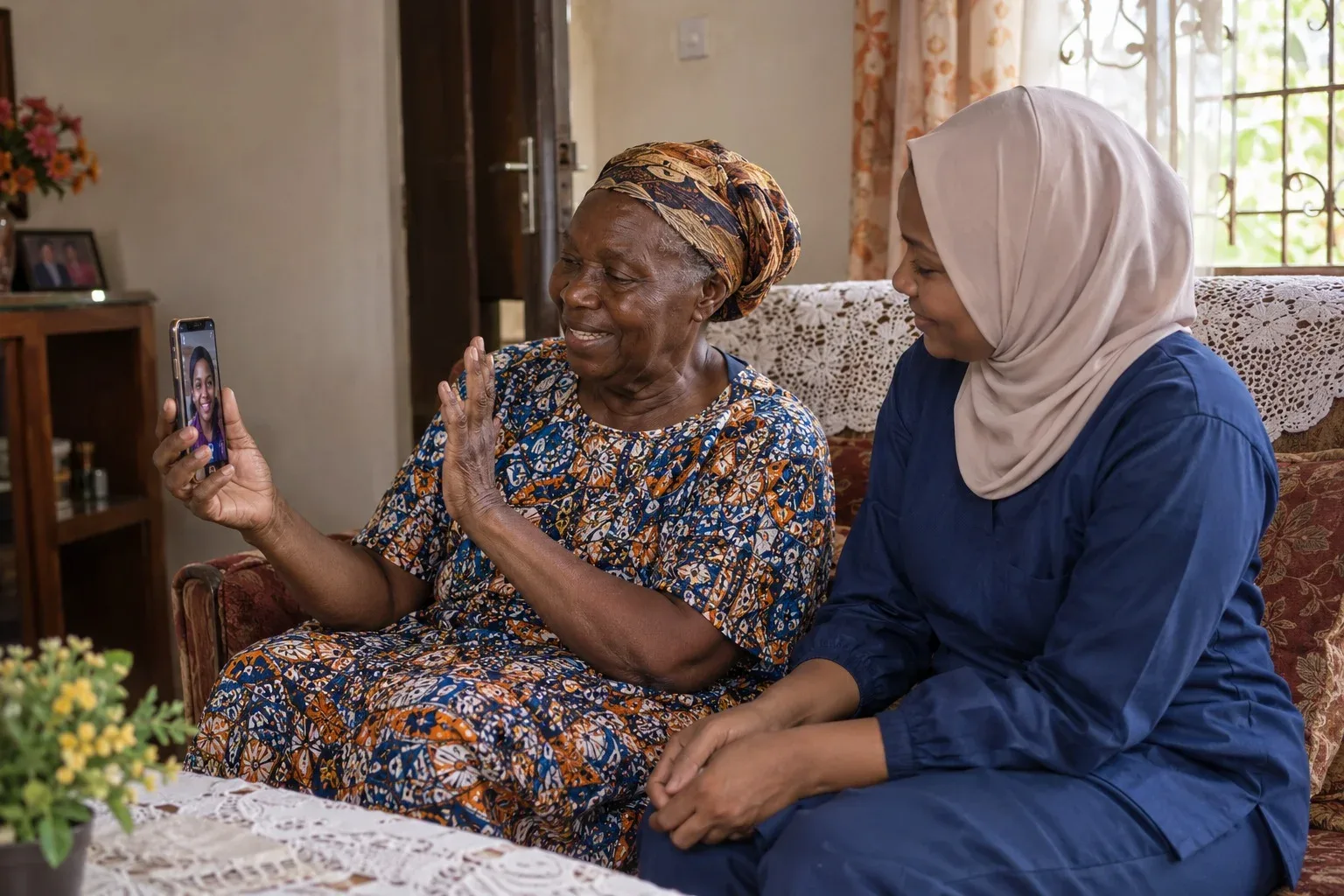
# Care for Parents in Uganda From South Africa: A Complete Guide for Families Living in South Africa
**Primary Keyword:** care for parents in Uganda from South Africa
**Secondary Keywords:** elderly care Uganda from South Africa, home care for parents in Uganda, caregiver Uganda from South Africa, caregiver Kampala for parents, diaspora care Uganda South Africa, healthcare for parents in Uganda, specialist appointments Uganda, elderly transport Uganda, care coordination Uganda, care for elderly parents in Kampala, Ugandan diaspora care
**Search Intent:** Informational + problem-solving + service discovery
---
# Quick Answer: How Can You Arrange Care for Parents in Uganda From South Africa?
If you live in South Africa and your parents or relatives live in Uganda, you can begin organising their care without being physically present for every step.
The practical process is to:
1. Speak with your parent and understand what they want. 2. Identify what has changed and what support is actually needed. 3. Separate household assistance from medical care. 4. Identify upcoming appointments, hospital visits or specialist needs. 5. Determine whether transport or an accompanying person is required. 6. Identify relatives, friends or existing caregivers already helping. 7. Establish who will coordinate the different parts of the care plan. 8. Set up a reliable communication process between Uganda and South Africa. 9. Verify who will actually provide each service. 10. Review the arrangement as your parent's needs change.
For Ugandans living in Johannesburg, Pretoria, Cape Town, Durban, Gqeberha and other parts of South Africa, the challenge is often not simply finding a person to help.
It is coordinating **the right support, in the right place, with clear responsibilities**.
Aethla Care Uganda provides a starting point for families abroad to explain a care need and explore the appropriate support route in Uganda.
---
# Why Caring for Parents in Uganda From South Africa Can Be Challenging
Being relatively close to Uganda compared with some other countries does not eliminate the difficulties of remote family care.
You may be able to travel to Uganda more easily than relatives living on another continent, but you may still spend most of the year away from your parents.
That means you may depend on:
- Phone calls - WhatsApp - Video calls - Siblings - Extended family - Neighbours - Friends - Healthcare providers - Caregivers - Community contacts
Each person may have only part of the picture.
Your sister might know that Mum has stopped going out.
Your brother might know that Dad has a hospital appointment.
Your parent might tell you everything is fine.
A neighbour might notice that household routines have changed.
A doctor may know about a medical issue that the wider family does not fully understand.
The challenge is bringing the practical pieces together.
That is where care coordination can become valuable.
---
# Start With the Person, Not the Service
One of the most common mistakes families make is beginning with a service label.
For example:
**"We need an elderly caregiver."**
That may be correct.
But it may also be too early.
The actual need could be:
- Transport to appointments - Help around the house - Companionship - Post-hospital support - Mobility assistance - Specialist appointment coordination - Family communication - Several of these at once
The better starting question is:
> **What is becoming difficult for my parent, and what would make everyday life easier?**
This is consistent with the person-centred approach promoted by the World Health Organization.
WHO's second edition of its Integrated Care for Older People guidance describes a pathway involving assessment, identification of social-care and support needs, personalised care planning, implementation and monitoring.
In other words, care should be built around the person rather than forcing every person into the same package.
---
# What Types of Support Can Parents in Uganda Need?
There is no single definition of "elderly care."
Different families need very different arrangements.
## 1. Home and Family Support
A parent may be able to live independently but need additional practical help.
That could include:
- Household routines - Meal-related assistance - Errands - Appointment reminders - Family coordination - Companionship - Practical organisation - Help managing day-to-day responsibilities
This type of support can be especially useful when the family is functioning reasonably well but one person has started carrying too much of the responsibility.
---
# 2. Elderly Care at Home
Some older adults want to remain in familiar surroundings.
Home-based support can potentially help families organise assistance around:
- Daily routines - Personal preferences - Companionship - Mobility - Appointments - Family communication - Post-discharge needs - Practical household responsibilities
The important point is that the level of support should reflect the person's actual needs.
Someone who needs help with shopping does not automatically need intensive personal care.
Someone recovering from a hospital stay may need a different arrangement altogether.
---
# 3. Specialist Doctor Appointments
Your parent may need to see a specialist.
The challenge for a family member living in South Africa is often coordinating the practical process from another country.
Questions may include:
- Which specialist is appropriate? - Does the patient need a referral? - Which facility should they attend? - What documents should they take? - Who will accompany them? - How will they travel? - How will the family receive updates? - What happens after the appointment?
Aethla Care's healthcare-navigation service is designed to help families organise these practical questions and explore relevant specialist or provider pathways.
Aethla does **not** replace a doctor, hospital or licensed healthcare professional.
Clinical assessment and medical decisions remain with the relevant professionals.
---
# 4. Hospital Visits and Follow-Up
A hospital appointment can create a surprisingly large amount of work for a family.
Someone needs to:
- Arrange the journey - Confirm the appointment - Gather documents - Accompany the patient where appropriate - Understand the next practical step - Communicate with relatives
When the main family contact lives in South Africa, this can become difficult.
A local coordination route can help make responsibilities clearer.
---
# 5. Post-Hospital Support
A hospital discharge may be a turning point.
An older person who was previously managing alone may temporarily require more support.
The family may need to think about:
- Follow-up appointments - Mobility - Transport - Household assistance - Communication - Medication-related instructions from the clinical team - Additional professional care - Family responsibilities
The medical team's discharge instructions should remain the basis for clinical follow-up.
A care coordinator can help with the **practical organisation** surrounding the agreed plan.
---
# 6. Mobility and Transport
Transport is an important part of care.
An appointment is not useful if the person cannot reasonably get there.
Families should ask:
- Can the person travel independently? - Do they need someone accompanying them? - Can they comfortably enter and exit the vehicle? - Do they need mobility assistance? - Is the journey short or long? - Does the person need support at the destination? - Who will communicate if the journey changes?
Uganda's National Essential Health Care Package includes evacuation and referral services within the health system and identifies geriatric care as a distinct service cluster. It also recognises the social and functional challenges associated with ageing.
For families, this reinforces an important practical point:
**Getting to healthcare can itself be part of the care plan.**
---
# 7. Disability and Independence Support
Older adults may also live with disability or changing mobility.
The family should avoid assuming that disability automatically means dependence.
A better approach is to ask:
**What does this person want to continue doing, and what barrier is preventing them from doing it?**
Possible areas of support include:
- Mobility - Transport - Home routines - Community participation - Communication - Access to specialist services - Rehabilitation pathways - Practical family coordination
Uganda's Ministry of Health launched the National Rehabilitation and Assistive Technology Strategic Plan 2025–2030 in May 2026, with the stated aim of improving equitable access to rehabilitation and assistive technology services across Uganda.
This makes rehabilitation and assistive technology an increasingly important part of conversations about independence and disability support in Uganda.
---
# How to Assess Your Parent's Situation From South Africa
Before arranging anything, conduct a simple family assessment.
## Step 1: Ask Your Parent
Where possible, your parent should be part of the conversation.
Ask:
- How are things going at home? - What has become difficult? - What do you want help with? - What do you still want to do independently? - Are you comfortable with someone coming into the home? - Are there appointments that are difficult to attend? - Is transport becoming a problem? - Who currently helps you?
Do not make every decision about an older adult without involving them when they are able to participate.
Dignity and choice should remain part of the process.
---
# Step 2: Identify What Has Changed
Changes are often more useful than general descriptions.
For example:
**"Mum needs care."**
is vague.
Compare that with:
**"Mum has recently stopped cooking and needs help getting to her appointments."**
Now the family can start thinking about practical support.
Or:
**"Dad is independent at home but cannot easily travel to the hospital alone."**
That points toward mobility and appointment support rather than full-time home care.
---
# Step 3: Separate Medical From Practical Needs
Create two lists.
### Medical or clinical
- Diagnosis - Treatment - Clinical assessment - Specialist review - Rehabilitation - Medical follow-up
### Practical
- Transport - Companionship - Household help - Appointment coordination - Family communication - Errands - Daily routines
This distinction helps prevent families from asking a non-clinical provider to perform a clinical role.
---
# Step 4: Map the Existing Family Network
Before hiring additional support, identify who is already involved.
| Person | Current responsibility | |---|---| | Parent | Daily decisions and preferences | | Spouse | Household support | | Daughter/son | Family coordination | | Sibling | Local visits | | Neighbour | Occasional check-ins | | Doctor/clinic | Clinical care | | Caregiver | Agreed practical support | | Relative in South Africa | Remote coordination |
This can reveal where the real gap exists.
---
# How to Create a Remote Care Plan Between Uganda and South Africa
A simple shared plan can make a significant difference.
## 1. Primary Family Contact
Choose one person who can coordinate day-to-day communication.
This could be:
- A sibling in Uganda - A trusted relative - Another family member
The person in South Africa does not necessarily have to be the operational coordinator.
They can remain involved without trying to manage every physical task remotely.
---
# 2. Backup Contact
Have a second person available.
If the primary contact is travelling, sick or unavailable, the family should know who takes over.
---
# 3. Appointment Calendar
Keep a shared record of:
- Appointment date - Time - Facility - Specialist - Transport arrangements - Person accompanying the parent - Follow-up action
This is especially useful when several siblings live in different places.
---
# 4. Communication Schedule
Agree how often the family communicates.
For example:
**Daily:** brief check-in with parent
**Weekly:** family update
**After appointments:** summary to relevant relatives
The exact schedule depends on the family.
The important thing is that everyone knows what to expect.
---
# 5. Escalation Plan
The family should know what happens if something changes.
For example:
**Parent → local family contact → healthcare provider when appropriate → overseas family**
The family should not rely on a person in South Africa discovering a problem through a missed WhatsApp call.
---
# Choosing a Caregiver for Your Parent in Uganda
If a caregiver is needed, take the selection process seriously.
## Ask About Experience
What type of people have they supported?
Do they have experience with older adults?
What responsibilities have they previously undertaken?
---
## Define Responsibilities
Write down exactly what the caregiver is expected to do.
For example:
- Companionship - Household assistance - Routine support - Appointment accompaniment - Mobility assistance
Avoid vague instructions such as:
**"Look after Mum."**
Different people can interpret that phrase very differently.
---
# Understand Professional Boundaries
A caregiver should not automatically be treated as a nurse or doctor.
Ask:
**What is this person's role?**
and:
**What is outside their role?**
Clinical responsibilities should remain with appropriately qualified professionals.
Aethla's own model distinguishes between services it operates, coordinates, provides through partners and information-only routes. This is important because families should understand who is responsible for each part of a care arrangement.
---
# Questions to Ask a Care Provider
Before agreeing to an arrangement, ask:
- Who will actually provide the support? - What experience do they have? - What tasks are included? - What tasks are excluded? - Who supervises the arrangement? - How are family updates provided? - What happens if the caregiver is unavailable? - How is privacy handled? - How is consent handled? - What happens if the person's needs change? - Is transport included? - Are professional healthcare services separate?
A clear answer to these questions can prevent misunderstandings.
---
# How Families in South Africa Can Stay Involved
Remote care works better when overseas relatives have defined responsibilities.
A family member in South Africa might handle:
- Communication - Family coordination - Financial administration - Appointment records - Travel planning - Document organisation - Regular calls with the parent
A family member in Uganda might handle:
- Physical visits - Transport - Appointment accompaniment - Household issues - Immediate practical decisions
A healthcare professional handles:
- Clinical assessment - Diagnosis - Treatment - Medical advice - Clinical follow-up
A caregiver handles the agreed responsibilities within their role.
A coordinator can help connect these different parts.
That is a much more workable model than expecting one person to do everything.
---
# What If Your Parent Says They Do Not Need Help?
This is common.
An older person may value independence and privacy.
That does not mean the family should ignore concerns.
But it also does not mean relatives should immediately take over.
Start a conversation.
Ask what type of help would be acceptable.
For example, your parent may reject the idea of a full-time caregiver but accept:
- Weekly household assistance - Appointment transport - Occasional companionship - Help with errands - A person checking in after hospital discharge
Small amounts of support can sometimes be easier to accept than a major change.
---
# What If Your Siblings Disagree?
Remote family care can create disagreements.
One sibling may think the parent needs a caregiver.
Another may think everything is fine.
A third may be worried about cost.
A fourth may live nearby and feel they are already doing too much.
Instead of arguing about labels, document the practical situation.
Ask:
1. What has changed? 2. What does the parent say? 3. What support is currently being provided? 4. What is not being done? 5. What does the healthcare professional recommend? 6. What can each family member realistically contribute? 7. What needs to be reviewed?
This moves the discussion from opinions toward concrete information.
---
# How Aethla Care Can Help Ugandans Living in South Africa
Aethla Care Uganda's diaspora service is designed for families who live outside Uganda and need help coordinating support for relatives inside the country.
A family can begin by providing:
- Parent's location - Type of support needed - Current situation - Preferred contact method - Relevant appointment or care information
A care advisor can then clarify the practical route and explain Aethla's role.
Possible areas include:
### Elderly care
Exploring support around daily routines, family coordination, mobility and changing needs.
### Home and family support
Helping families organise practical household responsibilities.
### Healthcare navigation
Helping families understand practical next steps around appointments, providers and referrals.
### Specialist appointments
Helping coordinate a specialist appointment request where an appropriate provider route exists.
### Travel and mobility
Exploring transport and accompanying-person requirements.
### Disability support
Helping families think through independence, access, mobility and practical support.
### Family communication
Helping relatives abroad remain connected to the care process.
Aethla does not make medical decisions on behalf of families.
Clinical decisions remain with licensed professionals and the family.
---
# Where Is Aethla Care Available in Uganda?
Aethla's current early service footprint focuses on:
- **Kampala** - **Wakiso** - **Entebbe** - **Mukono**
Availability depends on the support requested.
Aethla specifically advises families outside its early locations to provide their location and care need so the team can determine whether an appropriate route exists.
This is important for families living abroad:
**Never assume that a service advertised online is automatically available everywhere in Uganda.**
Confirm the location and service route first.
---
# How Much Does Elderly Care in Uganda Cost?
There is no single reliable price for all elderly care.
The cost can depend on:
- Number of hours - Type of assistance - Frequency - Location - Professional qualifications - Transport - Specialist involvement - Complexity of the support - Whether the service is directly provided or coordinated
A family should be suspicious of any provider that gives a highly specific price without understanding the person's situation.
Ask for clarity about:
**What exactly is included?**
and:
**What could cost extra?**
---
# Red Flags When Arranging Care Remotely
Families living abroad should be particularly careful about unclear arrangements.
Be cautious if a person or organisation:
- Cannot clearly explain who provides the service - Makes medical guarantees - Promises a health outcome - Claims an appointment is confirmed without verification - Cannot explain responsibilities - Refuses to provide basic information about the service - Pressures you to pay immediately - Provides no backup plan - Gives contradictory information - Treats every family as though they need the same service
Trust should be supported by transparency.
---
# What Documents Should You Keep?
Depending on the situation, families may benefit from keeping an organised folder containing:
- Identification information - Relevant medical records - Appointment details - Referral information - Medication information provided by the clinical team - Emergency contacts - Family contacts - Caregiver information - Transport arrangements - Important provider contacts
Do not share sensitive medical or personal information more widely than necessary.
The family should also agree who is authorised to receive information.
---
# When Should You Arrange Support?
Do not necessarily wait for an emergency.
Start considering support when:
- Your parent is becoming less independent - A spouse is struggling - A relative is overwhelmed - Hospital appointments are difficult to manage - Transport has become challenging - Your parent has recently been discharged - You live too far away to provide regular physical help - Siblings disagree about who should do what - Your parent repeatedly asks for assistance - You want a plan before a crisis happens
Planning early can give the family more time to understand its options.
---
# A South Africa-to-Uganda Family Care Checklist
Use this checklist when starting the conversation.
## About your parent
- [ ] Where does your parent live? - [ ] Who lives with them? - [ ] What has changed? - [ ] What support do they want? - [ ] What do they still want to do independently?
## Healthcare
- [ ] Are there current medical concerns? - [ ] Are there upcoming appointments? - [ ] Is a specialist involved? - [ ] Has there been a recent hospital admission? - [ ] Is follow-up required?
## Home
- [ ] Is household help needed? - [ ] Is companionship needed? - [ ] Has mobility changed? - [ ] Are daily routines becoming difficult?
## Transport
- [ ] Can your parent travel independently? - [ ] Is an accompanying person needed? - [ ] Is mobility assistance required? - [ ] Who will coordinate the journey?
## Family
- [ ] Who is the primary contact? - [ ] Who is the backup contact? - [ ] Who visits the parent? - [ ] Who communicates with healthcare providers? - [ ] Who communicates with relatives in South Africa?
## Provider
- [ ] Who provides the service? - [ ] What exactly is included? - [ ] What is excluded? - [ ] What needs professional confirmation? - [ ] What happens if the provider is unavailable?
---
# Frequently Asked Questions
## Can I arrange care for my parents in Uganda while living in South Africa?
Yes. You can begin the process remotely by explaining your parent's location and care needs. The next step is to determine what type of practical support is appropriate and who can provide or coordinate it.
## Can someone in Johannesburg arrange elderly care in Kampala?
Yes. A family member living in Johannesburg can start a care request for a parent in Kampala. The specific service and availability should be confirmed before arrangements are made.
## Can someone in Cape Town arrange healthcare support for a parent in Uganda?
Yes. Healthcare navigation and family coordination can be started remotely, although clinical decisions remain with the relevant healthcare professionals in Uganda.
## Can Aethla Care arrange specialist appointments?
Families can request specialist appointment coordination through Aethla. Appointment availability is not assumed or displayed as live unless connected to a real scheduling system; a coordinator confirms the request with the relevant provider or partner.
## Does Aethla provide medical treatment?
No. Aethla is a care-coordination and family-support platform rather than a hospital or clinic. Clinical services are provided by appropriately qualified professionals or partner facilities.
## Can Aethla help my parent get to hospital?
Aethla can explore travel and mobility support, including transport and accompanying-person requirements, where an appropriate route is available and confirmed.
## Can my parent receive support at home?
Home support may be appropriate depending on the person's needs, location and available service route.
## What if my parents live outside Kampala?
Tell Aethla the location and care requirement. Aethla currently has an early focus on Kampala, Wakiso, Entebbe and Mukono, while other locations need to be checked individually.
## Do I need to travel to Uganda before arranging care?
Not necessarily. Families can begin the conversation from South Africa and involve relatives in Uganda where appropriate.
## Can my siblings and I share responsibility?
Yes. Remote care often works better when responsibilities are distributed rather than left to one family member.
---
# Final Thoughts: You Can Be Present Without Being Physically Present
Living in South Africa does not mean you have to manage your parent's care entirely from a distance.
It also does not mean you have to make every decision yourself.
The first step is understanding the situation.
Talk to your parent.
Speak with the relatives already involved.
Separate medical needs from practical needs.
Identify where transport, appointments, household support or companionship are becoming difficult.
Then establish who should take responsibility for each part.
For some families, the solution may simply be better family coordination.
For others, it may involve home support, elderly care, healthcare navigation, specialist appointments, mobility assistance or several services working together.
The important thing is to start with the person rather than a generic service.
Aethla Care Uganda provides a starting point for Ugandans living in South Africa who need to coordinate care for parents or relatives in Uganda.
**Tell Aethla where your parent lives, what has changed and what support you are looking for. The team can help clarify the next practical route.**
---
# Factual References and Further Reading
### World Health Organization — Integrated Care for Older People (ICOPE), 2nd Edition
WHO's 2025 second edition of ICOPE provides guidance for person-centred assessment and care pathways in primary and community settings. It includes assessment, social-care needs, personalised care planning, implementation and monitoring.
### Uganda Ministry of Health — National Essential Health Care Package
Uganda's National Essential Health Care Package includes a dedicated geriatric-care cluster and describes the increasing importance of addressing the health and social-care needs of older people.
### Uganda Ministry of Health — National Rehabilitation and Assistive Technology Strategic Plan 2025–2030
Uganda launched this strategy in May 2026 to improve equitable access to rehabilitation and assistive technology services nationwide.
### Uganda Ministry of Gender, Labour and Social Development — National Council for Older Persons
The National Council for Older Persons was established under the National Council of Older Persons Act 2013 and has responsibilities including coordination, monitoring and advising stakeholders concerning service delivery to older persons.
### Aethla Care Uganda — Diaspora Care
Aethla's diaspora-care route allows families living outside Uganda, including South Africa, to explain a care need, coordinate the next practical step in Uganda and stay informed.
---
## Important Care Information
This article provides general information for families and is not medical advice, diagnosis or treatment.
Healthcare decisions should be made with appropriately qualified healthcare professionals.
Aethla Care does not replace doctors, nurses, hospitals, therapists or other licensed clinical providers.
Care availability, geographic coverage, provider participation and appointment availability can change. Families should confirm the relevant route before making commitments.
**Last reviewed: September 2026**