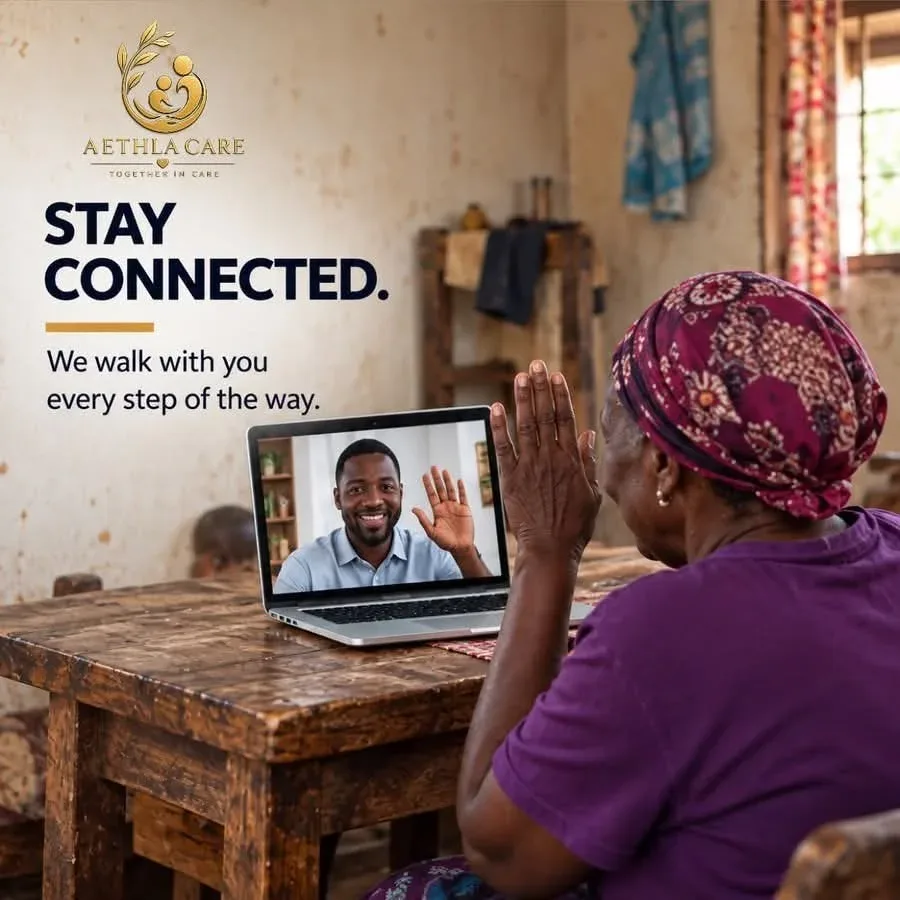
# Care for Parents in Uganda From Australia: A Complete Guide to Elderly Care, Home Support and Healthcare Coordination
**Meta Title:** Care for Parents in Uganda From Australia | Aethla Care
**Meta Description:** Living in Australia and caring for parents in Uganda? Learn how to arrange elderly care, home support, specialist appointments, transport and family care coordination in Uganda.
**Suggested URL Slug:** `/care-for-parents-uganda-from-australia/`
**Primary Keyword:** care for parents in Uganda from Australia
Secondary Keywords:
- elderly care Uganda from Australia - home care for parents in Uganda from Australia - caring for parents in Uganda from Australia - parent care Uganda Australia - care for elderly parents in Uganda - arrange caregiver Uganda from Australia - healthcare for parents in Uganda from Australia - elderly care Kampala - Uganda diaspora care - diaspora care Uganda - care coordination Uganda - home care Uganda - elderly support Uganda - specialist appointments Uganda - transport for elderly Uganda - looking after parents in Uganda from Australia
**Search Intent:** Informational + service research + high-intent diaspora care
---
# Care for Parents in Uganda From Australia: A Complete Guide for Families Living in Australia
Living in Australia while your parents live in Uganda can create a difficult gap between **being involved** and **being physically present**.
You may speak to your mother every evening.
You may call your father on weekends.
You may send money for household expenses.
You may help pay medical bills.
You may organise a doctor's appointment.
But when your parent needs someone physically present in Uganda, the distance becomes much more obvious.
Who will take them to hospital?
Who will accompany them to a specialist appointment?
Who can help with household routines?
Who can check on them if you cannot travel?
Who can help after they are discharged from hospital?
And perhaps most importantly:
**How can you remain involved in your parent's care when you are living in Australia?**
The answer is usually not to try to manage every practical task from overseas.
Instead, families can build a **local support system in Uganda while remaining actively involved from Australia**.
This guide explains how to approach that process, what types of support may be relevant, how to coordinate elderly care remotely and how families can reduce confusion when multiple relatives, caregivers and healthcare providers are involved.
---
# Quick Answer: How Can I Care for My Parents in Uganda From Australia?
If you live in Australia and your parents live in Uganda, start by:
1. Speaking with your parent about what support they actually want. 2. Understanding their current health, mobility and living situation. 3. Identifying relatives, neighbours or other trusted people already helping. 4. Separating healthcare needs from household and practical support. 5. Identifying gaps that require someone locally in Uganda. 6. Arranging appropriate elderly, home, transport or appointment support. 7. Establishing a clear communication system between Uganda and Australia. 8. Keeping important care and appointment information together. 9. Creating an emergency and escalation plan. 10. Reviewing the arrangement as your parent's needs change.
For many families, the goal is not to replace family involvement.
It is to make family involvement **work across distance**.
---
# Why Is Caring for Parents in Uganda From Australia Difficult?
Australia and Uganda are geographically far apart.
That matters when your parent needs something that cannot be handled by phone.
For example, you can:
- make a payment - speak to a doctor - send a message - arrange an appointment - check in by video - discuss family decisions
But you cannot instantly:
- drive your parent to hospital - inspect the home - accompany them to an appointment - buy groceries - help with household tasks - respond physically to a change in circumstances
This is where local care coordination becomes valuable.
WHO's current Integrated Care for Older People (ICOPE) approach emphasises person-centred and coordinated care, including identification of social-care and support needs, personalised care planning and ongoing implementation and monitoring.
For a Ugandan family member living in Australia, this principle can be translated into a simple idea:
**You remain part of the care team even when you are not physically in Uganda.**
---
# Who Is This Guide For?
This guide is particularly relevant if you are:
- a Ugandan living in Australia - an Australian with parents or relatives in Uganda - a son or daughter supporting elderly parents in Uganda - a family member paying for care in Uganda - someone worried about an ageing parent living alone - someone coordinating healthcare for a parent remotely - someone trying to arrange a caregiver in Uganda - someone whose parent needs help getting to appointments - someone whose parent has recently left hospital
It can also apply to families living in:
- Melbourne - Sydney - Brisbane - Perth - Adelaide - Canberra - Gold Coast - other parts of Australia
The location in Australia matters less than the fact that **your parent is in Uganda and you are not physically nearby**.
---
# Start With Your Parent, Not With a Service
One of the most common mistakes families make is starting with:
> “We need a caregiver.”
That may or may not be true.
Your parent may need:
- a cleaner - someone to help with shopping - transport - companionship - appointment coordination - occasional home support
rather than full-time personal care.
WHO's person-centred approach places the older person's needs, priorities and preferences at the centre of the care plan. Its personalised-care guidance also emphasises collaborative decision-making involving the older person, family and caregivers.
So begin with a conversation.
Ask your parent:
### “What is becoming difficult?”
### “What would make life easier?”
### “What help would you be comfortable receiving?”
### “What do you still want to do yourself?”
These questions can produce a much better care plan than simply deciding that an older person needs a caregiver.
---
# Assess Your Parent's Current Situation
If you are in Australia, create a simple picture of your parent's circumstances.
## 1. Where does your parent live?
For example:
- Kampala - Wakiso - Entebbe - Mukono - another town or district
## 2. Who lives with them?
- alone - spouse - adult child - relative - domestic worker - caregiver
## 3. What can they manage independently?
Consider:
- cooking - cleaning - shopping - bathing - dressing - mobility - appointments - finances - communication
## 4. What has changed?
Look for changes in:
- mobility - independence - memory or confusion - social interaction - ability to manage the home - appointment attendance
These observations are not a diagnosis.
They are simply information that can help determine whether the existing support arrangement remains appropriate.
---
# What Kind of Support Might Your Parent Need?
Different families need different combinations of support.
## Elderly care
May include support with daily routines, companionship, family coordination and practical assistance.
## Home support
May involve household routines, errands, meals or other agreed practical tasks.
## Healthcare navigation
May involve identifying an appropriate specialist route, organising an appointment request or helping the family understand what practical steps are involved.
## Transport and mobility support
May involve arranging journeys to appointments or essential activities.
## Domestic assistance
May involve cleaning, laundry, cooking or other household tasks.
## Family coordination
May involve keeping relatives informed and ensuring everyone understands who is responsible for what.
These categories should not automatically be combined into one job.
---
# Elderly Care Is Not the Same as Nursing Care
This distinction is particularly important when arranging care from Australia.
A caregiver or elderly-support worker may provide practical support.
A nurse or other healthcare professional has a different role and professional responsibilities.
Clinical tasks such as:
- diagnosis - treatment - clinical assessment - medication decisions - nursing procedures
should be handled by appropriately qualified healthcare professionals.
A family should not assume that because someone has experience caring for an older person, they are automatically qualified to provide clinical care.
---
# How to Arrange a Caregiver for Your Parent in Uganda From Australia
If your parent needs regular personal or daily support, start by defining the role.
Ask:
### What exactly will the person do?
For example:
- companionship - mobility assistance - household routines - meal preparation - appointment accompaniment - agreed personal support
### How often is support required?
Possibilities may include:
- occasional - several times per week - daily - live-in
The appropriate arrangement depends on the individual's needs.
### What experience is required?
This is especially important if the parent has:
- significant mobility limitations - complex support needs - disability - post-hospital requirements
A more specialised need may require a suitably qualified professional rather than a general caregiver.
---
# How to Verify a Caregiver When You Live in Australia
Distance makes verification especially important.
Before engaging someone, consider checking:
- full name - identity - relevant experience - references - previous work - responsibilities - working hours - communication arrangements - who supervises the arrangement
Do not rely solely on:
> “A friend recommended them.”
A recommendation can be useful.
It should not eliminate basic verification.
---
# Ask for References
Where appropriate, ask for references from previous employers or families.
Questions might include:
- How long did the person work for you? - What were their responsibilities? - Were they reliable? - How did they communicate? - Why did the arrangement end? - Would you engage them again?
The purpose is not to guarantee that someone will be perfect.
It is to reduce avoidable uncertainty.
---
# What If Your Parent Needs a Maid Rather Than a Caregiver?
This is another important distinction.
Your parent may not require personal care.
They may simply need help with:
- cleaning - laundry - cooking - shopping - errands - household organisation
In that situation, domestic support may be more appropriate.
Do not automatically give a domestic worker responsibilities that require healthcare expertise.
A clear job description protects everyone.
---
# Can One Person Be Both a Maid and a Caregiver?
Sometimes families may structure roles this way, depending on circumstances.
But the responsibilities should be explicit.
For example:
| Task | Domestic Support | Care Support | Healthcare Professional | |---|---|---|---| | Cleaning | ✓ | Sometimes | No | | Laundry | ✓ | Sometimes | No | | Cooking | ✓ | Sometimes | No | | Shopping | ✓ | Sometimes | No | | Companionship | Sometimes | ✓ | Sometimes | | Appointment accompaniment | Sometimes | ✓ | Sometimes | | Clinical assessment | No | No | ✓ | | Diagnosis | No | No | ✓ | | Treatment decisions | No | No | ✓ |
The exact responsibilities should always be agreed before the arrangement begins.
---
# Arranging Specialist Appointments From Australia
This is one of the areas where diaspora families can struggle.
Your parent may receive advice such as:
> “You need to see a specialist.”
But then several practical questions arise.
- Which specialist? - Where? - When? - What referral is required? - What documents are needed? - How will your parent get there? - Does someone need to accompany them?
A healthcare-navigation service can potentially help coordinate these practical steps.
Aethla Care can help families explore specialist appointment requests and navigation routes, with appointment confirmation remaining subject to the relevant provider.
Aethla does not replace the doctor or make clinical decisions.
---
# Do Not Confuse Healthcare Navigation With Medical Advice
This distinction is especially important for families overseas.
Healthcare navigation can help with questions such as:
- Where might the parent need to go? - How can an appointment be requested? - What information should the family prepare? - What practical arrangements are required?
Medical advice is different.
Questions about:
- diagnosis - treatment - medication - clinical risk - prognosis
should be addressed by qualified healthcare professionals.
WHO's integrated-care approach is specifically about connecting health and social-care services around the older person's needs rather than treating healthcare as a collection of isolated encounters.
---
# How to Arrange Transport for Your Parent in Uganda
Transport can become increasingly important as parents age.
Consider whether your parent can:
- travel independently - enter and exit a vehicle safely - walk from the vehicle to the facility - wait independently - navigate a hospital or clinic - return home without assistance
If not, the family may need to consider an accompanying person or another appropriate mobility arrangement.
For diaspora families, transportation should be planned as part of the appointment—not as an afterthought.
A complete plan should answer:
**Who picks Mum up?**
**What time?**
**Where is she going?**
**Who accompanies her?**
**Who brings her home?**
---
# What If Your Parent Lives Outside Kampala?
Aethla Care currently highlights an early service footprint covering:
- Kampala - Wakiso - Entebbe - Mukono
If your parent lives elsewhere in Uganda, the appropriate route depends on:
- location - type of support - provider availability - whether coordination or partner support is possible
This is why families should provide the parent's actual location when making an enquiry.
“Uganda-wide” does not mean that every service is automatically available in every district.
---
# Caring for a Parent in Kampala From Australia
Kampala can present a different set of practical considerations because of:
- traffic - travel time - large healthcare facilities - busy urban environments - distance between home and appointments
A parent may live relatively close to a facility geographically but still need significant travel planning.
A local coordinator can potentially help connect the practical pieces.
---
# Caring for a Parent in Wakiso From Australia
Wakiso includes many residential areas around Kampala.
Families should establish the parent's:
- exact area - transport needs - nearest appropriate healthcare facility - existing family support - household support needs
This helps avoid arranging a service that looks suitable on paper but is impractical in reality.
---
# Caring for a Parent in Entebbe From Australia
Families with parents in Entebbe may also need to consider:
- transport - appointments - household assistance - family visits - mobility
The same assessment approach applies.
The key is to design the care around the person rather than around a generic package.
---
# Caring for a Parent in Mukono From Australia
If your parent lives in Mukono, establish:
- home location - existing support - healthcare arrangements - transport needs - household needs
Then determine what additional assistance is required.
---
# What If Your Parent Lives Alone?
Living alone does not automatically mean your parent needs residential care or a full-time caregiver.
But families should consider:
- how often someone visits - what happens if they fall - who notices missed appointments - who helps with shopping - who responds to an urgent concern - how your parent gets to hospital
A simple local support network can make a significant practical difference.
---
# Build a Local Support Network
A useful structure may include:
### Primary local contact
A trusted relative or other person who can physically respond.
### Healthcare contact
The parent's existing healthcare provider or appropriate facility.
### Practical support
Caregiver, domestic support or another agreed service.
### Transport
A reliable transport arrangement for important journeys.
### Overseas family
You and other relatives in Australia or elsewhere.
### Coordinator
Where appropriate, a service such as Aethla Care can help coordinate multiple practical elements.
---
# Create One Communication System
One of the biggest problems in diaspora family care is fragmented communication.
One person sends a WhatsApp message.
Another makes a phone call.
A third person speaks to the hospital.
A fourth assumes someone else is handling transport.
Then nobody knows exactly what happened.
Create a simple communication structure.
For example:
**Parent → local contact → coordinator → overseas family**
Not every situation requires all four.
But everyone should know who communicates what.
---
# How Often Should You Check on Your Parent?
There is no universal schedule.
It depends on:
- health - independence - living arrangements - support network - family preferences
A possible arrangement could include:
**Daily:** short phone call
**Weekly:** longer conversation
**Monthly:** review of support needs
But this is only an example.
A parent with greater support needs may require more frequent communication.
---
# Use Technology Without Replacing Human Contact
Technology can help Australian families remain involved.
Possible tools include:
- WhatsApp - video calls - shared calendars - digital documents - appointment reminders - family group chats
But technology should support—not replace—appropriate local assistance.
A WhatsApp call cannot physically take your parent to a specialist appointment.
---
# Create a Shared Parent Care Calendar
A simple calendar can contain:
- appointments - transport - caregiver visits - family visits - important follow-ups - planned check-ins
This can be particularly useful when siblings live in different countries.
Everyone can see:
**what is happening, when it is happening and who is responsible.**
---
# Keep a Parent Care Record
Your family may find it useful to maintain a simple document containing:
### Parent information
- full name - location - emergency contacts
### Healthcare
- doctors - specialists - appointments - important documents
### Support
- caregiver - domestic worker - transport - family contacts
### Communication
- preferred family communication method
### Emergencies
- local contact - escalation plan
Avoid putting unnecessary sensitive medical information into informal group chats.
---
# What If Your Parent Has Multiple Specialists?
This can become complicated.
Your parent may have:
- a primary healthcare provider - one specialist - another specialist - laboratory appointments - rehabilitation - follow-up visits
The family should try to maintain one clear overview.
WHO's ICOPE model recognises the need for coordinated care across settings and supports a shift away from fragmented, disease-by-disease approaches for older people.
For the family, this means thinking about the **whole person**, not only individual appointments.
---
# What If Your Parent Has Mobility Difficulties?
Mobility problems can affect much more than walking.
They may affect:
- shopping - transport - appointments - social activities - household tasks - independence
WHO's ICOPE framework includes mobility among the areas that may need assessment as part of older-person care.
The family should consider whether support is required for:
- getting around the home - leaving the home - transport - appointment attendance - rehabilitation - safe daily routines
---
# What If Your Parent Has a Disability?
Ageing and disability can overlap.
A parent may require:
- mobility assistance - accessible transport - home adaptations - communication support - rehabilitation - personal assistance
The appropriate support depends on the individual's circumstances.
Do not assume that a general domestic worker can automatically meet disability-related support needs.
---
# What If Your Parent Has Recently Been Discharged From Hospital?
This is a particularly important moment for families in Australia.
Before discharge, establish:
- follow-up appointments - transport home - household assistance - rehabilitation needs - medication arrangements as instructed by the healthcare team - warning signs requiring medical attention - who will provide practical support
The first few days after discharge should not be treated as an administrative detail.
They are part of the transition from hospital to home.
---
# What If Your Parent Says They Do Not Need Help?
This is common.
Your parent may associate assistance with loss of independence.
Instead of saying:
> “You are getting old and need someone.”
try:
> “What would make things easier for you?”
Perhaps they would accept:
- transport - a cleaner - help with shopping - appointment support - occasional companionship
without wanting a full-time caregiver.
Person-centred care means taking the older person's preferences seriously.
---
# What If Your Parent Refuses a Caregiver?
Find out why.
Possible concerns may include:
- privacy - independence - cost - unfamiliar people - previous bad experiences - fear of losing control - cultural expectations
You may be able to start with a smaller support arrangement.
For example:
**Stage 1:** weekly household assistance
**Stage 2:** occasional appointment support
**Stage 3:** increased support if needs change
The appropriate approach depends on the individual.
---
# How Much Does Elderly Care in Uganda Cost?
There is no single price for elderly care in Uganda.
The cost can depend on:
- location - hours - type of service - caregiver experience - professional qualifications - transport - complexity of support - frequency
Be cautious about websites claiming that one universal price applies to all elderly care in Uganda.
Families should request a clear explanation of:
- what is included - what is not included - hours - transport - additional charges - cancellation arrangements
before committing.
---
# How Australian Families Can Avoid Care Scams
Distance can make families vulnerable to inaccurate information.
Be cautious if someone:
- refuses to provide basic identification - asks for unusual payments - refuses to explain responsibilities - makes medical promises - guarantees outcomes - pressures you to pay immediately - cannot explain who actually provides the service
A professional care arrangement should be transparent about roles.
---
# Never Pay for a “Guaranteed Medical Outcome”
No caregiver, coordinator or ordinary service provider should promise that a parent will:
- recover from a condition - avoid hospitalisation - be cured - achieve a particular medical outcome
Clinical outcomes cannot be guaranteed by a care coordinator.
---
# What Should Australian Families Ask Before Choosing a Care Provider?
Ask:
### Service
“What exactly will you provide?”
### Location
“Can you support my parent's location?”
### People
“Who actually provides the service?”
### Verification
“How are caregivers or partners verified?”
### Communication
“How will I receive updates from Australia?”
### Escalation
“What happens if something changes?”
### Healthcare boundaries
“What do you do if my parent needs medical attention?”
### Availability
“Is the service currently available?”
These questions can reveal whether you are dealing with a genuine care-coordination process or simply a directory listing.
---
# How Aethla Care Can Help Families in Australia
Aethla Care provides a Uganda-based care and family-support platform for families who may need to coordinate support for relatives in Uganda.
For a family living in Australia, the process can begin by explaining:
- who needs support - where they live - what has changed - what help already exists - what additional help may be needed
Depending on the situation, Aethla can help explore routes involving:
- elderly care - home and family support - healthcare navigation - specialist appointment coordination - travel and mobility support - family communication - practical care coordination
The exact role depends on the request and available service route.
---
# Aethla Care Is Not a Hospital
This distinction is important.
Aethla Care is a care-coordination and family-support platform.
It is not a hospital or clinic.
Clinical care remains the responsibility of appropriately qualified healthcare professionals and healthcare facilities.
Aethla can help a family navigate and coordinate practical steps, but it should not be presented as replacing a doctor, nurse, specialist or hospital.
---
# How the Aethla Care Process Works
A simple starting point is:
### 1. Tell Aethla what your parent needs
Include their location and the type of support required.
### 2. Clarify the care route
The request is reviewed to determine what type of support may be appropriate.
### 3. Confirm the role
The family should understand whether Aethla is directly providing, coordinating or connecting the service.
### 4. Coordinate the next step
Where an appropriate route exists, the practical arrangement can be explored.
### 5. Keep the family informed
Communication is particularly important when the primary family member is overseas.
---
# What If I Live in Melbourne?
If you live in Melbourne but your parent lives in Uganda, the same principle applies.
You may be thousands of kilometres away, but you can still:
- remain involved - communicate regularly - help coordinate services - participate in important decisions - fund appropriate support - review the care arrangement
The important question is:
**Which responsibilities require someone physically in Uganda?**
Those responsibilities need a reliable local solution.
---
# What If I Live in Sydney, Brisbane or Perth?
The approach does not fundamentally change.
Your Australian city matters less than:
- your parent's Ugandan location - their support needs - the available local network - the required services
Whether you live in Sydney, Brisbane, Perth, Adelaide, Canberra or elsewhere, your parent still needs a clearly defined local care plan.
---
# A Practical Australia-to-Uganda Parent Care Plan
Here is a simple framework.
## Week 1: Understand
Talk to your parent.
Find out what has changed.
## Week 2: Map
Identify:
- relatives - healthcare providers - household support - transport - appointments
## Week 3: Identify gaps
Ask:
**What cannot currently be managed?**
## Week 4: Arrange
Explore appropriate support.
## Ongoing: Review
Ask every few weeks or months:
**Is this still working?**
Care planning should not be a one-time exercise.
WHO's ICOPE framework includes implementation and monitoring as part of personalised care planning.
---
# Australia-to-Uganda Parent Care Checklist
Before arranging support, make sure you know:
### About your parent
- [ ] Where they live - [ ] Who lives with them - [ ] What they can manage independently - [ ] What has become difficult - [ ] What help they want
### Healthcare
- [ ] Current healthcare provider - [ ] Upcoming appointments - [ ] Specialist requirements - [ ] Recent hospitalisation - [ ] Follow-up needs
### Practical support
- [ ] Household help - [ ] Caregiver - [ ] Transport - [ ] Shopping - [ ] Companionship
### Family
- [ ] Local emergency contact - [ ] Primary overseas contact - [ ] Other relatives - [ ] Communication system
### Provider verification
- [ ] Identity - [ ] Experience - [ ] References - [ ] Responsibilities - [ ] Cost - [ ] Availability - [ ] Communication
---
# Frequently Asked Questions
## How can I arrange care for my parents in Uganda from Australia?
Start by assessing your parents' needs, location and existing support. Then identify gaps involving elderly care, household assistance, appointments, healthcare navigation, transport or family coordination.
## Can I arrange elderly care in Uganda while living in Australia?
Yes. You can coordinate many aspects of family care remotely, while local people or services handle tasks requiring physical presence in Uganda.
## Can Aethla Care help Australians care for parents in Uganda?
Aethla Care's diaspora-care pathway is designed to help families outside Uganda explore practical support and coordination for relatives in Uganda.
## Can Aethla arrange a caregiver for my parent?
Where an appropriate service route is available, Aethla can help families explore elderly and home-support options. The exact arrangement should be confirmed based on location and need.
## Can Aethla arrange a specialist appointment for my parent?
Aethla can help with healthcare navigation and specialist appointment requests. The appointment itself must be confirmed by the relevant healthcare provider.
## Can someone take my parent to hospital?
Transport and mobility support may be coordinated depending on the circumstances and available provider route.
## What if my parent lives outside Kampala?
Aethla currently highlights Kampala, Wakiso, Entebbe and Mukono as its early service footprint. If your parent lives elsewhere, provide the location and care requirement so an appropriate route can be assessed.
## Can I monitor my parent's care from Australia?
Yes. Families can establish agreed communication arrangements involving relatives, caregivers, coordinators and healthcare providers where appropriate.
## How often should I call my elderly parent in Uganda?
There is no universal schedule. Frequency should reflect your parent's independence, health, living situation and support network.
## What if my parent refuses help?
Start by understanding their concerns. Smaller forms of assistance may be more acceptable than immediately proposing full-time care.
## Is a caregiver the same as a nurse?
No. Caregiving and nursing are different roles. Clinical responsibilities should be handled by appropriately qualified healthcare professionals.
## How much does elderly care cost in Uganda?
There is no single national price. Costs vary according to location, service type, hours, qualifications, transport and support requirements.
---
# Final Thoughts: You Can Care From Australia Without Doing Everything Alone
Being an Australian-based family member does not mean you have to choose between:
**doing everything yourself**
and
**leaving everything to someone else.**
There is a middle ground.
You can remain closely involved while establishing reliable local support.
You can speak with your parent.
You can participate in decisions.
You can coordinate appointments.
You can arrange appropriate practical support.
You can communicate with local relatives.
You can review the care plan.
And you can use local care coordination when physical presence is required.
The most effective approach is usually not to ask:
> **“How can I manage my parent's entire life from Australia?”**
Instead ask:
> **“What does my parent need, what can I manage remotely, and what needs to be coordinated locally in Uganda?”**
That question creates a much more practical starting point.
WHO's current approach to integrated care for older people similarly emphasises person-centred, coordinated support spanning homes, primary care, hospitals and community settings, with attention to both older people and their carers.
For families in Australia, the goal is therefore not simply to arrange **a caregiver**.
The goal is to create a **reliable care system around your parent**.
That may include elderly care, domestic support, healthcare navigation, specialist appointments, transport, family communication and other practical services.
And because every family is different, the right starting point is always the same:
**Understand the person first. Then build the care around them.**
---
# Factual References
### World Health Organization — Integrated Care for Older People (ICOPE), Second Edition
WHO's second-edition ICOPE handbook describes practical pathways for detecting declines in intrinsic capacity, identifying social-care and support needs, developing personalised care plans and implementing and monitoring those plans.
### World Health Organization — Person-Centred Integrated Care
WHO describes integrated care for older people as a coordinated approach spanning settings including homes, primary-care facilities, hospitals and long-term-care environments. It also highlights the role of communities in enabling people to age in place.
### World Health Organization — Personalised Care Plans
WHO's ICOPE materials describe personalised care planning as a collaborative process involving the older person, family and caregivers, with shared decision-making and follow-up.
### World Health Organization — Ageing and Health
WHO identifies areas including mobility, cognition, vitality, vision, hearing and psychological capacity as relevant to maintaining functional ability in older age, alongside social care and support needs.
---
## Care and Healthcare Information Note
This article provides general information about organising family and care support for parents living in Uganda while relatives live in Australia. It is not medical, nursing, financial, immigration or legal advice.
Clinical concerns, diagnosis, treatment, medication decisions and medical emergencies should be handled by appropriately qualified healthcare professionals.
Aethla Care is not a hospital or clinic and does not replace qualified healthcare professionals.
Caregiver availability, service coverage, partner arrangements, transport options and costs can change. Families should confirm current arrangements before making commitments.
For urgent or potentially life-threatening medical situations, seek appropriate emergency medical assistance rather than relying on routine care coordination.